Choosing an electric scooter for commuting is not the same problem as choosing one for fun, and the product pages rarely make the distinction. A fun scooter only has to be entertaining for twenty minutes. A commuter has to start every weekday morning, carry a real adult up whatever hill sits between home and the office, and still have enough charge left to get back. That is a much narrower set of requirements, and it quietly eliminates a lot of listings.
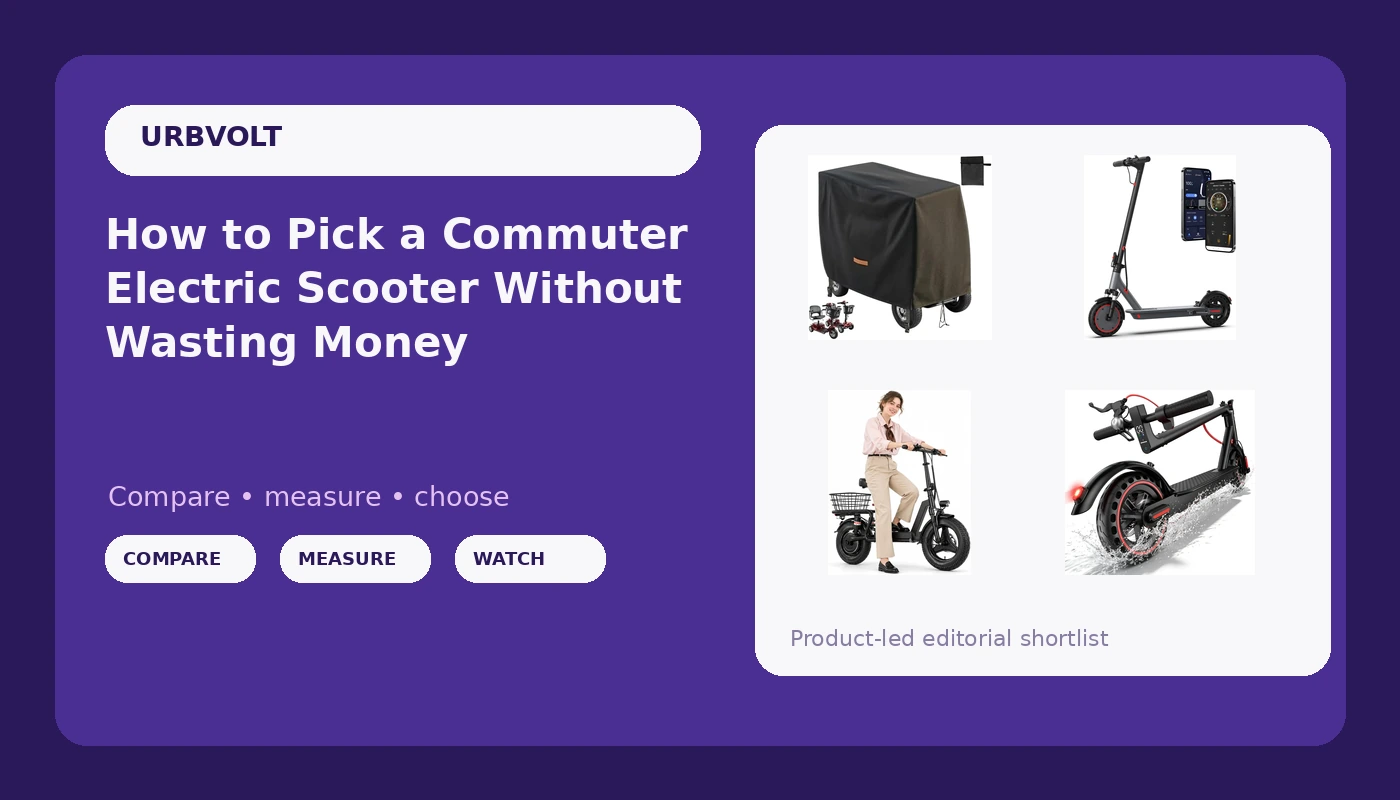
The four options below cover the range of what people actually buy when they are solving that problem: a low-cost folding scooter, a 10-inch wheel model with dual suspension, a seated model with a higher peak motor rating, and a storage cover for the scooter that has to live outside. Three are scooters and one is an accessory, which is roughly the ratio of what a new commuter ends up buying in the first month.
Related: Electric Scooter Tire Pressure and Real Range: Why PSI Beats Marketing →
Quick answer
Match the scooter to the ride, not to the headline spec. If your commute is short, flat, and you have somewhere to charge at both ends, a lighter folding scooter will do the job. If your route includes broken pavement, a bridge climb, or a bike lane full of debris, wheel size and suspension matter more than a low sticker price. If standing for the whole ride is the part you dread, a seated model changes the experience. And if the scooter is going to live outdoors, a cover costs far less than the battery it protects.
Four useful options
| Model | Best fit | What stands out |
|---|---|---|
| Phantomgogo Electric Scooter for Adults, Folding Commuter E Scooter | Short, flat rides and riders who need to fold and carry | Folding commuter frame at the lowest entry point in this group |
| VOLPAM 10 Inches 500W Adult Electric Scooter with Dual Suspensions | Rougher pavement and longer daily distances | 10-inch wheels and dual suspension as listed |
| Electric Scooter with Seat for Adults, 1000W Peak Motor E-Scooter | Riders who want to sit rather than stand | Seated design paired with a 1000W peak motor rating |
| Mobility Scooter Cover,Electric Scooter Storage Cover,Mobility Scooter Covers,Cover for Mobility Scooter Accessories Protector | Keeping a scooter outdoors or in a shared garage | A cover sized for scooter storage rather than a generic tarp |
The entry point: Phantomgogo Electric Scooter for Adults, Folding Commuter E Scooter
The case for a low-cost folding commuter is simple: it is the cheapest way to learn whether you will genuinely ride to work, and the cheapest way to learn what you actually need. The trade-off is that at this price point you are usually buying a smaller battery pack and a simpler controller, and those two parts decide whether the scooter still works in year two. Find the watt-hour figure before anything else. If the page gives you amp-hours and a voltage instead, multiply them, because that is your real capacity and the number that governs range. Then check the folded dimensions and the weight. A folding scooter you cannot lift onto a bus rack or up a stairwell has given up the only advantage it had.
The suspension pick: VOLPAM 10 Inches 500W Adult Electric Scooter with Dual Suspensions
Wheel size and suspension are the two features that separate a scooter you tolerate from one you ride daily. Small solid wheels transmit every crack in the pavement straight into your wrists and knees. Ten-inch wheels roll over expansion joints and chip seal more calmly, and suspension takes the edge off what is left. The middle of the market is usually where the honest value sits, because you are paying for wheels, a suspension fork, and a motor rated at 500W rather than for a badge. Ask what the tires are made of. Tubed tires on a daily commuter are a maintenance subscription, and in a hot climate with rough roads you will either learn to patch a tube or pay someone who can. Tubeless is a real upgrade for anyone riding five days a week.
The seated option: Electric Scooter with Seat for Adults, 1000W Peak Motor E-Scooter
A seated scooter solves a problem standing riders do not discuss enough: fatigue. Standing for forty-five minutes is a workout, and if your route is long, a seat turns the scooter into something you will use five days a week instead of two. Read the peak wattage carefully, though. Peak watts are a short burst, not a continuous rating, so do not assume the motor holds that number all the way up a bridge. What matters is whether the continuous rating and the pack's watt-hours can sustain the climb at your weight. A seat also raises the center of gravity and changes how the scooter turns and brakes, so a seated model is not simply a standing scooter with a chair attached.
The storage accessory: Mobility Scooter Cover,Electric Scooter Storage Cover,Mobility Scooter Covers,Cover for Mobility Scooter Accessories Protector
Most people buy a cover after the fact, once they realize the scooter is living on a balcony, under a carport, or in a shared garage where dust, rain, and sun go to work on it every day. Water intrusion is one of the fastest ways to kill a controller, and ultraviolet exposure degrades tires and deck grip over a single summer. A cover sized for a scooter is inexpensive compared with replacing a battery pack. Check that the dimensions fit your scooter with the handlebars folded, and check the material, because a thin tarp flaps, tears, and traps moisture against the frame, which is worse than leaving the scooter bare. Let the scooter dry before you cover it.
Prices and availability may change. Product images, names, and retailer links are matched to verified listings. No current price, rating, stock status, or measured result is stated here without current evidence.
The only battery number that matters
Manufacturers like to advertise battery size in amp-hours and motor output in peak watts, because both numbers sound bigger than they are. Watt-hours is the number that actually predicts range: multiply the pack's voltage by its amp-hour rating and you have the real capacity. A 48V 10Ah pack is 480Wh. A 36V 15Ah pack is 540Wh, even though the amp-hour figure looks larger. Once you have watt-hours, you can compare scooters honestly instead of comparing marketing.
Range is then a function of four things you control or can predict: your weight, the terrain, the temperature, and your speed. A pack that returns a certain distance with a light rider on flat ground in mild weather will return noticeably less with a heavier rider, a climb, a headwind, and a cold morning. This is also why voltage sag matters. As the pack drains, voltage drops, and a scooter showing half charge can feel like it has a fifth. Plan your commute around roughly two-thirds of whatever range you think you have, and keep the charger at the office if you can.
What fails first, and why
The controller is the part that strands people. It converts battery power into motor power, and a cheap one run at full throttle up a long hill in summer heat is the classic failure. That failure usually arrives as a burnt smell and a very long walk. There is not much you can inspect from a product page, but there are signals: a scooter with an honest continuous motor rating and a properly sized pack is working its controller less hard than one with an inflated peak number and a small battery.
Tires are the second failure point, and the one you can actually control. Check your pressure weekly, because low pressure costs you range, speed, and tube life all at once. Water resistance is the third. An IP rating tells you how much moisture the scooter is built to survive, and anything below a proper rain rating means it is a fair weather machine no matter what the listing implies.
- Measure your actual one-way commute distance, then double it, because you need to get home too.
- Find the watt-hour figure for the pack, calculating it from voltage and amp-hours if you have to.
- Check the continuous motor rating, not the peak number, and ask whether it can climb your worst hill at your weight.
- Identify the tire type and size, and decide now whether you are willing to maintain tubes.
- Weigh the scooter against the stairs, the bus rack, or the closet it has to live in.
Before you buy
- Confirm the folded dimensions and the total weight if you have to carry it indoors or onto transit.
- Check the tire type and pressure specification, then buy a pump with a gauge on day one.
- Read the water resistance rating and treat anything short of a rain rating as dry weather only.
- Budget for a helmet and wear it on every ride, including the short ones.
- Decide where the scooter will be stored and charged before it arrives, and buy the cover at the same time if that place is outdoors.
Which option should you choose?
Choose the Phantomgogo Electric Scooter for Adults, Folding Commuter E Scooter when your commute is short and flat, your budget is the binding constraint, and you want to find out whether commuting by scooter suits you at all. Choose the VOLPAM 10 Inches 500W Adult Electric Scooter with Dual Suspensions when your route runs over rough pavement or long distances and you would rather pay for wheel size and suspension than for a brand. Choose the Electric Scooter with Seat for Adults, 1000W Peak Motor E-Scooter when standing for the whole ride is what keeps you off the scooter, or when your commute is long enough that comfort decides whether you ride. Choose the Mobility Scooter Cover,Electric Scooter Storage Cover,Mobility Scooter Covers,Cover for Mobility Scooter Accessories Protector when your scooter will park outdoors and you want to slow down the weather instead of replacing parts.
One caveat worth stating plainly: the descriptions above come from the product listings, not from a measured test of each unit at a rider's real weight on a real commute. The practical notes are how scooters in these categories generally behave, and the numbers that matter most, watt-hours, continuous motor output, tire type, and water rating, are the ones you should confirm on the listing before you buy.
The bottom line
A commuter scooter is a tool with four requirements: enough watt-hours for the round trip, a motor that can climb your hill at your weight, tires you are willing to maintain, and a weight and folded size you can live with at both ends of the ride. Anything else on the page is decoration. The entry level folding scooter answers the question of whether you will ride at all; the 10-inch suspended model is the value pick for bad pavement; the seated scooter is for riders who want comfort to carry them through the week; and the cover is the cheapest way to protect whichever one you choose from the weather it parks in. Start with the watt-hours, end with the tires, and buy the helmet first.