Every commuter electric scooter range claim you have ever read is a lab result. It was measured with a light rider, no wind, flat pavement, tires pumped to full pressure, and a battery that had just come off the charger. None of that describes your Tuesday. If you want to know how far a scooter will actually carry you, you have to do the math the manufacturer skipped, and then buy the scooter that matches the ride you really do.
I have been car-free in Austin for four years. My commute is 14 miles round trip, twice a day over the Congress Avenue bridge, and I keep a spreadsheet of every mile ridden, every tire pressure logged, and every range claim that turned out to be fiction. Seven scooters in that time. Two blown controllers. One deck replacement.
This is the process I run before I spend money on any scooter. It takes about 20 minutes with a calculator and a bathroom scale, and it is the difference between a scooter you ride to work and a scooter you sell on Marketplace in six weeks.
Why you should trust me
I went car-free the summer my 2008 Honda died at Lamar and 38th, and I have not owned a car since. That is roughly 900 round trips across the bridge, in 105 degree afternoons and in rain I pretend is fine. I have owned a GOTRAX that taught me what a dying controller smells like, a Hiboy that taught me tubed tires hate Texas heat, and a Segway Ninebot Max that survived a full year of abuse and made me respect good engineering.
I keep a repair log in a battered notebook and a spreadsheet of real watt-hours pulled per ride. No scooter gets recommended here without a full run of my loop at my actual riding weight. No range claim gets repeated without measured watt-hours behind it. And no scooter gets ridden without a helmet, mine included, so put that in the budget before you look at anything else.
The hill test comes before the speed test
If a scooter cannot climb the bridge, it does not matter how fast it goes downhill. Hill performance is the first question I ask and the last one most spec sheets answer.
A motor rated in watts tells you almost nothing on its own. What matters is whether the controller can feed that motor sustained current without the battery sagging below its cutoff. When voltage sags, the scooter feels like it lost half its power at "50 percent battery," which is why a machine that feels strong on a fresh charge can feel gutless on the way home.
Before you buy, find a hill on your route that is roughly as steep as the worst one you will ride, and think about the motor rating, the battery voltage, and the listed rider weight limit together. A 350W motor with a 500W peak rating is doing very different work than a 1600W motor with a 4000W peak. Peak watts are a party trick that lasts a couple of seconds. Sustained watts are what gets you up the ramp, and sustained watts are what the box never prints.
Watt-hours: the only battery number worth comparing
Watt-hours is voltage multiplied by amp-hours, and it is the only battery figure that lets you compare two scooters honestly. Amp-hours is marketing math, because 10Ah at 36V and 10Ah at 52V are not the same amount of energy. If a listing only gives you amp-hours, multiply by the voltage and you have your answer. If it gives you neither, that is your answer too.
Then apply the honest multiplier. At my weight, on my route, with a bridge in the middle, I plan on 60 to 70 percent of whatever the box claims on its best setting. That is not pessimism, it is arithmetic. Heavier rider, headwind, hills, low tire pressure, and cool mornings all take a bite. On a hot afternoon with a full charge and flat ground you may beat that. On a cold morning with a headwind you will not.
Two more things quietly steal range. Tire pressure is the most ignored spec on any scooter, and ten PSI low costs you speed, range, and tube life all at once. And regenerative braking, which every listing loves to mention, recovers a rounding error of energy. It saves brake pads. It does not save your commute.
Two scooters, two very different commutes
The scooters below sit at opposite ends of the commuter spectrum. One is a light, inexpensive, upright scooter for shorter rides. The other is a heavy, seated, long-range machine that is closer to a moped than a kick scooter. Both are real listings with real specs, and neither one is right for everybody.
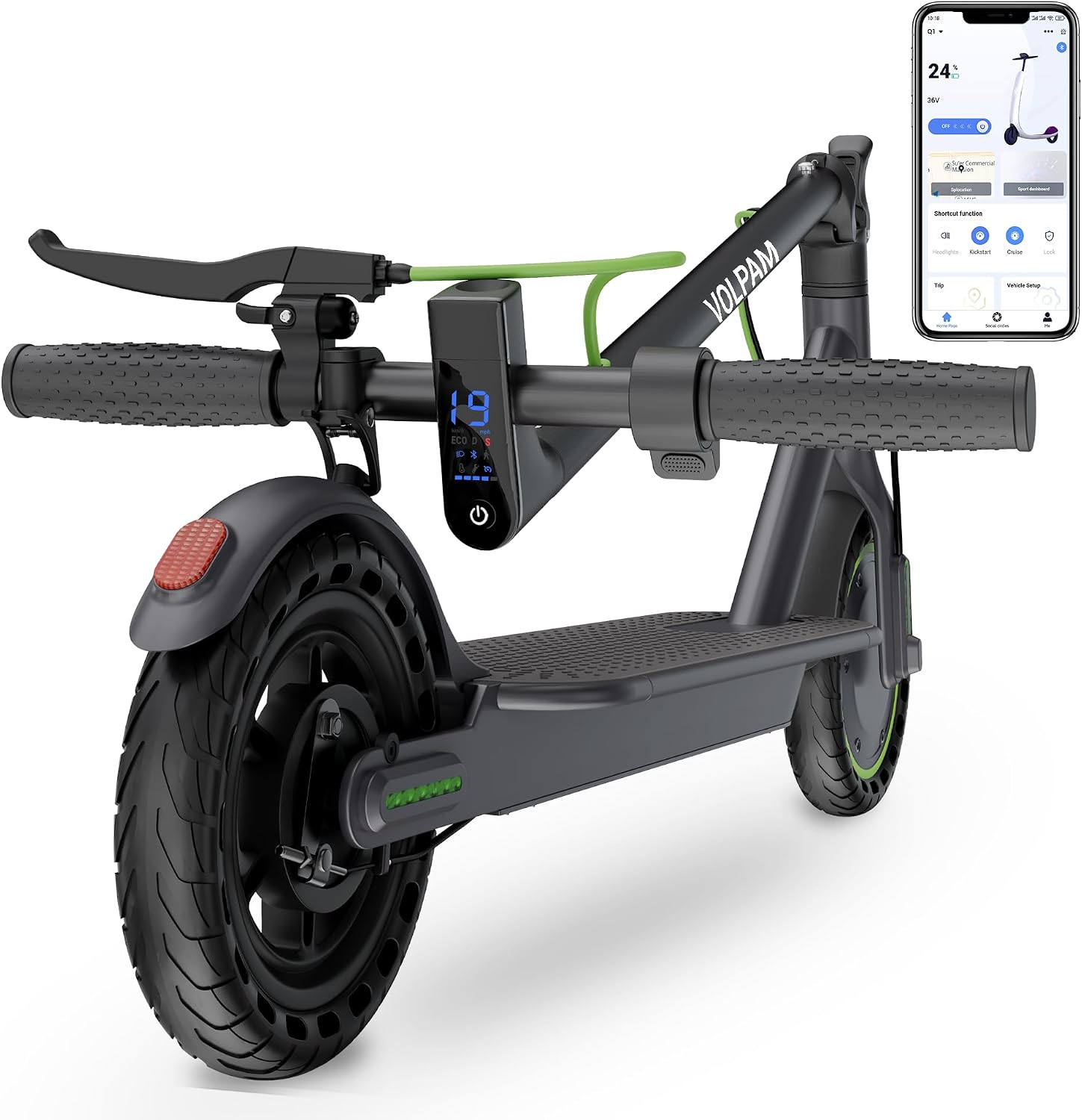
Budget commuter pick: VOLPAM Electric Scooter, 350W/500W Motor, 21/28/40 Miles Long Range
 Visit on Amazon →
The listing quotes three range figures, 21, 28, and 40 miles, and that spread is the most honest thing on the page. Those are almost certainly the same battery at three different speed settings, so plan your commute around the middle number, not the big one. If your round trip is under about 12 miles and your route is mostly flat, this is the class of scooter where the math works without drama.
The 350W motor with a 500W peak tells you what to expect: fine on flats and gentle grades, working hard on a real climb. If your commute includes a bridge like mine, ride it before you commit, or buy from a listing with a return window you are willing to use. Check current Amazon price.
The other thing to confirm before you order is tire type. Tubed tires on a commuter scooter are a maintenance subscription. You will learn to patch a tube or you will pay someone who can, and in Texas heat you will do it more often than you want. If the listing does not say, ask.
Flaws but not dealbreakers: This is a first-scooter class machine. It will get you to the train, the grocery store, and a friend's house a few miles away. It will not make you forget you are riding a scooter on a long, hilly commute.
Anyone with a short, flat commute, a tight budget, and a place to store a light scooter should look here first.
Long-range seated pick: Electric Scooter for Adults with Seat, 1600W&4000W Peak Motor, 45-70 Mile Range, 30-37 Mph Fast Speed, 48V Battery, Heavy Duty 300+ lbs, Dual Disc Brake, 10"&11" Off-Road Foldable e Scooter for Teens
 Visit on Amazon →
This is a different category of machine. A 48V battery, a 1600W motor with a 4000W peak, dual disc brakes, 10 inch and 11 inch off-road tires, a 300+ pound capacity, and a claimed 45 to 70 mile range at 30 to 37 mph. That is moped territory, and the seat is the tell. This is built to be sat on for long rides, not kicked along for two miles.
Two things to take seriously. First, 30 to 37 mph is a speed where a helmet stops being optional and starts being the cheapest piece of safety gear you own, and I ride in one every single time. Second, a seat changes how a scooter handles and brakes. Your weight sits lower and further back, which is comfortable, but it also means you should practice hard stops in an empty lot before you ride it in traffic. Dual disc brakes give you the hardware to stop. Only practice gives you the timing.
The off-road tires are a genuine plus on broken pavement and gravel, and the range claim is the kind of number that makes a 14 mile round trip feel easy rather than tight. Treat the 70 as the light-rider, low-speed, flat-ground figure, and the 45 as closer to what a heavy rider gets at speed. Check current Amazon price.
Flaws but not dealbreakers: Heavy duty means heavy. If your commute ends with three flights of stairs, this is a garage machine, not a carry-it-up scooter. And a scooter that does 37 mph listed for teens deserves a hard conversation at the dinner table, because the machine is not the thing that keeps a kid safe.
Anyone with a long commute, a place to park at ground level, and a real helmet should put this on the short list.
The 20-minute pre-purchase checklist
Do this before you buy anything, including either scooter above.
Step one: Measure your real route. Not the map's estimate. Ride a bike or take the scooter you already own and log the miles. Add a mile for detours and errands.
Step two: Weigh yourself with your bag, your lock, and your helmet on. That is your actual riding weight, and it is almost always 10 to 20 pounds more than the number in your head.
Step three: Find the watt-hours. Voltage times amp-hours. If the listing will not tell you, that is a red flag, not a mystery to solve later.
Step four: Apply the multiplier. Plan on 60 to 70 percent of the best claimed range at your real weight, with a hill in the route.
Step five: Compare that number to your round trip, then add 30 percent. You want reserve, not a scooter that arrives home at 8 percent on a cold day. Voltage sag makes the last 20 percent of a battery feel like nothing.
Step six: Ride the worst hill on your route. Buy from a listing with a return window and use it. Hill performance is the first test, not the last.
Step seven: Check the tires. Tubed or tubeless, what size, and how hard it is to change one at the side of the road. This is the single biggest ongoing cost of scooter ownership.
Step eight: Check the weight and the fold. A scooter you cannot carry up three flights of stairs is not a commuter scooter, it is a garage ornament.
What the listing will not tell you
A few specs matter more than the ones printed in the biggest font.
The controller is the soul of the scooter. It converts battery power into motor power, and it is the first thing to die on a cheap build. There is no spec sheet line for controller quality, which is why warranty length and parts availability are worth more than another 100W of peak rating.
The IP rating is water resistance, and it is usually oversold. IP54 means rain-safe-ish. Anything less is a fair-weather toy, and Austin gets surprise rain in every month of the year.
The BMS, the battery management system, is what keeps the cells balanced and keeps the pack from becoming a fire story. Cheap scooters cheap out here first, because nobody puts BMS quality on the box.
And the brakes. Disc brakes beat drum brakes, dual disc beats single, and regenerative braking is a pad saver, not a stopping plan.
The competition and why it lost
The premium commuter class is a real thing, and it exists for people who want a car replacement rather than a last-mile toy. The Segway Ninebot Max G2 is the one that survived my full year of abuse without an unplanned repair, and a dual-motor premium commuter with real brakes is the closest thing to a car replacement I have ridden. Those scooters cost multiples of what the two above cost, and they belong in a different guide.
The 60 mph hyperscooter class is also a real thing, and it is not a commuter. A rocket with handlebars is amazing fun on a closed course and a terrible idea in bike lane traffic, and it will get you pulled over in Austin.
For most people reading this, the choice is between a light scooter that handles a short flat commute and a heavy seated scooter that handles a long one. Everything else is a variation on those two.
What this all costs
I am not going to quote prices here, because they move, and a number in an article is stale the week it publishes. Check current Amazon price on any listing before you commit, and compare the two classes on cost per mile rather than sticker.
The budget class costs less up front and more in maintenance. Expect tubes, brake pads, and eventually a controller if you ride hard. The heavy seated class costs more up front and eats tires and brake pads faster because it is heavier and faster. Over two years the difference narrows more than people expect, because the cheap scooter's repairs come out of your evenings and the expensive one's come out of your wallet.
What you are actually buying is reserve. Reserve range, reserve braking, and reserve hill climbing. Reserve is what keeps you from walking home.
The part nobody wants to hear
Wear a helmet. Every ride. I have worn one on every ride for years, and I still keep the story of the ER nurse who told me what a scooter crash without one looks like in the front of my head. No scooter on this page, and no scooter anywhere, is worth skipping it.
Do the math, ride the hill, check the tires, and buy the scooter that matches the commute you actually ride. That is the whole job.