Buying an electric scooter for commuting is where most people get talked into the wrong machine. The listing promises range, the box promises speed, and neither number describes the ride you actually take: seven miles to work, a bridge in the middle of it, a 185-pound rider with a backpack, a headwind, and a battery sitting at 60 percent when you leave the office at 6 PM. The distance between the number on the page and the number on your route is exactly where the money goes wrong.
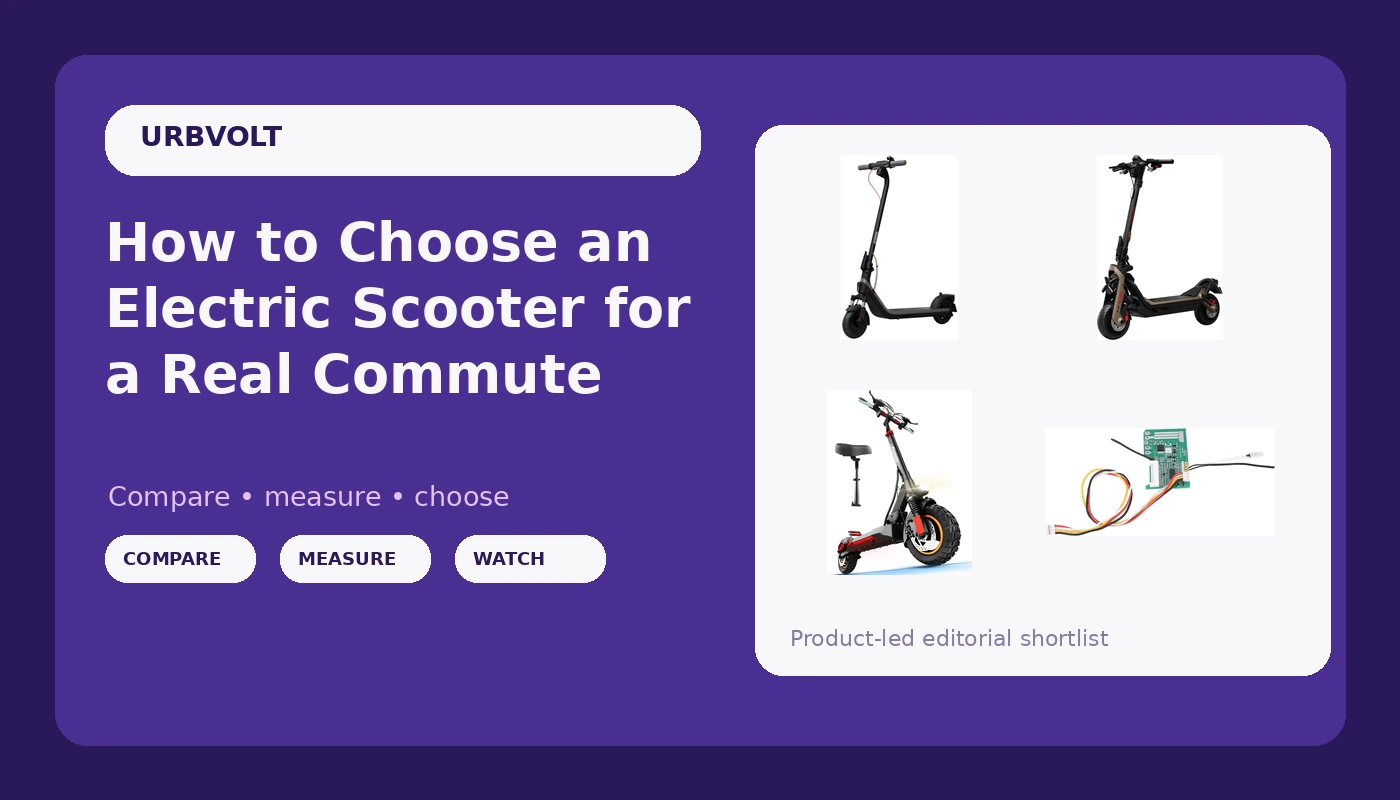
This is an explainer, not a ranked list. Four very different things tend to land in the same shopping session: a lightweight UL-certified commuter folder, a high-output performance scooter, a budget off-road model, and a battery protection board that exists to keep an older scooter alive instead of replacing it. They are not competitors. They are four answers to four different questions, and the only way to pick correctly is to know which question you are actually asking.
Related: How to Read an Electric Scooter Spec Sheet Without Getting Fooled →
Quick answer
There is no single best electric scooter for commuting, because your round-trip distance, your weight, the steepest hill on your route, and where the scooter sleeps at night decide more than any badge on a spec sheet. Match the machine to the route: a light, certified, dual-brake folder for short flat runs; a high-output scooter for long, fast ones; a budget off-road model if your commute mixes pavement with gravel; and a replacement battery protection board only if you already own the scooter it fits. Watt-hours, hill performance, tire type, and controller quality are the four things worth comparing. Claimed range is not one of them.
Four useful options
| Model | Best fit | What stands out |
|---|---|---|
| Segway Ninebot E2 Plus II/E2 Pro/E3 Pro Electric Scooter | Short to medium paved commutes and riders who need to fold and carry | UL 2272 and UL 2271 certified, dual braking system, foldable adult frame |
| Segway SuperScooter GT3 Pro Electric Scooter | Long, fast routes where the rider wants performance headroom | Manufacturer-stated up to 50 MPH and up to 86-mile range |
| M4 Electric Scooter for Adults Off Road Escooter for Commuting | Mixed-surface routes and budget-conscious buyers | Off-road oriented build marketed for commuting |
| Yoidesu Battery Protection Board for F30 F40 Electric Scooters | Repairing an existing Segway F30 or F40 rather than replacing it | A replacement protection board made for those two models |
The everyday commuter: Segway Ninebot E2 Plus II/E2 Pro/E3 Pro Electric Scooter
Two things matter more than the headline specs here. The first is the certification. UL 2272 and UL 2271 are the standards that speak to how the electrical system and battery behave, and they are the difference between a scooter built to a safety framework and one assembled to a price. The second is the dual braking system. A single brake on a commuter scooter means one point of failure on the exact component you need most in Austin traffic or on a wet bridge deck.
The listing name covers several trims in the same family, so read the variant selector carefully before you buy. Trim changes can change the battery, the motor, and the weight, and weight is what decides whether this thing goes up three flights of stairs with you or lives in the garage.
The long-range performance option: Segway SuperScooter GT3 Pro Electric Scooter
When a scooter is advertised at 50 MPH, the conversation stops being about commuting and starts being about consequences. At that speed you need a full-face helmet, real gloves, and a route where 50 MPH is even legal, which in most cities it is not. You also need to think about weight and storage: performance scooters are heavier, and a heavier scooter that cannot go upstairs is a scooter that lives on the ground floor.
The range claim deserves the same skepticism as any other. An 86-mile figure is a lab number produced under favorable conditions. What matters is the battery capacity in watt-hours, and how much of it your route actually consumes at your weight, in your heat, with your hills. Treat the number as a ceiling, never as a plan.
The budget off-road option: M4 Electric Scooter for Adults Off Road Escooter for Commuting
Off-road design is a genuine advantage if your commute includes gravel, broken asphalt, or a park path, and a genuine penalty if it does not. Knobby or heavily treaded tires and a stiffer, more absorbent setup trade efficiency for grip, which means you pay for that grip in range and in noise on smooth pavement. If your route is 90 percent clean bike lane, this is the wrong trade. If it is not, it is the right one.
Before buying any budget scooter, confirm the three things that get omitted from marketing copy: the battery capacity in watt-hours, the tire type, and the brake type. Ask about all three in writing if you have to. A budget scooter with a small pack, tubed tires, and a single brake is not a commuter, it is a first scooter.
The repair part: Yoidesu Battery Protection Board for F30 F40 Electric Scooters
This belongs in a different conversation entirely. It is not an alternative to the scooters above; it is what you buy when the scooter you already own has a failed protection board. The board is the circuit that manages the battery cells, and a bad one can produce exactly the symptoms people misdiagnose as a dead pack: no power, sudden cutoff under load, or a charge that never completes.
Two cautions. First, confirm the model match before ordering, because this board is specified for the F30 and F40 and nothing else. Second, understand what you are opening. Battery work on a scooter means high-current DC, and a pack that has been physically damaged, swollen, or exposed to water should be replaced, not patched. If you are not comfortable working inside a battery enclosure, this is a job for someone who is.
Prices and availability may change. Product images, names, and retailer links must be matched by verified ASIN. Do not state a current price, rating, stock status, or measured result without current evidence.
Watt-hours is the only battery number that matters
Amp-hours are marketing math. Watt-hours are capacity. If a manufacturer lists amp-hours, multiply by the nominal voltage to get watt-hours, and if they list neither, that is your answer about how seriously to take the listing.
Here is why the distinction matters. Two scooters can both claim a 10 Ah battery and deliver completely different amounts of energy, because one pack runs at 36 volts and the other at 48. The first holds roughly 360 watt-hours, the second roughly 480, and the second will go meaningfully farther doing the same work. Comparing amp-hours across scooters is comparing the size of a cup without knowing how tall it is.
Watt-hours also tell you what to expect from voltage sag, which is the drop in power you feel when the pack is low, cold, or being asked for more current than it can comfortably give. That is why a scooter at "50 percent battery" can suddenly ride like it is at 20 percent on a hill. A bigger pack sags less for the same load, and a bigger pack is a watt-hour number, not a marketing adjective.
Finally, remember that watt-hours are only the supply side. Speed, rider weight, tire pressure, temperature, hills, and wind all decide how fast you drain them. Capacity sets the ceiling; your route sets the reality.
Hill performance and range claims: what to check before you buy
Every range figure you will ever read was produced with a lighter rider, a flatter route, a warmer battery, and more favorable wind than you will have on a Tuesday in August. That does not make manufacturers liars. It makes their numbers irrelevant to your commute unless you adjust them.
Hill performance is the first test, not the last. A scooter that climbs your worst hill at your weight without drama will handle everything else on the route. A scooter that bogs down on that hill will bog down everywhere, and no top-speed figure compensates for it.
Use this sequence before you spend anything:
- Measure your real round trip in miles, including the detours you actually take, not the straight-line distance on a map.
- Weigh yourself with the bag, the laptop, and the water you carry, then add a few pounds for weather gear.
- Identify the steepest sustained climb on your route and treat it as the deciding test.
- Check the tire type and the brake type before you check the top speed, because tires and brakes are what you will actually maintain.
- Decide where the scooter sleeps and whether you can carry it there, since a scooter you cannot lift is a scooter you will not ride.
What to do in the first week
- Set tire pressure to the sidewall or manual specification and check it weekly. Low pressure costs you range, speed, and tube life, and it is the single most ignored spec on any scooter.
- Wear a helmet on every ride, including the short one. This is not negotiable and it is not a style choice.
- Read the exact variant name on the listing before you order, because families like the E2 and E3 series change battery, motor, and weight between trims.
- Charge where you can see the scooter, away from anything flammable, and let the pack cool before plugging in after a hot ride.
- Start a repair log with dates, miles, tire pressure, and anything that felt wrong. Patterns show up in a log long before they show up as a failure.
Which option should you choose?
Choose the Segway Ninebot E2 Plus II/E2 Pro/E3 Pro Electric Scooter when your commute is mostly paved, your round trip is moderate, and you want a certified, dual-brake, folding scooter you can carry and store indoors. Choose the Segway SuperScooter GT3 Pro Electric Scooter when your route is long, your riding is fast, and you have already accounted for the gear, the storage weight, and the legal limits that come with that speed. Choose the M4 Electric Scooter for Adults Off Road Escooter for Commuting when part of your route leaves smooth pavement and you would rather have grip than maximum efficiency. Choose the Yoidesu Battery Protection Board for F30 F40 Electric Scooters only if you already own an F30 or F40 with a failed protection board and you are prepared to work inside a battery enclosure.
A caveat that applies to all four: the speed and range figures quoted above are manufacturer claims, not measured results, and no scooter should be bought on a claimed range alone. Confirm the watt-hour capacity, the tire type, and the brake type from the listing or the manual before you commit, and treat any number that arrives without those three as incomplete.
The bottom line
The right electric scooter for commuting is the one that survives your specific route at your specific weight, and that is a question about watt-hours, hill climbing, tires, brakes, and controller quality, not about the biggest number on the box. A certified folding commuter covers most paved trips. A performance scooter covers long, fast ones, provided you accept the gear and the weight that come with it. A budget off-road model covers mixed surfaces at the cost of efficiency. And a battery protection board is what you buy to keep an existing scooter out of the trash, not to start a commute. Match the machine to the route, check the three specs that get hidden, and the decision stops being complicated.