Related: Best Electric Scooter for Commuting: Range, Hills, and What Breaks First
I have commuted on electric scooters for adults for four years, 14 miles round trip, over the Congress Avenue bridge twice a day, in Austin heat that turns a battery pack into a science experiment. Seven scooters in that time. Two blown controllers, four patched tubes, one replaced deck, and a spreadsheet where I log every mile and every PSI, mostly because I got tired of being lied to about range.
So when I sit down with a new spec sheet, I don't start at top speed. I start with watt-hours, tire type, and what happens to the controller under sustained load. Everything else is decoration. This guide is how I sort the scooters and gear I've been watching for the 2026 season, including a seated model, two standing models, and the one accessory that outlives whatever you attach it to.
What I check before anything else
Watt-hours first. Voltage times amp-hours is the only honest capacity number. A pack sold as 48V and 10Ah is 480 Wh, and that number, not the mileage on the box, tells you how far you can realistically go. Manufacturers love listing amp-hours alone because it makes small packs look big. Do the multiplication yourself.
Hill climbing second. If a scooter can't pull the bridge at my weight without voltage sag drama, top speed doesn't matter. A 20 mph scooter that drops to 9 mph on an incline is a 9 mph scooter with extra steps.
Tires third. Tubed tires on a commuter are a maintenance subscription. You will patch them, or you will pay someone who can. Tubeless is the upgrade I recommend to anyone riding more than a couple of miles each way, and tire size matters more than most buyers think: bigger wheels roll over potholes instead of getting punched by them.
Controller fourth. It's the part that actually fails. It's also the part nobody reviews, because you can't photograph it and it doesn't show up in a marketing video.
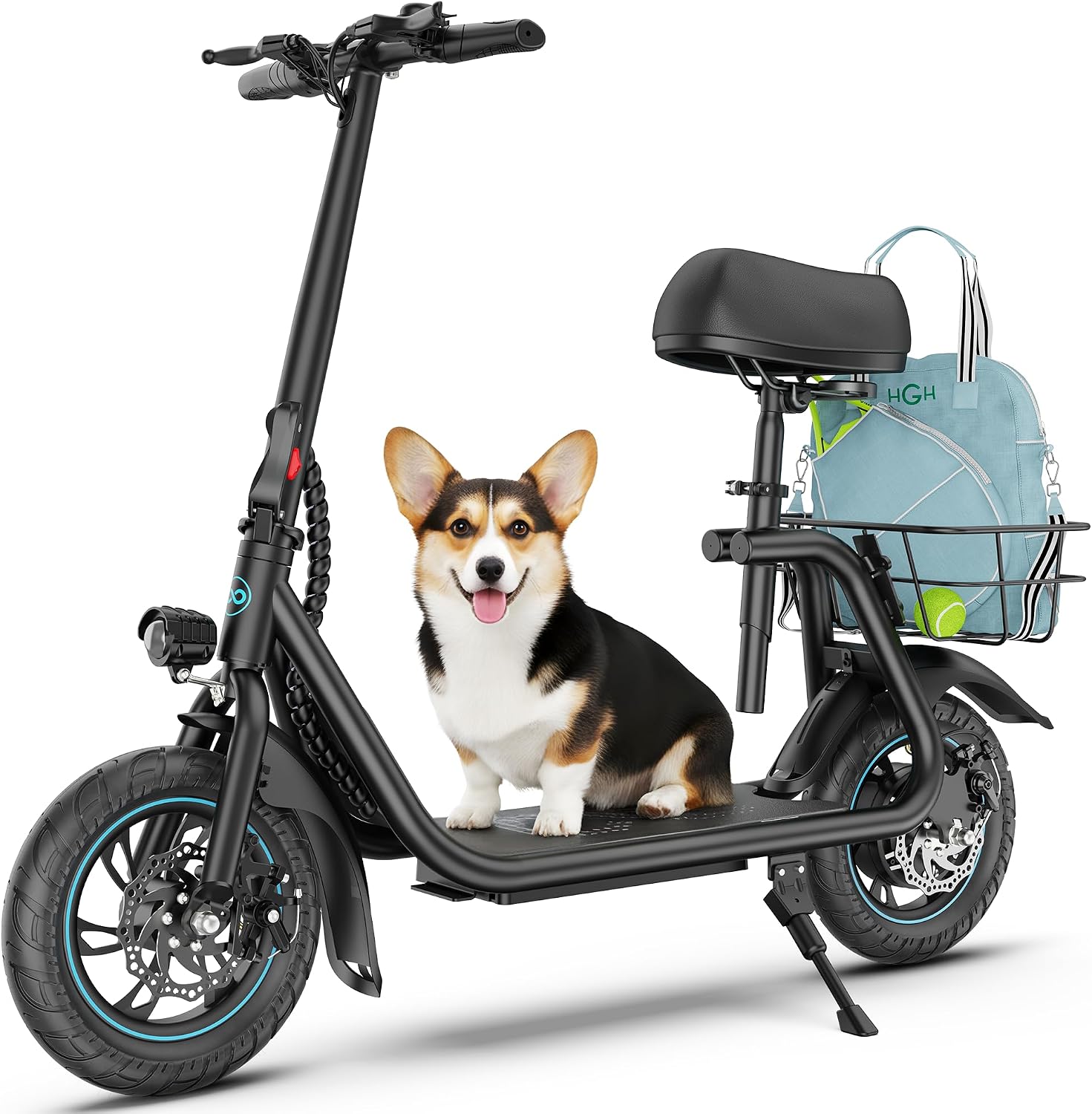
Best for seated riding: Gyroor C1 Electric Scooter with Seat
Most adult scooters assume you're standing the whole way. The C1 takes the other approach: a seat, a 450W motor, and a stated 20-mile range. That matters more than it sounds. Standing for 45 minutes is fine at 25. It's less fine at 45, or after a long shift, or if you have knees with opinions.
The 450W figure tells you about the motor, not the battery, so before you buy, find the watt-hours. A 450W motor paired with a small pack and a big rider is a scooter that sags on the second half of the ride. That's the number I'd chase down in the listing or the manual.
What I'd want to check in person is the seat itself: how it mounts, whether it comes off for standing rides, and how high it sits relative to the deck. A seat that's too low turns a 20-minute ride into a cramped one. I'd also confirm tire type, because a seated scooter usually carries more weight over the rear wheel, and that's exactly where tubes fail first.
For errands, brewery runs, and riders who want the scooter to do more of the work, this is the most interesting shape in the group. Check current Amazon price on the Gyroor C1.
Best budget starter: Electric Scooter for Adults and Teens
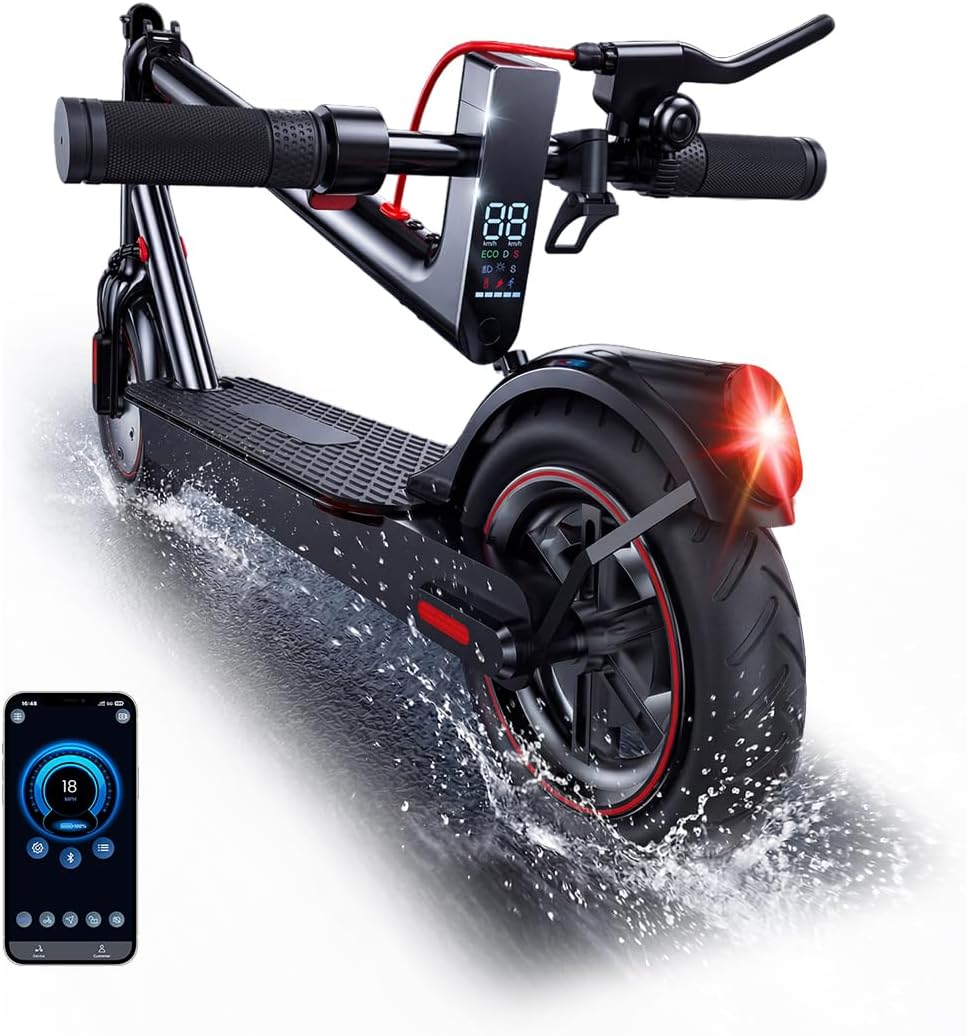
This is the entry tier, and I want to be straight with you about what that means. The listing is thin on specs, which is normal for this bracket, and thin listings are a reason to ask questions before you click, not after.
Here's my honest read: a scooter at this level is a last-mile machine and a learner's machine. It gets you to the bus stop, the corner store, the two miles to campus. It is not a 14-mile commuter, and if you treat it like one you'll be the person walking the last three miles at 9 PM.
What you get at this price is a lighter build, a smaller battery, and a controller with less margin. That last part is the real cost. Cheap controllers are the first thing to die on a budget scooter, and when they go, the scooter is done, not degraded. If you're buying your first scooter to figure out what you actually want, this is a reasonable place to learn. Buy it knowing that you will likely outgrow it within a season, and budget for the upgrade now.
The case for buying cheap first is real: you don't know yet whether you want a seated scooter, an all-terrain build, or something light enough to carry up three flights of stairs. This one teaches you that at a low entry cost. Check current Amazon price on this starter scooter.
Best all-terrain pick: 550W dual-suspension scooter
The spec sheet here is the most commuter-shaped of the standing scooters: a 550W motor, up to 20 mph, a stated 28-mile range, dual suspension and dual brakes, 12-inch front and 8.5-inch rear tires, app control, TCS, and UL2272 certification.
Two of those specs do the heavy lifting. First, the 12-inch front tire. That is a genuinely big wheel for a scooter, and bigger wheels are the single best defense against the potholes and cracked asphalt that eat small-wheel riders alive. Second, UL2272. That's the safety certification for the electrical system, and it's the one I'd refuse to go without. An uncertified battery and BMS on a scooter you charge inside your apartment is a risk I won't take, and I'd rather pay more up front than wonder about it at 2 AM.
Dual suspension is the other thing I care about. On my loop, the bridge approach is a mess of expansion joints, and a scooter without suspension transmits every one of them through the deck. Suspension doesn't just add comfort, it keeps your hands and feet planted, and planted feet are safer feet.
The 28-mile claim is a claim. I don't repeat range numbers without watt-hours behind them, so the first thing I'd do is find the pack capacity and do the math against my own weight and route. What I can say is that the motor, wheel size, and certification stack up as the most serious commuter build in this group. Check current Amazon price on this all-terrain scooter.
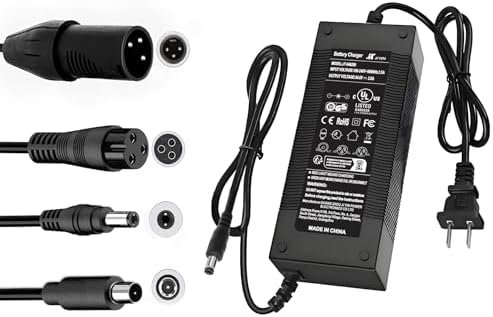
The accessory: UL Certified 54.6V 2A charger for 48V batteries
This one is an e-bike charger, not a scooter charger, and I'm going to say that plainly instead of pretending otherwise. It's here because the math is the math, and because a spare charger is the difference between riding tomorrow and waiting on a replacement.
The 54.6V output is the correct charging voltage for a 48V nominal lithium pack: 13 cells in series at 4.2V each lands at 54.6V. That's not marketing, that's how the chemistry works. If your battery is 48V nominal, this is the right voltage. If yours is 36V, it is not, and using it would be genuinely dangerous.
The compatibility list is specific: Lectric XP 2.0 and 3.0, Ecotric City and Beach, Evercross H5 and H7. The 2A rate is a slow charge, and I mean that as a compliment. Slow charging is gentler on cells and easier on the BMS than a hot fast charge, and most commuters charge overnight anyway, so 2A costs you nothing you were using.
The one thing you must check is the connector. Voltage and current have to match your pack, but the plug has to physically fit it too. UL certification on the charger itself is the reason this one makes the list over the anonymous options, because charger failures are how battery fires start. Check current Amazon price on this charger.
The reference table
This is how the four items line up on the specs that actually decide whether you'll still be riding in a year. Stated range is the manufacturer's claim, not a measured number, and you should treat it accordingly.
| Product | Stated specs | Tires and suspension | Best for |
|---|---|---|---|
 Visit on Amazon → Visit on Amazon →Gyroor C1 with seat |
450W motor, 20 miles stated | Confirm tire type and size before buying | Seated riding, errands, riders who don't want to stand |
 Visit on Amazon → Visit on Amazon →Electric Scooter for adults and teens |
Entry tier, listing is thin on specs | Expect a lighter build and less controller margin | First scooter, last-mile trips, learning what you want |
 Visit on Amazon → Visit on Amazon →550W all-terrain scooter |
550W, up to 20 mph, 28 miles stated, app control, TCS, UL2272 | 12-inch front, 8.5-inch rear, dual suspension and dual brakes | Real commuting, rough pavement, pothole country |
 Visit on Amazon → Visit on Amazon →54.6V 2A charger |
54.6V output for 48V packs, 2A, UL certified | Not applicable | A spare or replacement charger for a 48V battery |
The pattern in that table is the whole lesson of this guide: the specs that keep you riding are boring ones. Wheel size, suspension, certification, charger quality, and watt-hours. Top speed is the number that sells the scooter and the number you'll use least.
How I judge a spec sheet
I don't run marketing copy through my head and call it a review. I look for what's missing. A listing that shouts about peak watts and hides watt-hours is telling you something. A listing that names a UL standard and lists real compatibility is telling you something too, and it's the better kind of something.
Rider weight is the spec nobody prints and the one that changes everything. A range claim is made with a light rider, no wind, flat ground, and a fresh pack. At my weight, in August, with a bridge in the way, the real number is smaller. That's not cynicism, it's arithmetic. So when I say a scooter looks like a commuter, I mean the hardware suggests it can absorb that gap: bigger wheels, real suspension, a certified electrical system, and a battery you can actually calculate.
The same goes for chargers. A charger is a power supply with a job, and the job is to hit a specific voltage without cooking the pack. Match the voltage, match the connector, don't rush the amps, and don't charge a damaged pack. That's the entire discipline.
Should you buy the Gyroor C1 with seat?
If you want to sit, yes. A 450W motor and a stated 20-mile range with a seat is a genuinely different riding experience, and for errands, short commutes, and riders who don't want to stand for half an hour, it solves a problem the standing scooters ignore. Find the watt-hours first, and check the tire situation, because a seated scooter loads the rear wheel harder. Check current Amazon price on the Gyroor C1.
Should you buy the budget scooter for adults and teens?
Buy it as a first scooter or a last-mile machine, not as a commuter. The low entry cost is real, and learning what you want on a cheap scooter beats guessing on an expensive one. Just go in knowing that the controller is the part with the least margin, and that a 14-mile round trip is not what this tier is built for. Check current Amazon price on this starter scooter.
Should you buy the 550W all-terrain scooter?
This is the one I'd shortlist for actual commuting. The 12-inch front tire, the dual suspension, the dual brakes, and UL2272 certification are exactly the specs I'd want on a scooter that has to survive a bridge, a pothole, and a 105-degree Tuesday. Confirm the watt-hours before you believe the 28 miles. Check current Amazon price on this all-terrain scooter.
Should you buy the 54.6V charger?
Only if your battery is 48V nominal and your connector matches, and in that case, yes. A UL certified spare charger at 2A is cheap insurance against a dead charger on a Sunday night. Do not buy it for a 36V scooter, and do not buy it hoping the plug will fit. Check current Amazon price on this charger.
Whichever way you go, wear a helmet. I've worn one on every ride for four years, and the one time I nearly needed it was a pothole I never saw coming.