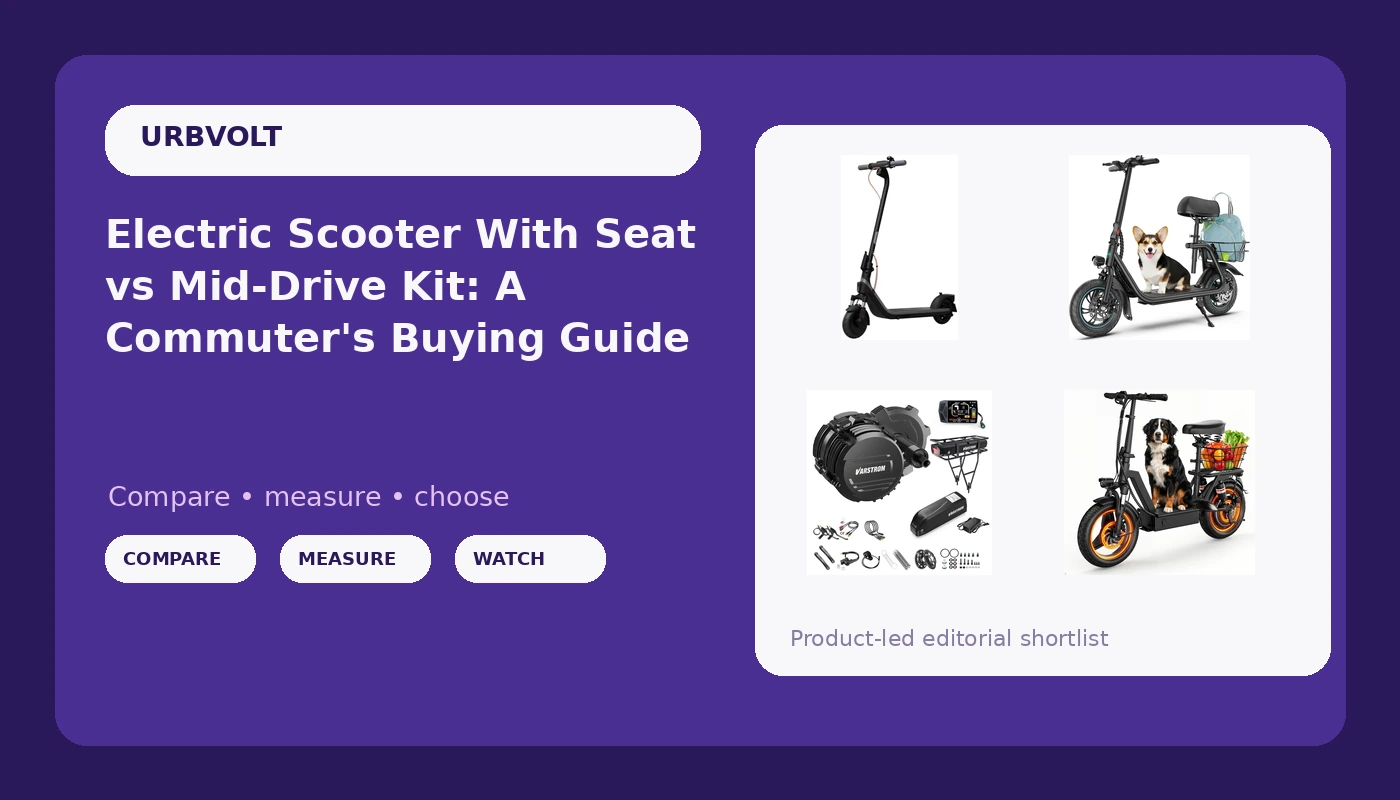
Three of the four products in this comparison sit in the same broad price neighborhood, and they solve completely different problems. Two are seated electric scooters: a chair, a deck, a motor in a wheel, and a battery under your feet. One is a stand-up commuter scooter from a manufacturer with a long paper trail. And one is not a scooter at all. It is a mid drive kit that turns a bicycle you already own into an e-bike.
If you searched for an electric scooter with seat because you want to get to work without a car and without arriving soaked in sweat, the order in which you consider these four matters more than any single number on the box.
That is the trap with this category. Every listing leads with a motor figure, a claimed range, and a battery voltage. Almost none of them lead with watt-hours, which is the only number that lets you compare two batteries honestly, and none of them tell you what the motor can hold on a climb rather than for two seconds on flat ground. So here is how to sort these four, what each one is genuinely for, and where each one will disappoint you.
Related: How to Read an Electric Scooter Spec Sheet Without Getting Fooled →
Quick answer
For a seated ride that can also haul groceries, the seated scooter with the 48V battery, the 1000W peak motor, and the rear basket is the most versatile of the four. If you want a stand-up scooter and you care about documented electrical safety testing, the Segway Ninebot E2 line is the only listing here that states UL 2272 and UL 2271 certification. The Gyroor C1 is the lighter-duty seated option, with a smaller motor and a shorter claimed range. The TSDZ2B mid drive kit is the right answer only if you already own a bicycle you like and want to convert it, not if you are shopping for a scooter.
Four useful options
| Model | Best fit | What stands out |
|---|---|---|
| Electric Scooter with Seat for Adults, 1000W Peak Motor, 35 Miles Range, Rear Basket, Foldable Escooter with Comfort Seat, 48V Large Battery | Seated commuting with cargo | 48V battery, 1000W peak motor, rear basket, folding frame |
| Gyroor Electric Scooter with Seat for Adults C1 450W Motor 20 Miles | Short seated trips | 450W motor, seat, listed 20 mile range |
| Segway Ninebot E2 Plus II/E2 Pro/E3 Pro Electric Scooter, Dual Braking System, Long Range, Foldable Adult Scooter, UL 2272 & 2271 Certified | Stand-up commuting with a safety paper trail | Dual braking system, folding frame, UL 2272 and 2271 certification |
| TSDZ2B Z8 TSDZ16 48V 250W 500W 750W 1000W Mid Drive Kit for Ebike | Converting a bike you already own | 48V mid drive, multiple power configurations, fits an existing bicycle |
Cargo and comfort: the seated scooter with the 48V battery
The trade-off here is the one every seated scooter shares: you are adding a chair, a wider frame, and a basket, and all of that costs you weight and folding bulk. A seated scooter is harder to carry up stairs than a stand-up model, and it is harder to maneuver through a doorway. If your commute ends with three flights of stairs, this is the wrong shape of vehicle no matter how good the specs look. The 1000W figure is also a peak number, which means it describes a brief surge rather than what the motor can hold for twenty minutes on a bridge climb. Ask what the continuous rating is before you assume the peak number means hill power.
The lighter-duty seated option: Gyroor C1
The honest read on a 450W seated scooter is that it is a short-hop machine. That is not a criticism; it is a use case. If your round trip is under ten miles and mostly flat, a smaller motor means less weight, less battery to charge, and less money tied up in a vehicle you use twice a week. What it will not do is carry a heavy rider up a long grade at speed without voltage sag showing up early. Any claimed range figure also assumes a lighter rider, no wind, and a fresh battery, so plan on less than the number printed on the page and treat the difference as the cost of riding in the real world.
The certified stand-up pick: Segway Ninebot E2 line
Certification is not marketing decoration. UL 2272 covers the electrical system of a personal e-mobility device, and UL 2271 covers the battery pack, which is the component most often implicated when a scooter battery becomes a fire. A listing that states both is telling you the design went through testing that a no-name listing usually skips. That matters most if you plan to charge indoors, and it matters most of all if you live in an apartment where the scooter charges near your door.
The trade-off is the seating position. You stand. On a fourteen mile round trip that is fine, and the folding frame makes it easy to bring inside. If you have back or knee issues, or if you simply want to sit down at a red light, this is not the shape for you. Note also that "E2 Plus II/E2 Pro/E3 Pro" in the title means you need to confirm which configuration you are actually buying before you order, because motor output and battery size differ across the trims.
The conversion route: TSDZ2B mid drive kit
A mid drive kit is a completely different project from buying a scooter. You need a bicycle with a compatible bottom bracket, the tools to pull a crank and install a motor unit, and the patience to route wiring and mount a battery. In exchange, a mid drive setup climbs better than a hub motor of similar rating because it can use the bike's low gears, and it keeps the weight centered instead of loading one wheel. If you already own a bike you love and you are comfortable turning a wrench, this is a genuinely good path. If you are reading this because you want something to ride next week with no assembly, this is the wrong product in the list.
Watt-hours are the battery number that matters
Manufacturers list battery size in amp-hours because it makes the pack sound bigger and because it lets them avoid comparing directly with a competitor's 48V pack. Watt-hours is voltage multiplied by amp-hours, and it is the actual measure of how much energy you have to spend. A 48V pack with a small amp-hour rating can hold less energy than a lower-voltage pack with a larger one. If a listing does not state watt-hours, you can work it out from the voltage and the amp-hour figure when both are given, and if neither is given, treat the claimed range as unverifiable.
Peak watts deserve the same skepticism. A peak figure describes a short burst, often a few seconds, not the power the motor can sustain on a climb. Continuous rating is what determines whether you crest a bridge at 15 mph or slow to walking pace while the battery sags. When a listing only prints a peak number, assume the continuous number is meaningfully lower.
Seated scooter, stand-up scooter, or a converted bike
These three formats fail in different ways, and knowing which failure you can live with is most of the decision.
A seated scooter is the most comfortable option and the easiest to ride in ordinary clothes. It is also the heaviest and the bulkiest to store, and the seat position means you are less visible in traffic than a standing rider, so lights and a helmet matter more, not less.
A stand-up scooter is the most portable and the easiest to bring inside at night, which is also the best theft prevention there is. It is less comfortable over distance and it demands more from your balance and your core.
A converted bike is the most efficient over long distances and the most serviceable, because bicycle parts are everywhere. It is also the only option here that requires you to already own a suitable bike and to do real installation work.
- Measure your actual round trip in miles, then add 30 percent as a buffer for cold, wind, hills, and the fact that you will not always charge to full.
- Identify the worst climb on your route and ask whether the motor rating is continuous or peak, because the bridge is where the spec sheet meets reality.
- Convert every battery spec to watt-hours so you can compare packs honestly instead of comparing voltage labels.
- Check for stated certification, especially UL 2271 for the battery, if you plan to charge indoors or in an apartment.
- Weigh the storage problem: stairs, doorways, elevators, and whether the thing folds small enough to live inside your home.
Practical guidance before you order
- Wear a helmet on every ride. This is not negotiable, and it is the single cheapest safety decision in micromobility.
- Check tire pressure weekly. Low pressure costs you range, speed, and tube life, and it is the most ignored maintenance item on any small EV.
- Charge where you can see the vehicle, on a hard surface, away from the door you would need to escape through.
- Confirm the exact configuration before buying when a listing covers multiple trims, since motor and battery differ across them.
- Budget for a lock that costs more than you think it should. A folded scooter inside your apartment beats any lock, and a cheap cable beats nothing only barely.
Which option should you choose?
Choose the Electric Scooter with Seat for Adults, 1000W Peak Motor, 35 Miles Range, Rear Basket, Foldable Escooter with Comfort Seat, 48V Large Battery when you want a seated ride, you carry things regularly, and your route is mostly flat to rolling with a place to park at both ends. Choose the Gyroor Electric Scooter with Seat for Adults C1 450W Motor 20 Miles when your trips are short, your budget is tight, and a smaller, lighter seated scooter is genuinely enough. Choose the Segway Ninebot E2 Plus II/E2 Pro/E3 Pro Electric Scooter when you want a stand-up commuter, you value stated UL certification, and you can carry a folding scooter inside. Choose the TSDZ2B Z8 TSDZ16 48V 250W 500W 750W 1000W Mid Drive Kit for Ebike when you already own a bicycle you like and you are ready to install a conversion yourself.
One caveat applies to all four. Claimed range figures are produced under favorable conditions that rarely match a real commute, and none of the numbers in a listing tell you how a controller or a battery pack will hold up after a year of daily riding. Treat every spec as a starting point for your own decision, not a promise.
The bottom line
The most versatile seated option here is the seated scooter with the 48V battery and the rear basket, because it is the only one built for carrying things as well as carrying you. The Gyroor C1 is the budget short-trip seated choice. The Segway Ninebot E2 line is the pick if you want to stand and you want documented electrical certification. The TSDZ2B kit is the right answer for a narrow group of riders: people with a bike in the garage and the tools to convert it. Match the format to your route, your storage, and your body, then check the current listing details before you commit, because configurations and availability change.