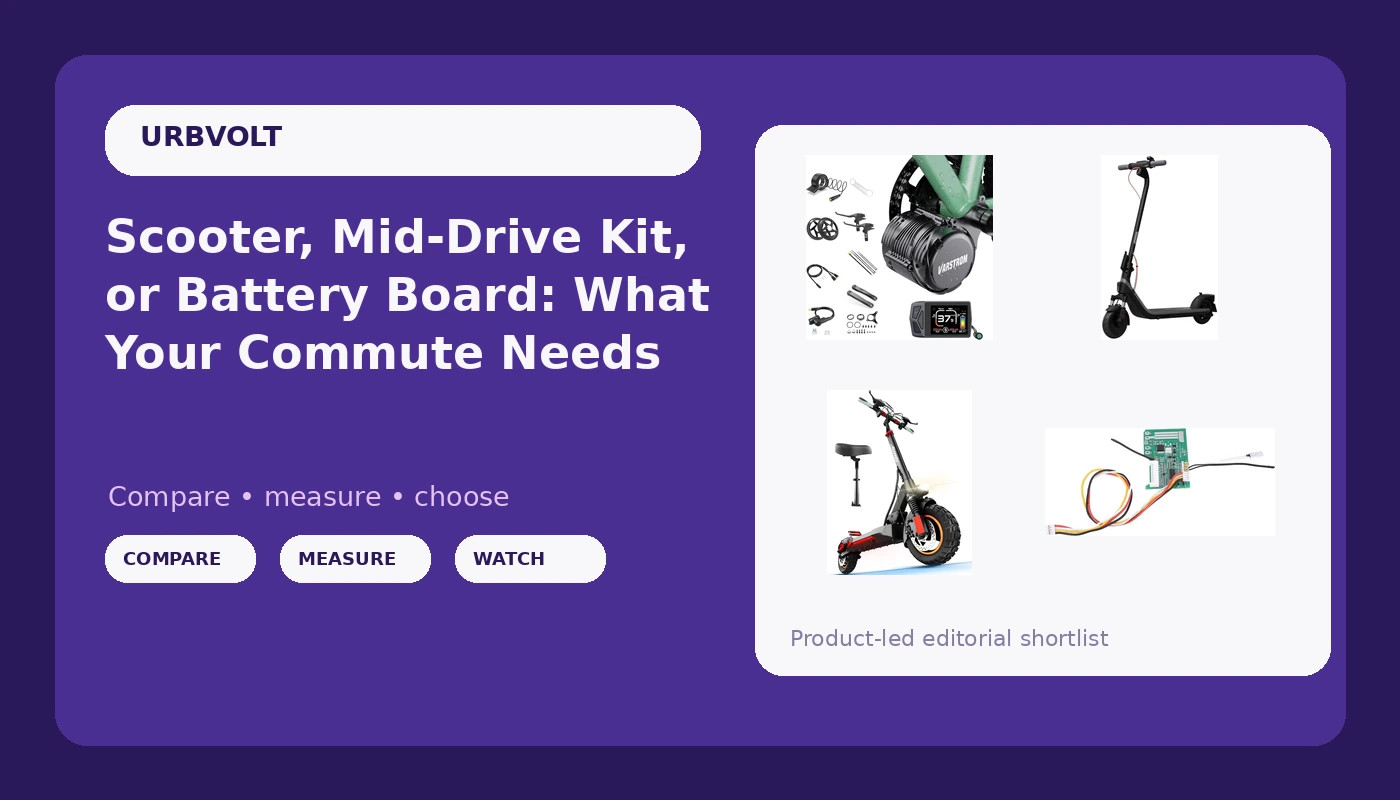
An electric scooter commuter upgrade rarely looks like the purchase you imagined. You start by comparing top speeds and peak watts, and somewhere around month three the ride ends because of a circuit board you never knew existed. The four products below cover the four honest answers to the same question: buy a complete scooter, buy one built for rougher ground, convert a bicycle you already own, or repair the scooter already sitting in your hallway. Which one is right depends far less on the number printed on the box than on what you already own and what your route actually asks of it.
Related: How to Read an Electric Scooter Spec Sheet Before You Buy →
Quick answer
None of these four products replaces another, because they solve different problems. A complete, certified scooter is the lowest-risk way to start commuting, since the battery, controller, motor, and brakes were designed as one system. An off-road scooter trades some street manners for tires and clearance that tolerate torn-up pavement. A mid drive kit is for riders who would rather electrify a bicycle than buy a scooter at all. And a battery protection board is a repair part, not an upgrade: it exists to keep a specific scooter running. Match the product to the job you actually have, not to the one with the biggest number on the box.
Four useful options
| Model | Best fit | What stands out |
|---|---|---|
| Segway Ninebot E2 Plus II/E2 Pro/E3 Pro Electric Scooter, Dual Braking System,Long Range,Foldable Adult Scooter, UL 2272 & 2271 Certified. | A first or replacement commuter scooter | UL 2272 and UL 2271 certification, dual braking system, folding frame |
| M4 Electric Scooter for Adults Off Road Escooter for Commuting | Riders whose route includes rough or unpaved surfaces | Off-road positioning in an adult scooter built for commuting |
| 48V750W Mid Drive Kit ,Upgraded 1056W Peak Power Torque Sensored Mid Drive | Converting an existing bicycle | 48V, 750W nominal, 1,056W peak, torque-sensored mid drive |
| Yoidesu Battery Protection Board for F30 F40 Electric Scooters | Repairing a Ninebot F-series scooter | Built specifically for the F30 and F40 platforms |
The turnkey commuter: Segway Ninebot E2 Plus II/E2 Pro/E3 Pro
The case for a complete scooter is not that it is more exciting. It is that every part inside it was chosen to work with the others, and that this listing carries certification on two separate things: UL 2272 covers the electrical system of a personal e-mobility device, and UL 2271 covers the battery pack used in a light electric vehicle. Those are the two places where cheap scooters cut corners, which is why the certification matters more than a peak watt figure. The trade-off is flexibility. When something eventually wears out, you are sourcing parts for a specific platform rather than upgrading one component at a time. For a rider who wants to charge overnight, fold the stem, and ride to work without thinking about any of it, that is the right trade.
The rough-pavement option: M4 Electric Scooter for Adults
Off-road scooters exist because a lot of commutes include a stretch that is not a bike lane. Broken asphalt, gravel shoulders, unpaved cut-throughs, and the kind of patched pavement that eats small wheels. A scooter built around off-road use is generally set up with more tire and more clearance than a street model, and that is what you are paying for here. The trade-off runs in both directions: knobby or aggressive tires can be louder and can wear faster on hot asphalt, and a taller, more rugged scooter is often heavier to carry up stairs. If your route is genuinely smooth end to end, a street-oriented scooter will usually serve you better. If it is not, this is the category that keeps you riding instead of walking.
The conversion route: 48V750W Mid Drive Kit
A mid drive motor sits at the bottom bracket and drives the bicycle's own gears, which is the main mechanical difference between this and a hub motor in a wheel. Because it uses the drivetrain, it can multiply its torque through a low gear on a climb, and a torque sensor reads how hard you are pushing on the pedals rather than simply detecting that the pedals are turning. That is the difference between assistance that feels like a tailwind and assistance that feels like a switch. The trade-offs are real: a conversion assumes you have a bicycle worth converting, it assumes you are comfortable with tools and wiring, and a 750W nominal system is a serious amount of power to add to a frame that was not built for it. Peak figures like 1,056W are short bursts, not what the system holds continuously.
The repair part: Yoidesu Battery Protection Board
This is the least glamorous product in the article and the one that most often decides whether a scooter gets repaired or replaced. The battery protection board, usually called a BMS, is the circuit that sits between the cells and everything else. It balances the cells against each other, cuts power on overcharge and over-discharge, limits current, and manages temperature. When it fails, the scooter does not gradually get slower. It simply stops, and the battery pack looks perfectly healthy from the outside. Because this board is built for the F30 and F40, the important step is confirming your model before ordering. A board that fits one platform will not fit another, and a mismatched BMS is worse than no board at all.
Prices and availability may change. Product images, names, and retailer links must be matched by verified ASIN. Do not state a current price, rating, stock status, or measured result without current evidence.
Watt-hours, voltage sag, and the numbers that matter
Manufacturers advertise peak watts because peak watts are impressive and nearly meaningless. A motor can hit its peak rating for a couple of seconds on a fresh charge, which tells you nothing about whether it will hold speed on the bridge climb at mile five of your commute. The number worth finding is watt-hours, which is voltage multiplied by amp-hours. A 48V pack rated at 10Ah holds roughly 480Wh, and that figure is comparable across scooters in a way that amp-hours alone never are. Amp-hours without voltage is marketing math.
The second number that matters is voltage sag. As a pack drains, its voltage drops, and the controller responds by delivering less power. That is why a scooter that feels strong at full charge can feel tired at half charge, and why cold weather makes a battery behave as if it has lost capacity it still technically holds. A pack with more parallel cells sags less under the same load. This is also where the BMS comes back in: it is the component enforcing the limits that keep the pack from sagging into damage, and it is the component that cheap scooters cheap out on.
What a mid drive kit and a battery board actually do
These two products sit at opposite ends of the same system. The mid drive kit is the power source side: 48 volts feeding a 750W nominal motor through the bicycle's gears, with a torque sensor deciding how much help to add. The battery protection board is the safety side: the circuit inside a scooter pack that keeps individual cells balanced and stops the pack from being charged or drained past its limits.
Understanding both is what separates a rider who maintains a scooter from a rider who replaces one every eighteen months. Controllers and BMS boards are the failure points, not motors. Motors are generally robust. The electronics that feed them are where heat, moisture, and cheap components do their damage.
- Measure your real route: distance one way, total climb, and the worst surface on it.
- Decide what you already own, because a kit and a repair part only make sense if there is a bike or a scooter to attach them to.
- For a complete scooter, check the certification on the electrical system and the battery pack, not just the top speed.
- For any repair or conversion part, match the exact model or platform before ordering.
- Budget for consumables: tires, tubes, brake pads, and the charger, which are the things that actually wear out.
Practical guidance before you buy
- Check tire pressure weekly. Underinflation costs you range, speed, and tube life, and it is the single most ignored spec on any scooter.
- Store and charge the battery at moderate temperatures. A pack left in a hot garage degrades faster than one kept indoors.
- Treat range claims as lab numbers. Real range depends on rider weight, hills, wind, and temperature, and yours will be lower.
- Wear a helmet on every ride, including the short ones. This is not negotiable and it is not a style decision.
- Keep water out of the equation unless the rating supports it. An IP rating is a specific claim, and "water resistant" without one is a guess.
Which option should you choose?
Choose the Segway Ninebot E2 Plus II/E2 Pro/E3 Pro Electric Scooter when you want a finished, certified machine and your route is mostly paved. Choose the M4 Electric Scooter for Adults Off Road Escooter for Commuting when your shortest route runs across gravel, broken pavement, or unpaved cut-throughs. Choose the 48V750W Mid Drive Kit when you already own a bicycle you like and want assistance that responds to how hard you pedal. Choose the Yoidesu Battery Protection Board when you own an F30 or F40 and the scooter has stopped accepting or delivering power.
One caveat applies to all four. None of these listings tells you how the product performs over a year of commuting, and no spec sheet captures how a controller handles a hot afternoon or how a tire handles a pothole at speed. Certification, nominal ratings, and platform compatibility are the verifiable facts here. Everything else is a claim to be tested by your own route.
The bottom line
A commuter scooter decision is really two decisions: what you ride, and what keeps it riding. Buy the complete, certified scooter if you want the shortest path to a working commute. Buy the off-road model if your pavement is bad enough to justify it. Build the mid drive kit if you would rather electrify a bike than replace it. And keep the battery protection board in mind long before you need it, because the part that ends most scooter lives is a small circuit board, not a worn-out motor.