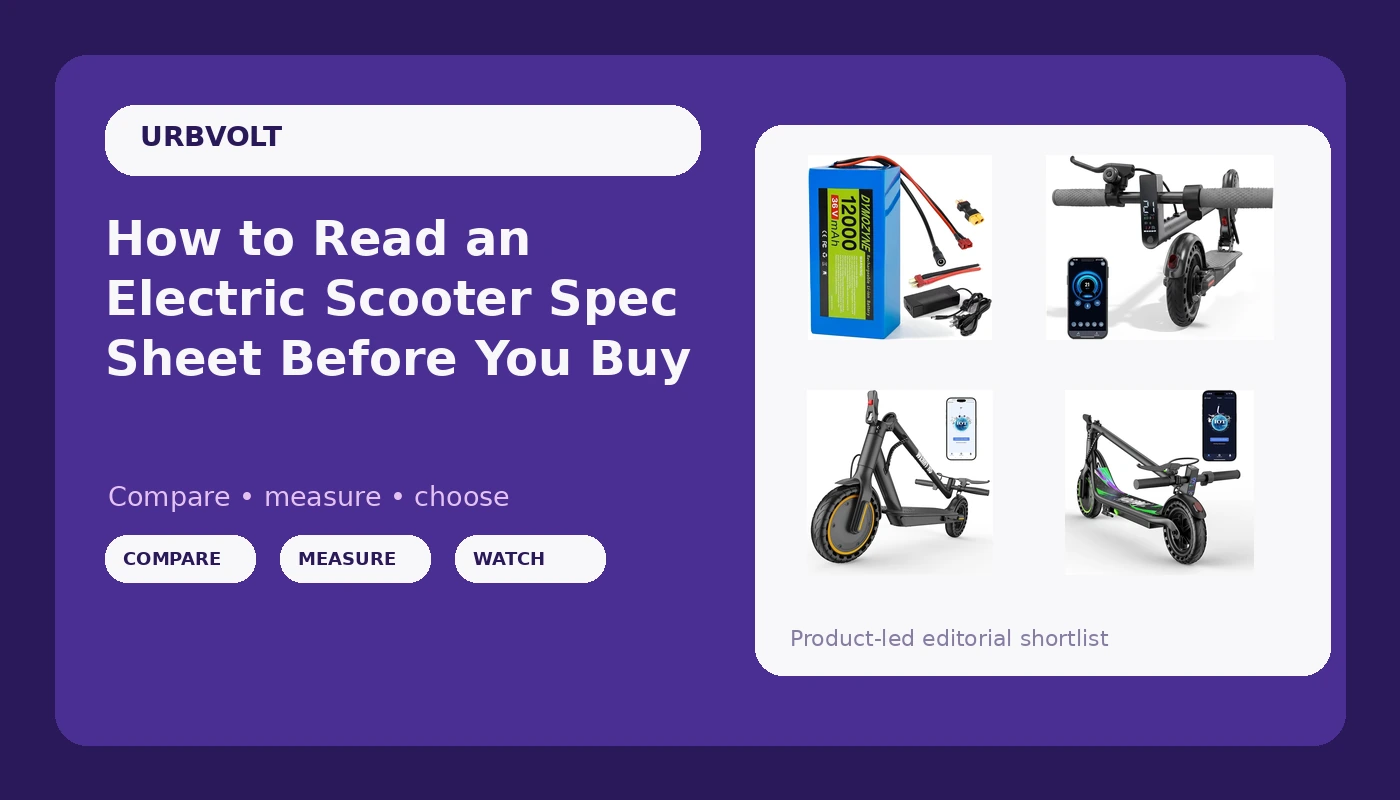
If you have ever stood in a listing trying to compare a 350W scooter against a 1000W scooter and a loose replacement battery pack, you already know the problem: the numbers on the box are not the numbers that decide whether you make it home. The electric scooter battery and motor specs that actually matter are watt-hours, continuous motor rating, tire type, and the controller that ties all of it together. I ride 14 miles round trip across the Congress Avenue bridge in Austin, I have killed two controllers and patched four tubes, and I read a spec sheet the way a mechanic reads a wiring diagram. This is how the four options below really differ, and which one fits which kind of rider.
Related: Electric Scooter Tire Pressure and Range: The Free Upgrade Nobody Does →
Quick answer
Match the battery's watt-hours and the motor's continuous rating to your hills and your round-trip distance, not to the biggest number on the listing. Of the four options here, the VOLPAM scooter is the commuter model sold in three range tiers, the 36V/48V pack is a replacement or DIY battery rather than a complete ride, the 1000W scooter is the higher-power option with dual brakes and app control, and the WERHY is the solid-tire option for riders who never want to fix a flat.
Four useful options
| Model | Best fit | What stands out |
|---|---|---|
| VOLPAM Electric Scooter, 350W/500W Motor, 21/28/40 Miles Long Range | Commuters who want to choose their range tier | 350W or 500W motor with claimed range tiers of 21, 28, or 40 miles |
| 36V 48V Ebike Battery, 12Ah 20Ah Lithium-ion Battery Pack with 30A BMS, High Power Replacement Battery for 100W-2000W Electric Bike Motor, Scooter, Go-Kart & DIY E-Bicycle, Long Range Cycles | Replacing a dead pack or powering a DIY build | 36V or 48V with 12Ah or 20Ah options and a 30A BMS |
| Electric Scooter - Electric Scooter Adults, 1000W/500W Motor, 10''/8.5'' Tires, 28/23/21 Miles, APP Control, Dual Brake, Long Range Electric Scooter for Gift | Riders who want motor headroom and dual brakes | 1000W or 500W motor, 10 inch or 8.5 inch tires, dual brake, app control |
| WERHY Adult Electric Scooter, 8.5''/10'' Solid Tire, 350W/500W | Riders who want to stop dealing with tubes | Solid tires in 8.5 inch or 10 inch, 350W or 500W motor |
The commuter scooter with three range tiers: VOLPAM Electric Scooter
This is the option to look at first if your commute has a hill on it, because the 500W configuration gives you more headroom before the controller starts working hard. It is also the option that demands the most attention before you click, since a 40 mile claim and a 21 mile claim are not the same scooter. Before buying, confirm which motor and which battery the specific variant includes, because the range figure is a configuration detail, not a model-wide promise. If you weigh more than about 170 pounds and your route climbs, plan on the lower end of whatever range is printed, and plan on the motor doing more work than the number suggests.
The replacement pack: 36V 48V Ebike Battery with 30A BMS
Do the math before you buy this one. A 36V, 12Ah pack works out to 432 watt-hours, the 36V, 20Ah version to 720, the 48V, 12Ah to 576, and the 48V, 20Ah to 960. That is the number that decides your range, and it is the number most listings hide behind amp-hours. The 30A BMS rating also matters: at 48 volts, 30 amps is roughly 1,400 watts of discharge headroom, which is plenty for a commuter motor and tight for a big direct-drive build. Match the voltage to your existing controller and charger, confirm the connector before ordering, and never mix a 36V pack with a 48V system. This is also the one product here where the safety question is on you: buy from a seller with a real battery certification, charge it where a fire would not trap you, and do not leave it charging unattended overnight.
The higher-power scooter with dual brakes: 1000W/500W Adult Scooter
Here is the part most buyers get backwards: the brakes matter more than the motor. A 1000W scooter that stops with one weak brake is a worse commuter than a 500W scooter with two good ones, and dual brakes on a scooter this size are the feature I would pay for first. Check your local rules too, because several states cap scooter motor output for street use, and a 1000W peak figure can put you outside the legal definition of a scooter in some places. The 10 inch tire option is also worth the upgrade over 8.5 inches if your roads are rough, since larger wheels roll over cracks and potholes with less drama. App control is a convenience, not a reason to buy, and it should never be the deciding factor.
The solid-tire option: WERHY Adult Electric Scooter
Tubed tires on a commuter scooter are a maintenance subscription, and I say that as someone who has patched four tubes on the side of the road in August. Solid tires end that entire category of problem: no pinch flats, no slow leaks, no weekly pressure check, no spare tube in your bag. What you give up is compliance. A solid tire transmits every crack in the pavement straight into your knees and wrists, and it has less grip in the rain than a properly inflated pneumatic tire. On smooth bike lanes and short errands, that trade is easy. On 14 miles of chip-seal and bridge expansion joints, it is a real cost. If flats are what keep you off a scooter, this is the configuration that solves it.
Prices and availability may change. Product images, names, and retailer links must be matched by verified ASIN. Do not state a current price, rating, stock status, or measured result without current evidence.
Watt-hours versus amp-hours: the only battery math that travels
Manufacturers list battery size in amp-hours because amp-hours make a 36V pack and a 48V pack look similar when they are not. Multiply volts by amp-hours and you get watt-hours, which is the actual measure of how much energy you are carrying. This is why a 48V, 12Ah battery (576 Wh) holds more energy than a 36V, 12Ah battery (432 Wh) even though both say 12Ah on the label. It is also why a 36V, 20Ah pack (720 Wh) beats the 48V, 12Ah in capacity while losing on voltage and therefore on top speed.
For planning purposes, many riders use a rough figure of 20 to 30 watt-hours per mile at commuter speeds with a 180 pound rider, no headwind, and mild terrain. Run a 432 Wh pack through that and you land somewhere around 15 to 20 miles of real riding, well below a lab claim made with a lighter rider and a fresh battery. Hills, cold mornings, low tire pressure, and a heavy throttle hand all push you toward the low end. That gap between the box number and the real number is not a scandal, it is just physics being honest about the test conditions.
Voltage sag is the other thing amp-hours do not tell you. As a battery drains, its voltage drops, and the controller delivers less power. That is why a scooter at 40 percent charge feels slower and weaker than the same scooter at 90 percent, especially climbing. A bigger pack sags less for the same load, which is why watt-hours buys you performance consistency, not just distance.
What 350W, 500W, and 1000W actually mean on a bridge
Motor wattage on a scooter listing is usually a mix of continuous and peak ratings, and peak watts are a party trick that lasts a few seconds. Continuous rating is what the motor can sustain without cooking itself, and that is the number that decides whether you climb the bridge at 14 mph or crawl up it at 6 while the controller heats up. A 350W continuous motor will move most adults on flat ground all day. A 500W continuous motor handles moderate grades with less strain. A 1000W motor climbs better and accelerates harder, and it also draws more current, which is harder on the battery, the wiring, and the controller.
The controller is the part nobody advertises and the part that fails first. It converts battery current into motor current, and cheap ones run hot under sustained full throttle. If you ride a long grade at full power every day, you are running a thermal test on a component that most listings do not even name. Treat any scooter's controller as the weak link until proven otherwise, and give it airflow rather than a bag strapped over the deck.
Tire size belongs in the same conversation, because a 10 inch wheel rolls over bad pavement with noticeably less violence than an 8.5 inch wheel, and tire type decides how much maintenance you sign up for. Pneumatic tires ride better and grip better. Solid tires never flat. Tubed pneumatic tires are the middle option that flats most often.
- Find the watt-hours first: multiply the listed voltage by the listed amp-hours, and ignore amp-hours on their own.
- Identify the continuous motor rating, not the peak, and compare it to the steepest grade on your actual route.
- Check the tire size and whether it is tubed, tubeless, or solid, then decide how much flat maintenance you are willing to do.
- Look for a brake description: two brakes on a commuter scooter is the minimum I would ride in traffic.
- Confirm the water resistance rating and the weight, because a scooter you cannot carry up stairs will not get used.
What to check before you click buy
- Weigh yourself with your bag and commute gear, then plan your range at the low end of any claim, because lab numbers assume a lighter rider and a fresh pack.
- Check tire pressure weekly if the scooter runs pneumatic tires. Ten PSI low costs you range, top speed, and tube life, and it is the single most ignored spec on any scooter.
- Wear a helmet on every ride. I have worn one since an ER nurse explained what a scooter crash without one looks like, and no spec on this page changes that.
- Confirm the voltage and connector compatibility before ordering a replacement battery, and never pair a 36V pack with a 48V controller or charger.
- Charge lithium packs where a failure would not block your exit, and prefer sellers who can show a battery safety certification.
Which option should you choose?
Choose the VOLPAM Electric Scooter when you want a commuter scooter and you are willing to verify exactly which motor and range tier you are buying. Choose the 36V 48V Ebike Battery with 30A BMS when you already own a ride with a dead or undersized pack and you can match voltage and connectors yourself. Choose the 1000W/500W Adult Scooter when you want more motor headroom, dual brakes, and the option of 10 inch tires. Choose the WERHY Adult Electric Scooter when flat tires are the thing you hate most and you accept a firmer ride in exchange.
A caveat worth repeating: none of the range or wattage figures above were measured by me on these specific products. They come from the listings, and listings describe ideal conditions. The watt-hours math is arithmetic you can check yourself, and it is the most reliable number in any of these descriptions. Everything else, including which configuration a given price reflects, needs to be confirmed on the product page before you order.
The bottom line
Read the watt-hours, find the continuous motor rating, and look hard at the tires and brakes, because those four things decide how a scooter behaves on a real commute and none of them are the number printed largest on the box. The VOLPAM is the commuter option with a range tier for different riders, the 36V/48V pack is the part for reviving or building a ride, the 1000W scooter is the pick when you want power and dual brakes, and the WERHY is the one for riders who never want to patch a tube again. Pick the configuration that matches your hill and your round trip, then check your tire pressure more often than I do.