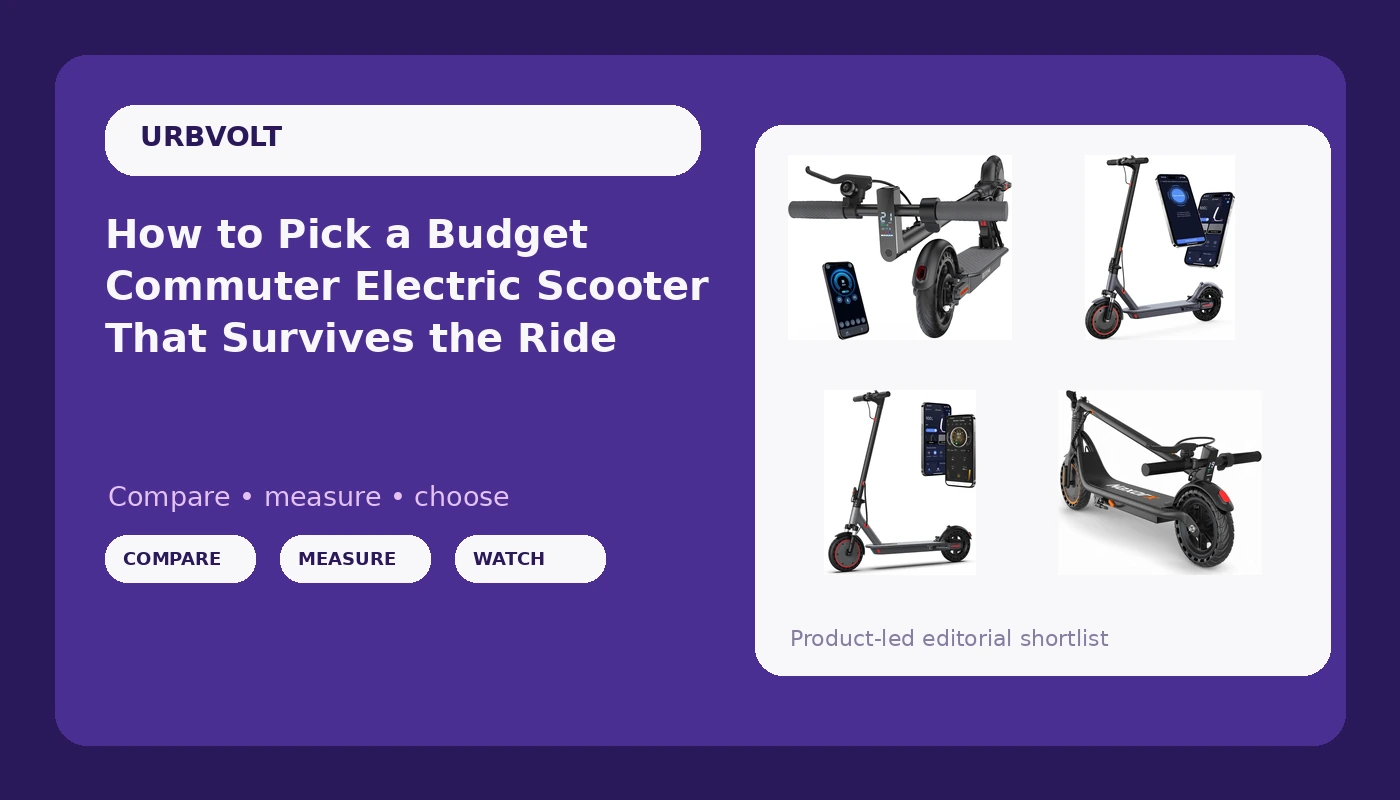
Shopping for a budget commuter electric scooter is mostly an exercise in decoding marketing. The listing says 1000W, but the motor that actually pushes you up a bridge might be rated at half that. The listing says 28 miles, but that number came from a lighter rider on flat ground, with no wind and a freshly charged pack. And almost nobody publishes the one figure that would let you compare two scooters honestly, which is watt-hours. The four models below all sit in the affordable end of the adult commuter market, and they make genuinely different trade-offs: motor headroom, claimed range, suspension, and connected features. This explainer walks through what each spec actually means, where the numbers mislead, and which of the four fits which kind of rider.
Related: How to Read a Scooter Spec Sheet Without Getting Fooled →
Quick answer
There is no single best budget commuter electric scooter, because the right pick depends on your hill, your round-trip distance, and your body weight. If suspension and bigger tires matter most on the pavement you actually ride, the VOLPAM dual suspension model is the one to look at first. If you want the most motor headroom and the highest stated top speed in this group, the 1000W/500W all terrain model leads on paper. If the longest claimed range ladder is your priority, the 350W/500W VOLPAM lists the widest spread of range configurations. And if you want the lowest entry point with app control and a dual braking system, the 19/22MPH foldable model covers that. Every one of these figures is manufacturer-stated, not independently measured, so treat them as a starting point for comparison rather than a promise.
4 useful options
| Model | Best fit | What stands out |
|---|---|---|
| VOLPAM 10 Inches 500W Adult Electric Scooter with Dual Suspensions | Rough pavement and long commutes | 10 inch tires combined with dual suspensions, plus a 500W motor rating |
| Electric Scooter Adults, 1000W/500W Motor, 28/21 Miles Max Range, 10''/8.5" Tires All Terrain | Riders who want motor headroom | Highest stated motor rating and top speed here, with all terrain tires and a foldable frame |
| VOLPAM Electric Scooter, 350W/500W Motor, Long Range 15/17/21/28Miles, 19 Mph Top Speed | Riders who prioritize claimed range | The widest range ladder in this group, listed from 15 up to 28 miles |
| 19/22MPH Electric Scooter for Adults and Teens, 15/30Miles Max Range, 8.5"/10" Foldable E Scooter with APP Control, Dual Braking System | First scooter and app users | App control and a dual braking system at the lowest listed price tier |
Best fit for rough pavement: VOLPAM 10 Inches 500W Adult Electric Scooter with Dual Suspensions
Suspension is the spec that gets cut first when a manufacturer needs to hit a price, and it is the one you feel every single day. On a rigid scooter, every pothole, tree root, and poorly patched utility cut goes straight into your wrists, knees, and the deck welds. Dual suspension plus a 10 inch tire is a meaningfully different ride than the same frame on 8.5 inch wheels with no suspension at all. The trade-off is that suspension adds weight and moving parts, and cheap suspension can be underdamped and bouncy rather than plush. This is also the most expensive model in this group, which is consistent with what it is carrying. If your route includes brick, chip seal, or a stretch of road that gets patched instead of repaved, that premium buys something real. If your commute is smooth fresh asphalt, you are paying for hardware you will not notice.
Most motor headroom: Electric Scooter Adults, 1000W/500W Motor, 28/21 Miles Max Range, 10''/8.5" Tires All Terrain
Two numbers separated by a slash are a pattern worth understanding, and this listing is the clearest example of it. A 1000W/500W rating almost always means 1000W peak and 500W continuous, and peak is a burst you get for a few seconds on a launch or a short climb. Continuous is what the motor can hold while you grind up a long hill. That distinction matters more than the big number, because a 500W continuous motor will out-climb a 350W continuous motor on a sustained grade even if both advertise the same peak. The 25/20 MPH speed listing follows the same logic: the higher figure is likely a lighter rider or a downhill run, and the lower figure is the realistic one. This is also the only model here that pairs its motor rating with all terrain tires, which is a sensible match if your route includes gravel or unpaved paths.
Longest claimed range: VOLPAM Electric Scooter, 350W/500W Motor, Long Range 15/17/21/28Miles, 19 Mph Top Speed
A four-step range ladder is the most honest thing on any of these listings, because it admits that range depends on the battery you buy rather than on the scooter. The catch is that the same model name can be sold with very different packs, so the 28 mile figure applies only to the configuration that carries the biggest battery. Before you compare this scooter to anything else, confirm which configuration you are actually buying. This is also the model where the watt-hour question matters most, because range is a function of battery capacity, rider weight, speed, wind, and hills, not of the motor. A 19 MPH top speed is a reasonable commuter ceiling and it tends to preserve range, since aerodynamic drag rises steeply with speed. If your round trip is 20 miles and you cannot charge at work, this is the one to investigate first, and you should still plan a buffer.
Lowest entry point: 19/22MPH Electric Scooter for Adults and Teens, 15/30Miles Max Range, 8.5"/10" Foldable E Scooter with APP Control, Dual Braking System
A dual braking system is the feature I would protect hardest on a first scooter, because stopping distance is the spec that keeps you out of the emergency room, and single-brake budget scooters are the reason so many riders learn that lesson the hard way. App control is a convenience rather than a safety feature, but it does let you adjust settings without menu-diving on a small display, and it gives you a record of your rides. The 15/30 mile range spread is wide, which is the tell that this model is also sold in more than one battery configuration, so confirm which one you are getting. The 8.5 inch and 10 inch tire options matter too: the larger tire is the better commuter choice on imperfect pavement, and it is the option to look for if your route is anything other than smooth.
Prices and availability may change. Product images, names, and retailer links must be matched by verified ASIN. Do not state a current price, rating, stock status, or measured result without current evidence.
Peak watts versus continuous watts
When a listing prints two motor figures, the larger one is almost always peak and the smaller one is continuous. Peak watts are a burst: the controller dumps current into the motor for a few seconds to launch you from a stop or to punch over a short rise. Continuous watts are what the motor can sustain for minutes at a time without overheating, and that is the number that decides whether you crawl or climb on a long grade. A 1000W/500W rating therefore behaves like a 500W scooter with a useful burst of extra shove, not like a 1000W scooter that can hold that output all the way up a bridge.
The second thing to know is that continuous watts interact with rider weight and hill length. A 350W continuous motor is plenty for a 150 lb rider on flat ground and genuinely marginal for a 220 lb rider on a sustained incline. Peak wattage printed on a box is a party trick unless the continuous rating and the controller can support it, and cheap controllers are exactly where budget scooters cut corners. When you compare these four, compare the lower number first, then the higher one.
Range claims, watt-hours, and rider weight
Amp-hours are marketing math. Watt-hours are the real measure of battery capacity, and you get them by multiplying voltage by amp-hours. A 36V pack rated at 10Ah holds roughly 360Wh; a 48V pack at 10Ah holds roughly 480Wh. Two scooters can both advertise 10Ah while carrying meaningfully different energy, which is why comparing amp-hours across models tells you almost nothing. If a listing hides the voltage, that is usually not an accident.
Once you know the watt-hours, you can plan realistically. Estimate your consumption per mile for your weight, your speed, and your terrain, then divide the battery capacity by that figure. Many riders use a rough planning range of 20 to 30 Wh per mile for a mid-weight adult at moderate speed, but treat it as a starting point rather than a spec, because hills, headwinds, cold, and low tire pressure all push consumption upward. Then account for voltage sag: as the pack drains, output drops and the last 20 percent of the battery feels much weaker than the first. A hill you climb easily on a full charge may require walking on a low one. Plan your round trip with a buffer, and if you cannot charge at your destination, size the battery for the whole loop, not half of it.
- Weigh yourself with your bag, helmet, and anything else you carry, then find the watt-hours of the battery you are actually buying.
- Measure your real round trip with a phone app, then add a buffer for wind, cold, and detours.
- Judge the scooter on continuous watts rather than peak watts, and check whether the controller can support sustained output.
- Check the tire size and whether the tires are tubed or tubeless before you buy, not after your first flat.
- Confirm the folded dimensions and the total weight against your stairs, your elevator, and your desk, because the best scooter is the one you can actually carry.
Practical guidance for the first thousand miles
- Check tire pressure weekly with a gauge. Low pressure costs you range, speed, and tube life, and it is the most commonly ignored spec on any scooter.
- Wear a helmet on every ride. A scooter without a helmet is not a commuter, it is a bet.
- Look at the IP rating before you ride in the rain. An IP rating of 54 or better is the minimum for a scooter that sees weather, and anything less is a fair-weather toy.
- Treat the controller as the part most likely to strand you. It is the brain that converts battery power into motor power, and on budget scooters it is where the cost cutting shows up first.
- Budget for consumables: tires, tubes, brake pads, and eventually a battery. A cheap scooter is cheap to buy and not always cheap to keep.
Which option should you choose?
Choose the VOLPAM 10 Inches 500W Adult Electric Scooter with Dual Suspensions when your route is rough, your wrists and knees are already complaining, and you want the ride quality that bigger tires and suspension provide. Choose the Electric Scooter Adults, 1000W/500W Motor, 28/21 Miles Max Range, 10''/8.5" Tires All Terrain when you want the most motor headroom here, ride mixed surfaces, and are willing to accept that the top speed figure applies to a lighter rider than you. Choose the VOLPAM Electric Scooter, 350W/500W Motor, Long Range 15/17/21/28Miles, 19 Mph Top Speed when distance is the whole point of the purchase and you can confirm which battery configuration you are buying. Choose the 19/22MPH Electric Scooter for Adults and Teens, 15/30Miles Max Range, 8.5"/10" Foldable E Scooter with APP Control, Dual Braking System when you are buying your first scooter, want dual braking and app control, and are working to a tight budget.
A limitation worth naming: none of the figures above are independent measurements. They are manufacturer-stated numbers, and the real-world results will depend on your weight, your terrain, your tire pressure, and the temperature. Use these specs to narrow the field, then verify the details that matter most to you before you commit.
The bottom line
Every scooter in this group is a set of compromises, and the useful question is which compromise you can live with. If ride quality is the priority, pay for suspension and 10 inch tires. If climbing and speed are the priority, look at the continuous wattage behind the peak number. If distance is the priority, confirm the watt-hours of the exact configuration you are ordering and plan a buffer for wind and hills. If this is your first scooter, prioritize brakes, a helmet, and a battery you can carry. None of these four is a car replacement on its own, but any of them can replace a lot of short trips, and the one that fits your route and your stairs will get ridden far more than the one with the best spec sheet.