An electric scooter battery upgrade is the cheapest big repair in micromobility, and the one most riders get wrong. I have watched people spend a Saturday trying to revive a pack that was never going to hold a hill again, and I have watched people throw away a perfectly good chassis because one cell group went soft. Both mistakes cost real money.
Here is the fork in the road. Your range is falling off, the scooter dies at 40 percent, or the charger clicks off in twenty minutes. You can replace the battery, or you can replace the scooter. The right answer comes down to three things: how many watt-hours you have actually lost, whether the rest of the scooter is still sound, and whether you can find a pack that matches your voltage and your connector.
I have been car-free in Austin for four years, which is about 14 miles a day across the Congress Avenue bridge plus errands and late taco runs. Seven scooters in that time, one deck replaced, four tubes patched, two controllers blown. The lesson from all of it is boring: the battery is a wear item, and on a decent scooter everything else usually outlives it.
Why you should trust me
I am not a shop. I am the person who has to get to work on a 105-degree Tuesday, and that changes how gear gets judged. My rules are simple. No range claim gets repeated here without the watt-hour math behind it, because the miles printed on a box were measured with a lighter rider, no wind, and a fresh pack. No scooter with tubed tires gets called a commuter without a note about the tube reality. And nothing gets ridden without a helmet, including the trip to the mailbox.
Four years of this taught me to read a spec sheet the way a mechanic reads a wiring diagram: voltage first, amp-hours second, and the controller as the part that decides whether you get home.
How to tell whether you need a pack or a whole scooter
The short answer: if the scooter is under three years old, the frame is straight, the brakes work, and the motor does not grind, a pack is usually the cheaper fix. If two or more of those are false, buy the scooter.
Run four checks before you spend anything.
Check one: convert the battery to watt-hours. Watt-hours is the only battery number that matters. Multiply nominal voltage by amp-hours. A 48V 10Ah pack is 480 Wh. If a listing gives you amp-hours and hides the voltage, you cannot compare it to anything, and that is usually the point.
Check two: measure how far the scooter goes now. Ride your normal loop and note the distance and where the power starts to sag. Voltage sag is the drop you feel when the pack is low or cold, and it is why "40 percent battery" can ride like 15. A pack that sags early is a pack that is done.
Check three: judge the rest of the scooter. Straight frame, working brakes, no play in the stem, tires that hold air, a controller that does not smell like burnt toast. If those are all fine, the chassis has years left in it.
Check four: match voltage and connector before you buy anything. Nominal voltage has to match. The connector has to match or you are soldering. And the pack has to be rated for the watts your motor actually pulls, which is why you will see packs listed with a motor wattage range.
The two routes, and what each one uses
Route one is a new pack on the scooter you already own. It is cheaper, it keeps a machine you already know, and it takes an afternoon. Route two is a new scooter, which makes sense when the pack is only one of several things wearing out, or when you want more range than your current frame can hold.
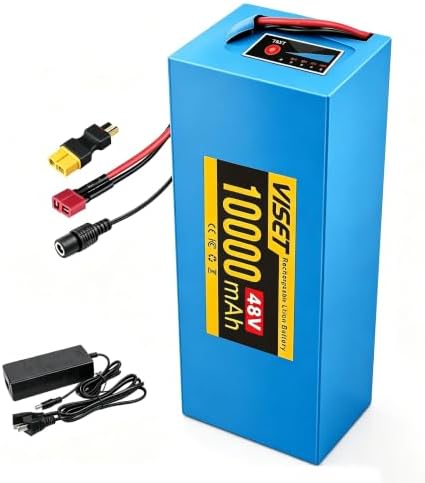
The replacement-pack route: VISET 48V/36V/ Ebike Battery 10AH/20AH/Electric Bike Battery with BMS, Power Indicator Light,XT60 Connector,Compatible with E-Bikes, Scooters, ATVs, Motorcycles and100-1000W Motors(48V10AH)
 Visit on Amazon →
This is the shape of pack you are looking for if you are going the repair route. It comes in 48V and 36V versions and in 10Ah and 20Ah capacities, which maps directly onto the watt-hour math above: the 48V 10Ah version is roughly 480 Wh, and the 20Ah version doubles that. It uses an XT60 connector, so check what your scooter has before you order, because XT60 to whatever-your-scooter-uses is the part of this job that eats the afternoon.
The features that matter for a commuter are the ones you can verify on the listing: a BMS to keep the cells balanced, a power indicator light so you can read state of charge without guessing, and a stated compatibility range of 100 to 1000W motors, which covers most adult commuter scooters. Check current Amazon price.
Caveats before you buy: match the nominal voltage exactly, not approximately. Confirm the connector type and the physical dimensions against the bay in your scooter, because a pack that does not fit is a pack you are returning. And if your old pack is swollen, punctured, or smells sweet, stop riding and recycle it at a proper drop-off rather than storing it in the garage.
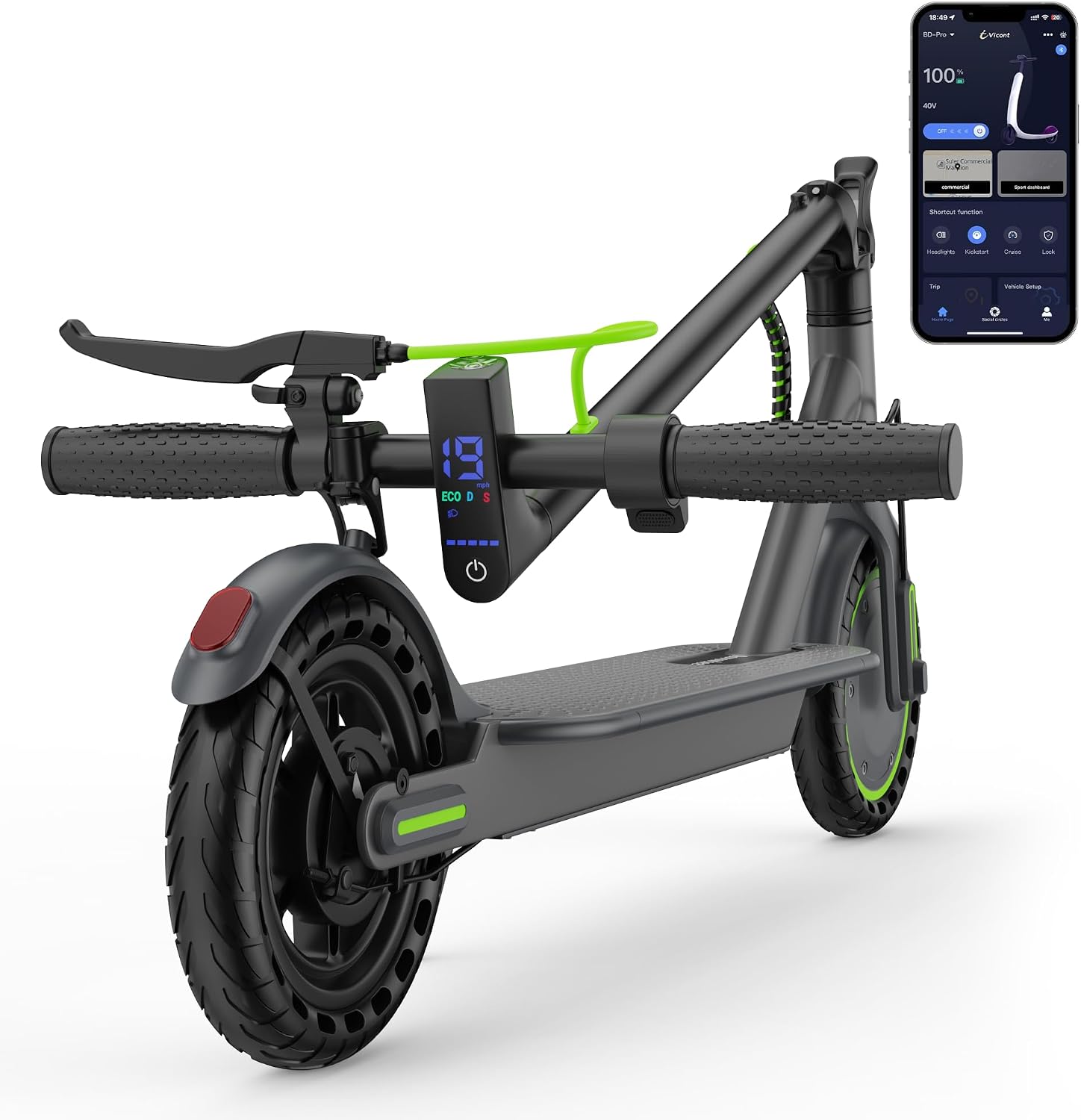
The fresh-scooter route: Aovowheel Electric Scooter for Adults, Folding E Scooter with 250W-500W Motor 16-24 Mph Top Speed, Max 15-60Miles Long Range,Commuting Scooters with 6.5''/8.5''/10''/14'' Tires, Dual Brakes
 Visit on Amazon →
When the whole scooter is tired, this is the other end of the fork: a folding adult commuter with a 250W to 500W motor, a claimed 16 to 24 mph top speed, and a listed range of 15 to 60 miles. That range spread is the honest part of the spec sheet. Sixty miles and fifteen miles are the same scooter under different riders, speeds, and hills, so plan your commute around the low end and treat the high end as a tailwind story. Check current Amazon price.
Two details I would look at first on a listing like this. Tires: it is offered with 6.5, 8.5, 10, and 14 inch options, and the bigger ones ride potholes and expansion joints noticeably better. Brakes: it lists dual brakes, which is the minimum I want on anything that can hold 20 mph in traffic. It folds, which matters if you carry it upstairs or onto a bus.
Caveats before you buy: a folding scooter you cannot lift is a garage ornament, so check the weight against your stairs. Confirm which tire size and which motor variant you are actually ordering, because one listing covers several. And ride it with a helmet.
The actual workflow: swapping a pack without cooking anything
Step one: write down the old pack's numbers. Nominal voltage, amp-hours, connector type, and physical dimensions. Photograph the label and the connector before you touch anything.
Step two: power down and disconnect. Turn the scooter off, unplug the charger, and disconnect the pack. Work on a clean surface with no loose metal that can bridge the terminals. A shorted pack is a fire, not a warranty claim.
Step three: buy the closest match, not the biggest number. More amp-hours means more range and more weight. If your commute is 14 miles round trip and your old pack was around 480 Wh, a pack in the same neighborhood is the sane buy.
Step four: check the connector before you cut anything. If the new pack has an XT60 and your scooter does not, adapt it with a proper harness rather than twisting wires and taping them. Solder, heat shrink, and a tug test.
Step five: install the pack so it cannot move. Foam or rubber padding in the bay, no pressure on the cells, no sharp edges against the casing. Movement kills packs.
Step six: charge it outside or in a garage the first time. Not because the pack is bad, but because that is how you treat every new battery. Then do a short shakedown ride before you trust it on the bridge.
Step seven: log the numbers. Distance, temperature, tire pressure, and where the sag starts. Do that for two weeks and you will know more about your scooter than any review will tell you.
Caveats that will bite you
Voltage sag is not a battery failure by itself, but it is the first sign of one. Tubed tires are a maintenance subscription, so keep the pressure up and learn to patch. An IP rating of IP54 or better is what rain-safe-ish looks like, and anything less is a fair-weather toy. A cheap BMS is the reason cheap packs die young. And peak watts on a box are a party trick; the controller and the pack are what actually deliver.
What this all costs
Do the math in cost per mile, not sticker price. A pack for a scooter you already own is one purchase. A new scooter is that purchase plus a frame, a motor, tires, and brakes. Check current Amazon price on the pack and on the scooter on the same day, then divide by the miles you ride in a year. If you ride 14 miles a day, five days a week, you are looking at roughly 3,600 miles a year, and the cheaper option usually becomes obvious fast.
Other routes people try
Taking it to a shop works if the shop knows your model, but plenty of shops will not touch a pack they did not sell. Buying a used scooter to dodge the repair usually just trades one tired battery for another. Running a pack at the wrong voltage is the route that ends with a burnt-toast smell and a long walk home. None of those are cheaper than matching a pack to a scooter you already trust.
The bottom line
If the frame is straight and the brakes work, replace the pack. If the whole scooter is tired, replace the scooter and keep the old pack's lesson: watt-hours, connector, BMS, in that order. Either way, do the math first, ride with a helmet, and log what you learn. That is the whole job.