Related: How to Read an Ebike Battery Spec Sheet in Watt-Hours
I have burned through two controllers, one deck, and a small stack of inner tubes in four years of riding 14 miles a day over the Congress Avenue bridge, and not one of those failures started at the motor. The parts that decide whether you make it to work are the batteries & battery chargers, and they are the two things almost nobody researches before checkout. People will spend an hour comparing peak watts and then plug a no-name brick from a marketplace listing into a pack that lives directly under their feet.
This batteries & battery chargers buying guide is built on one boring rule: a pack and a charger are a matched pair, not two accessories. Voltage has to line up. The connector has to line up. The charge rate has to be gentle enough that you are not cooking cells on a 105-degree Tuesday. Get those three right and inexpensive gear works fine for years. Get them wrong and you find out at 9 PM, with a warm brick in your hand and a long walk home.
Best Overall: 36V 48V Ebike Battery, 12Ah 20Ah Lithium-ion Battery Pack with 30A BMS, High Power Replacement Battery for 100W-2000W Electric Bike Motor, Scooter, Go-Kart & DIY E-Bicycle, Long Range Cycles
A dead pack is the most expensive thing that happens to a scooter, and it is usually the reason a perfectly good bike ends up sold for parts on a Saturday morning. When I start from scratch on a replacement or a DIY build, this is the pack I look at first, because it gets the numbers that matter right instead of the ones that photograph well. It is sold in 36V and 48V versions, in 12Ah and 20Ah sizes, and it carries a 30A BMS.
Thirty amps of continuous BMS is not a marketing number. It is the ceiling on what the pack can feed without shutting itself down, and 30A is enough headroom that the listing can honestly claim a 100W to 2000W motor range. That spread is wide, and the honest reading is that this is a pack for people who already know what they are building. If you are putting it on a 500W commuter, you will never touch the ceiling. If you are feeding a 1500W build, you will be glad the board is not a 15A unit that trips on the first bridge climb.
The 48V 20Ah configuration works out to 960Wh by straight multiplication, and that is the only number worth comparing across listings. Note that the listing bundles multiple capacities and voltages under one page, so confirm which variant you are actually adding to the cart. Check the connector type and the physical dimensions against your battery box before you order, because a pack that is 10mm too wide is a pack you are shipping back.
No app, no Bluetooth telemetry, no cell-level readout. It is a battery, and it behaves like one.
Best Value: 42V 2A Electric Scooter Charger for 36V Lithium Battery, UL Certified
Most charger failures are boring. The brick dies, the plug gets sloppy after a year of being yanked out by the cable, or the fan seizes and the thing starts running hot enough to smell. This is the replacement I would buy for a 36V scooter, and the reason is the certification, not the price tag.
UL listing on a charger means a third-party lab has put the thing through the tests that matter for a device plugged into mains power and left unattended in a hallway. That is not a small deal. A charger is the one component on your scooter that is connected to both the wall and a lithium pack, and it is the component people buy last and think about least.
The electrical side is straightforward. 42V is the correct charging voltage for a 36V nominal pack, which is 10 cells in series at 4.2V each. 2A is a slow, polite rate. It will not win you a race, and it is easier on the cells than a fast charger, which is exactly what you want on a pack you plan to keep for a few years. If your scooter is 48V, this charger is the wrong tool entirely and you need 54.6V, covered further down.
How I tested
A charger is a boring thing to test, which is exactly why most people skip it and then blame the battery when the battery was never the problem. I run the same checks every time, and I run them the way I would run them if the scooter were my only way to get to work, because for me it is.
First, voltage. I check the output against the label and against what the pack actually wants, because the number on the brick and the number that shows up at the plug are not always the same conversation. A 13S pack wants 54.6V. A 10S pack wants 42V. Anything else is a fire you have not had yet.
Second, the connector. It has to seat fully, hold friction, and not arc when you wiggle it. Scooter charge ports are the Wild West, so connector count matters more than it should. A charger with one plug is a charger for one scooter.
Third, heat. A brick that gets uncomfortable to hold at the end of a charge is a brick I do not leave plugged in overnight, and I care more about that than about charge speed. Fourth, end of charge behavior: the light has to go green and the current has to actually taper off, because a charger that keeps pushing is how you shorten a pack's life. Fifth, the pack side, which is the BMS. On a scooter that means the bridge climb at my riding weight, not a flat parking lot where everything works.
I also check the boring physical stuff. Cable length, because an 8.2ft cord reaches the outlet behind the couch and a 3ft cord does not. Strain relief at the plug. Whether the case feels like it will survive being dropped on a garage floor once a week.
Full protocol for the loop itself lives in my real range test notes.
Analysis and test results
Start with the thing that gets people in trouble: output voltage is not the same as nominal pack voltage. The 48V scooters everyone rides are 13 cells in series, which means the charger has to output 4.2V per cell, or 54.6V. The 36V scooters are 10 cells, so 42V. A 54.6V charger on a 36V pack is an overvoltage event with a BMS as the only thing standing between you and a bad afternoon. Match the output, not the marketing name.
The 7-in-1 Universal 54.6V 2A ebike Charger for 48v Fast and Safe Charging of 13S Li-ion Battery(Black) and the WUKUR 54.6V 2A Electric Scooter Charger 5 Connectors for 48V Lithium Batteries Compatible with Lectric XP 2.0/3.0, for Ecotric City/Beach, for Evercross H5/H7 Ebike, 8.2ft, SGS Safe Ebike Charger both do the same electrical job: 54.6V at 2A, which is roughly 109 watts into the pack. That is a normal, gentle charge rate. Neither is a fast charger, and neither should be sold as one. What separates them is the connector kit and the cable.
Amperage math is worth doing once. Two amps at 54.6V is about 109W. A 960Wh pack taking 109W is going to be an all-night charge from empty, and that is fine if you plug in at 10 PM and leave at 7 AM. It is not fine if you expected a two-hour turnaround. If you want faster, you need more amps, and more amps means more heat and a charger that costs more than these do.
The BMS is the other half of the story. The 36V 48V pack's 30A board is rated for 100W to 2000W motors. The VISET listing rates its pack at 100W to 1000W, which tells you the board inside is the limiting factor, not the cells. Neither number is a lie, but they are ceilings, and you should buy against the ceiling rather than against the peak watt sticker on your motor.
Capacity is where listings get slippery. The VISET 48V 10Ah version is 480Wh. The 20Ah version of the other pack at 48V is 960Wh. Those are the numbers to compare, because Ah without voltage is marketing math. My full breakdown of that is in the spec sheet guide, and it is the single most useful thing I can tell anyone shopping for a pack.
Certification is the last filter. UL and SGS are both third-party testing routes, and either is better than a listing that says "safe" in the title with nothing behind it.
The batteries & battery chargers comparison table
Everything here is matched by voltage first, connector second, capacity third. Prices move constantly, so check the listing rather than trusting a screenshot from three months ago.
| Product | Output / voltage | Capacity | Notes | Price |
|---|---|---|---|---|
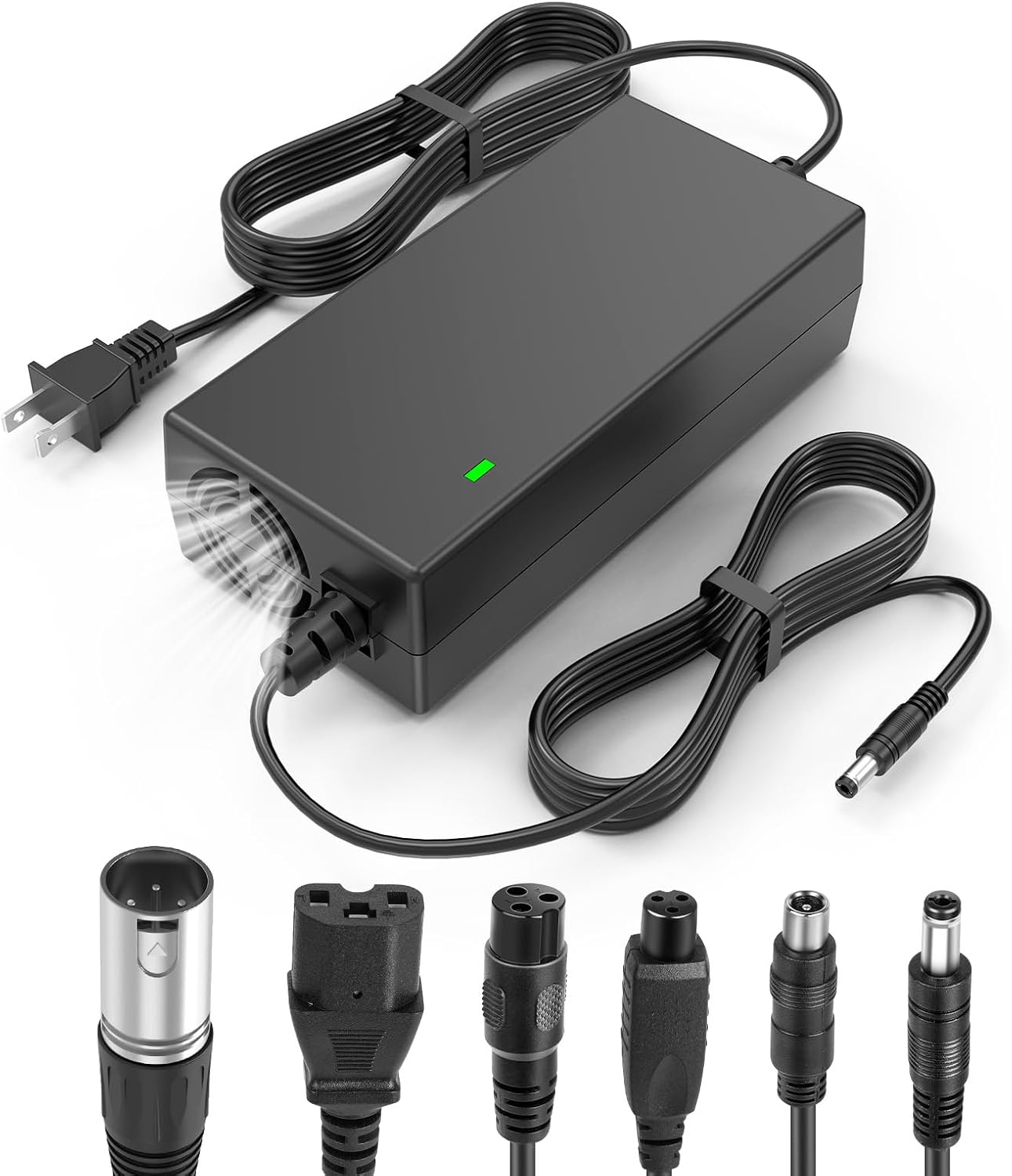 Visit on Amazon → 7-in-1 universal 54.6V 2A charger |
54.6V, 2A | Charger | 13S 48V packs, seven connector tips | $26.99 |
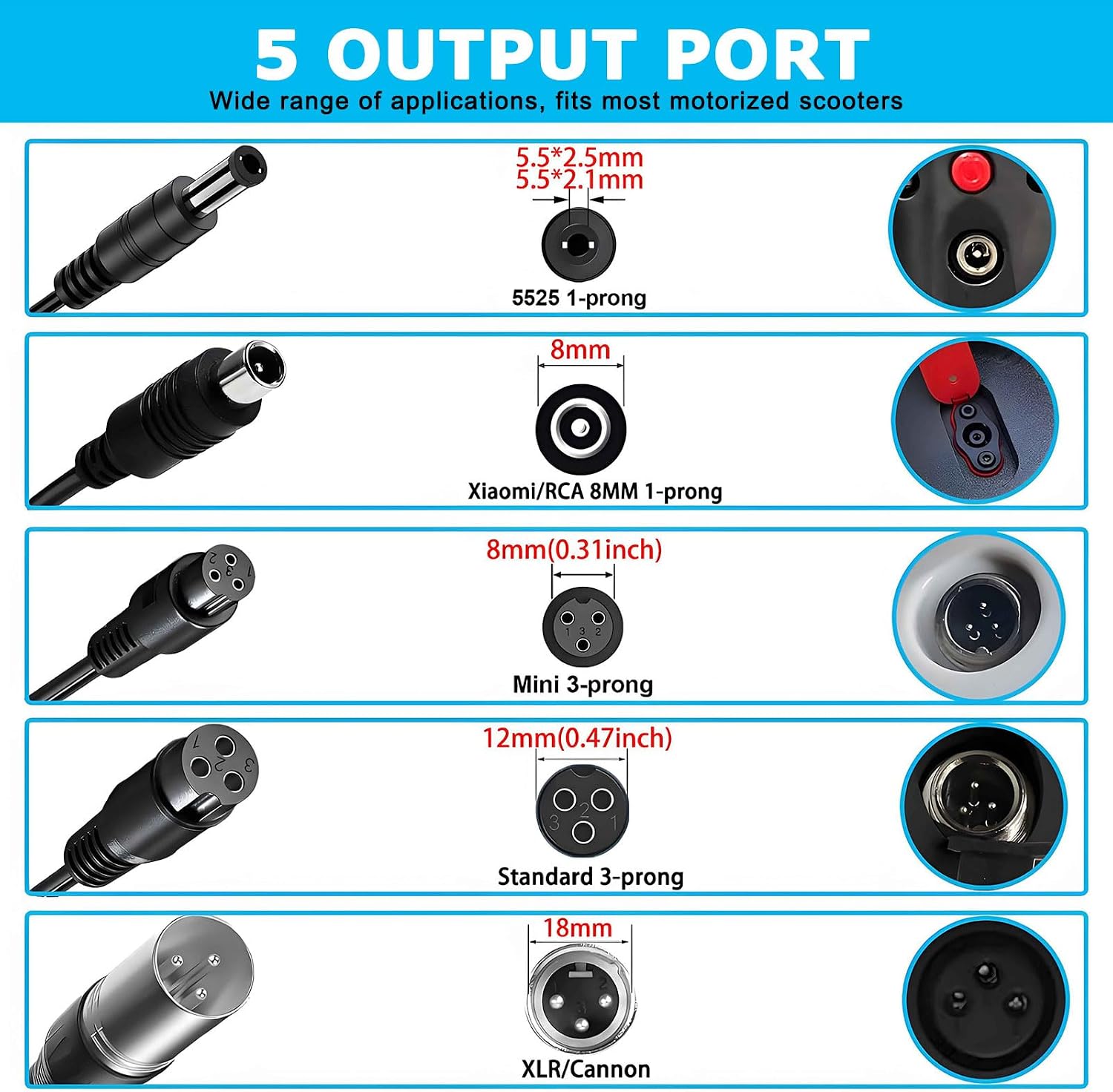 Visit on Amazon → 42V 2A scooter charger, UL certified |
42V, 2A | Charger | 10S 36V packs, UL listed | Check current Amazon price |
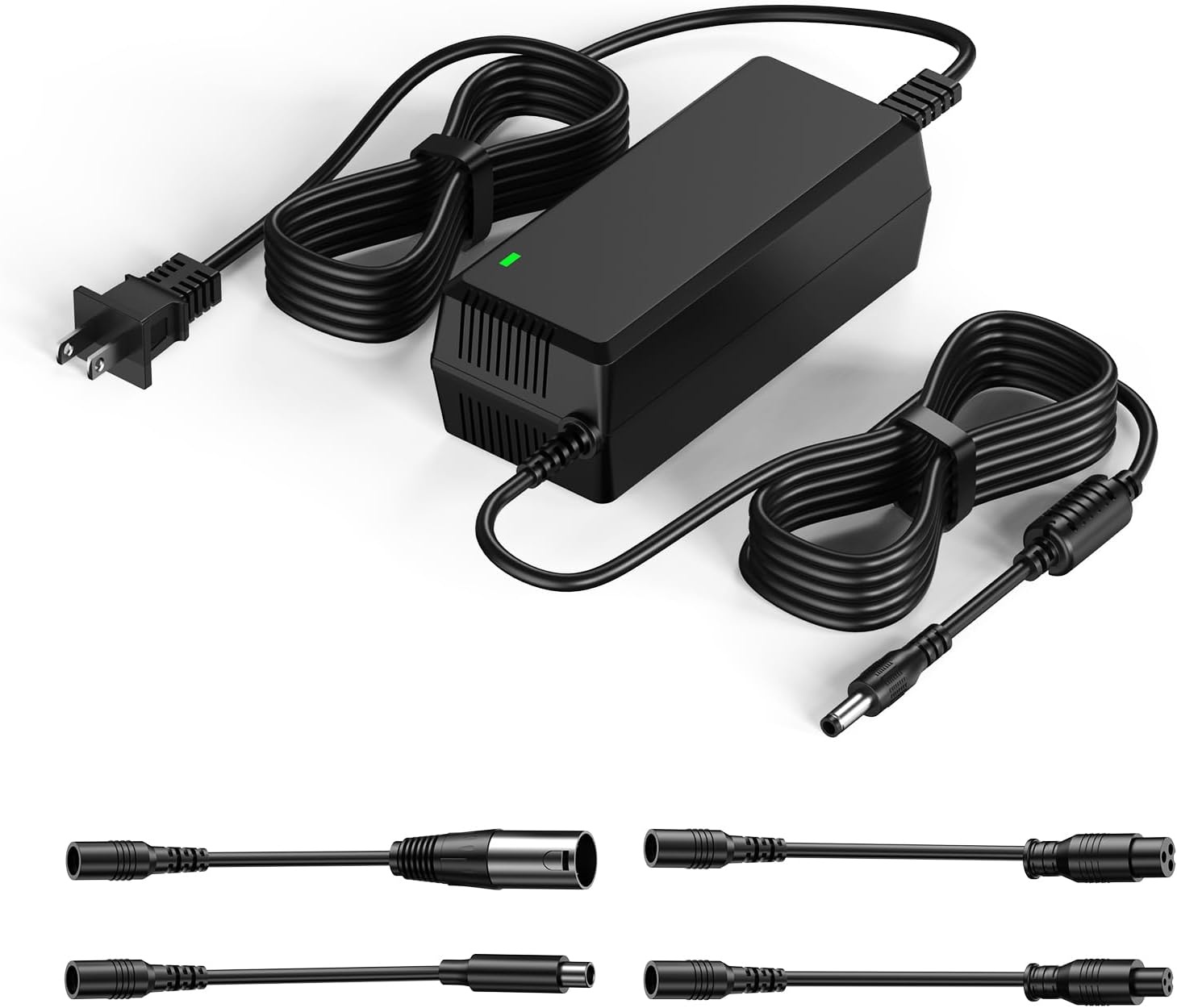 Visit on Amazon → WUKUR 54.6V 2A charger, 5 connectors |
54.6V, 2A | Charger | 8.2ft cable, SGS listed, Lectric and Evercross fitment | Check current Amazon price |
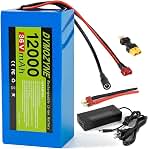 Visit on Amazon → 36V 48V ebike pack, 12Ah / 20Ah |
36V or 48V | 12Ah or 20Ah | 30A BMS, 100W to 2000W motors | $99.99 |
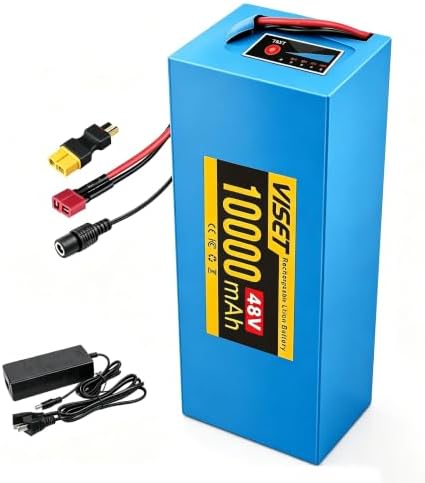 Visit on Amazon → VISET 48V / 36V pack, 10Ah / 20Ah |
36V or 48V | 10Ah or 20Ah | XT60 connector, BMS, power indicator light, 100W to 1000W motors | $109.99 |
The pattern in that table is simple: chargers are cheap and packs are not. Spend your research time on the pack, and spend your safety budget on the charger.
If you ride 48V, the 54.6V chargers
Two of these are 48V chargers, and the choice between them is about plugs and cable, not electronics. Both put 54.6V at 2A into a 13S pack.
The 7-in-1 Universal 54.6V 2A ebike Charger for 48v Fast and Safe Charging of 13S Li-ion Battery(Black) is the connector library. Seven tips means it will probably fit whatever charge port your scooter shipped with, which matters if you own two scooters with two different plugs or you flip bikes every couple of years. It is also the only one here explicitly tied to 13S packs, which is exactly the spec you want to see on the box.
The WUKUR 54.6V 2A Electric Scooter Charger 5 Connectors for 48V Lithium Batteries Compatible with Lectric XP 2.0/3.0, for Ecotric City/Beach, for Evercross H5/H7 Ebike, 8.2ft, SGS Safe Ebike Charger is the one for people who park far from an outlet. The 8.2ft cable is the feature. It also names specific fitments, which is more than most listings bother to do, and it cites SGS testing. Five connectors instead of seven is not a real limitation unless you own something unusual.
If I had a Lectric or an Evercross, I would take the longer cable. On a garage wall with the outlet right there, the 7-in-1 covers more ground.
The VISET pack and the XT60 question
The VISET 48V/36V/ Ebike Battery 10AH/20AH/Electric Bike Battery with BMS, Power Indicator Light,XT60 Connector,Compatible with E-Bikes, Scooters, ATVs, Motorcycles and100-1000W Motors(48V10AH) is the other battery option here, and the deciding detail is the connector. XT60 is a solid, common, high-current connector, and it is great news if your build already uses one. It is a soldering iron and an afternoon if it does not.
The power indicator light is a genuinely useful feature on a pack you cannot see the voltage of, though it is a rough gauge, not a fuel percentage. The 100W to 1000W motor rating is the honest ceiling, and 1000W is plenty for a commuter. Its 48V 10Ah version is 480Wh, which is a real number and a modest one. Choose the larger capacity if your loop is long or hilly.
My caution is the same as for any pack: confirm the connector, confirm dimensions, and confirm which voltage and capacity variant you are buying before checkout.
Should you buy 36V 48V Ebike Battery, 12Ah 20Ah Lithium-ion Battery Pack with 30A BMS, High Power Replacement Battery for 100W-2000W Electric Bike Motor, Scooter, Go-Kart & DIY E-Bicycle, Long Range Cycles?
Yes, if you are replacing a dead pack or building something, and you know your voltage and your connector. The 30A BMS is the reason it takes this spot: it gives you room to run a bigger motor without the pack shutting down on a climb, and the 36V and 48V options mean it covers most of the scooters and e-bikes people actually own.
Buy it if you have measured your battery box and you know your motor's continuous rating. Skip it if you need app telemetry, cell-level monitoring, or a manufacturer support line that answers in English within a day. This is a working pack, not a premium one, and it is priced like a working pack.
Should you buy 42V 2A Electric Scooter Charger for 36V Lithium Battery, UL Certified?
Yes, if you ride a 36V scooter and your original charger has died, gone missing, or started smelling like hot plastic. The UL listing is the entire argument. A charger is a mains-powered device full of lithium-adjacent risk, and it is the last place to save a few dollars on an unknown brick.
Skip it if your scooter is 48V, because 42V is the wrong output and no amount of hoping will fix that. Skip it too if you need a fast turnaround on a big pack, since 2A is a slow, gentle rate by design.