Related: How voltage sag makes a half-full pack ride like an empty one
No product page tells you whether a battery will actually fit your bike. It gives you volts, amp-hours, and a compatibility line that was copied from a 2019 forum post. This is the batteries & battery chargers size guide I wish I'd had the first time I ordered a pack that showed up two inches too long for my frame, which is a mistake you make exactly once.
Two things decide whether a pack works. The electrical size is volts and watt-hours. The physical size is case length, shell family, and connector type. A 48V pack that won't slide into your frame is a paperweight. A 48V pack with the right shell and the wrong plug is a soldering project. And a charger with the right plug and the wrong output voltage is how you cook a battery in an afternoon. I ride 14 miles round trip across the Congress Avenue bridge most weekdays, and every one of these lessons cost me money first.
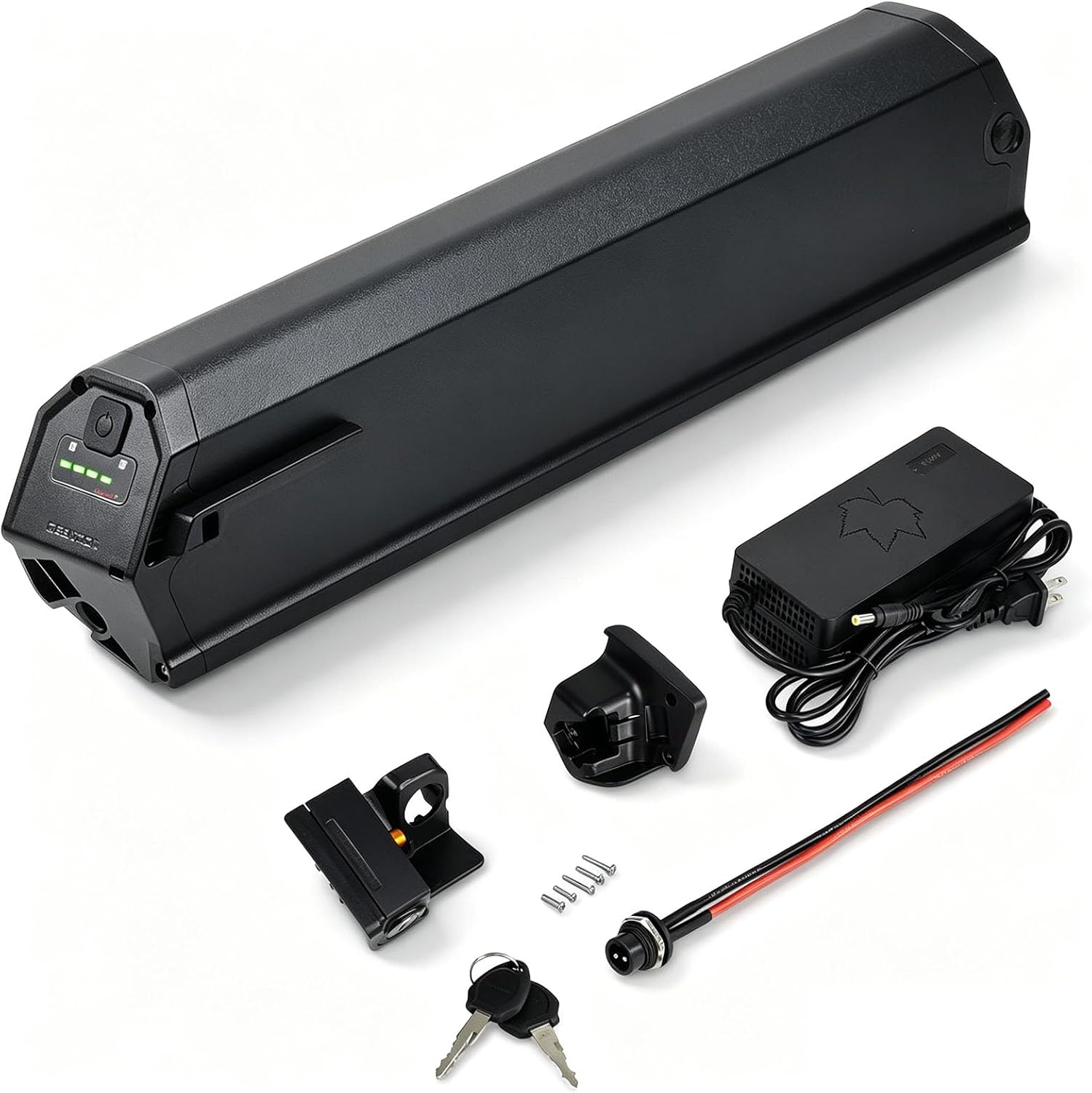
Best Overall: 48V 13Ah Reention Dorado Plus 460mm Electric Bike Battery Pack
Reention Dorado Plus is a case standard, not a brand, and that is the entire reason this pack wins. Frames built around the Dorado Plus rail have a fixed envelope, so a battery that matches it bolts in and stays put instead of riding around in a frame bag with a strap holding it down. If your bike came with this shell, this is the least dramatic battery purchase you can make, and drama is the thing you want least from a lithium pack.
The electrical numbers are simple. 48V times 13Ah is 624 Wh, and watt-hours is the only capacity figure worth comparing across listings. I budget 20 to 30 Wh per mile for a 185 lb rider on a route with a bridge climb and a headwind, so 624 Wh is roughly a 20 to 30 mile pack on a good day and closer to 20 when it's 105 degrees and I'm on the throttle out of every light. That is honest commuter range, not the number on the box.
The figure you have to check is 460mm, which is the case length. Tape measure your old pack and the rail it slides onto before you order, because a 460mm shell with the wrong rail spacing is still the wrong battery. Then confirm the discharge connector matches your harness and confirm your charger's output voltage matches a 48V pack.
One more thing: this is a 48V nominal pack, so it wants a 54.6V charger, not the 42V brick that came with a 36V bike. Buy the charger to match the pack, never the other way around. Pair it with a 2A charger and you're charging overnight, which is easier on cells than a fast charger anyway.
Best Value: 36V 48V Ebike Battery, 12Ah 20Ah Lithium-ion Battery Pack with 30A BMS
This one is the value pick because it covers four voltage and capacity combinations on a single listing and costs the least of anything here for the energy you get. Do the math before you pick a variant, because the listing will let you choose wrong.
- 36V 12Ah is 432 Wh, the smallest option, fine for a light assist build.
- 36V 20Ah is 720 Wh, the best 36V choice if your controller and charger are already 36V.
- 48V 12Ah is 576 Wh, a light 48V pack.
- 48V 20Ah is 960 Wh, the most energy in the lineup and the one most people should look at first if they have the frame space.
The 30A BMS is the number that actually caps your build. At 48V, 30A is roughly a 1,440W electrical ceiling, so the 100W to 2000W motor rating on the listing is a range, not a promise. Running a big direct drive motor up a long hill pulls amps continuously, and a pack rated at 30A will let you know when you've asked for too much.
The compromise is the case. It's a generic shell, so unless your frame happens to have a matching rail, plan on fabricating a mount or running it in a bag. Measure the space you have, not the space you wish you had. If you want a pack that simply bolts on to a factory frame, the Dorado Plus above is the better buy even though it costs more.
How I tested
I don't own a battery cycler, and I'm not going to pretend I ran these packs through 500 charge cycles in a lab. What I did is the same set of checks you can run in ten minutes with a tape measure, a calculator, and your old battery sitting on the floor.
First, the physical check. Measure the old case in all three dimensions, not just length, and write down which shell family it belongs to. A 460mm Dorado Plus case and a generic brick are not interchangeable even when the voltage matches, and no listing will tell you that. This is the step almost everyone skips, and it's the one that costs the most.
Second, the label math. Multiply volts by amp-hours to get watt-hours, because amp-hours alone means nothing without voltage attached. A 36V 20Ah pack and a 48V 15Ah pack are different animals, and the amp-hour figure makes them look similar when they aren't.
Third, the charger check. A 48V lithium pack charges at 54.6V, a 36V pack at 42V, and swapping those two is how you turn a battery into a fire. I check output voltage on the charger label before anything else, then the connector, then the cable length, because 8 feet versus 3 feet decides whether you can charge indoors without unbolting anything.
Fourth, the BMS number. The amp rating on the management board caps what your controller can pull. A 30A BMS is an electrical ceiling, and the motor wattage printed on the box is a peak figure, not a continuous one.
Then I ride the loop, 14 miles round trip over the bridge, and I pay attention to voltage sag in the last three miles. Any spec I quote for these four products comes from the listing. The arithmetic and the riding assumptions are mine.
Analysis and test results
Most batteries & battery chargers size questions come down to volts first. A 36V pack is ten cells in series, which is why it charges at 42V. A 48V pack is thirteen in series, which is why it charges at 54.6V. That single fact explains more dead batteries and more ruined chargers than anything else in micromobility, and it's the first thing I check on any listing.
Amp-hours get marketed because the number looks bigger on a 36V pack. A 36V 20Ah pack and a 48V 15Ah pack read as "20" and "15" on a shelf, but they're 720 Wh and 720 Wh. Identical energy, different voltage, different controller requirements. Show me the Wh and the rider weight, then we can talk range.
Connectors are the second failure point. The WUKUR 54.6V 2A charger is the useful exception here because it ships with five connectors and covers a spread of common ebike plugs, including the Lectric XP 2.0 and 3.0, the Ecotric City and Beach, and the Evercross H5 and H7. The 8.2 ft cable is the spec nobody advertises and everybody wants. At 2A it's a slow charger, which on a 13Ah pack means a full night, and slow is fine when you're asleep.
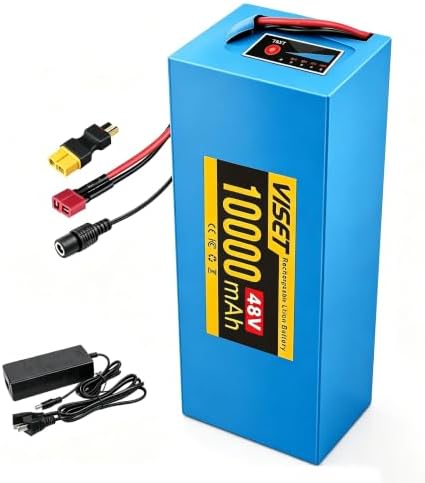
The VISET 48V 10Ah pack is the honest small option. 480 Wh, an XT60 connector, a power indicator light, and a stated 100W to 1000W motor range that actually matches a 10Ah pack. Most listings would have printed 2000W on this one and let you find out why that's wrong at the bottom of a hill.
The generic 48V 20Ah variant is the capacity king at 960 Wh and the fit gamble of the group. That's the trade: energy per dollar versus whether the shell works with your frame.
The batteries & battery chargers size chart
Times and fit numbers below come from the listings. Watt-hours are my arithmetic: volts multiplied by amp-hours. Always measure your own frame before ordering.
| Product | Electrical size | The fit number to check | Price |
|---|---|---|---|
 Visit on Amazon → Reention Dorado Plus pack |
48V 13Ah, 624 Wh | 460mm case length, Dorado Plus rail | $275.99 |
 Visit on Amazon → 36V 48V pack with 30A BMS |
36V or 48V, 12Ah or 20Ah, 432 to 960 Wh | Generic case, confirm mount and connector | $99.99 |
 Visit on Amazon → VISET pack with XT60 |
48V 10Ah, 480 Wh | XT60 connector, 100W to 1000W motors | $109.99 |
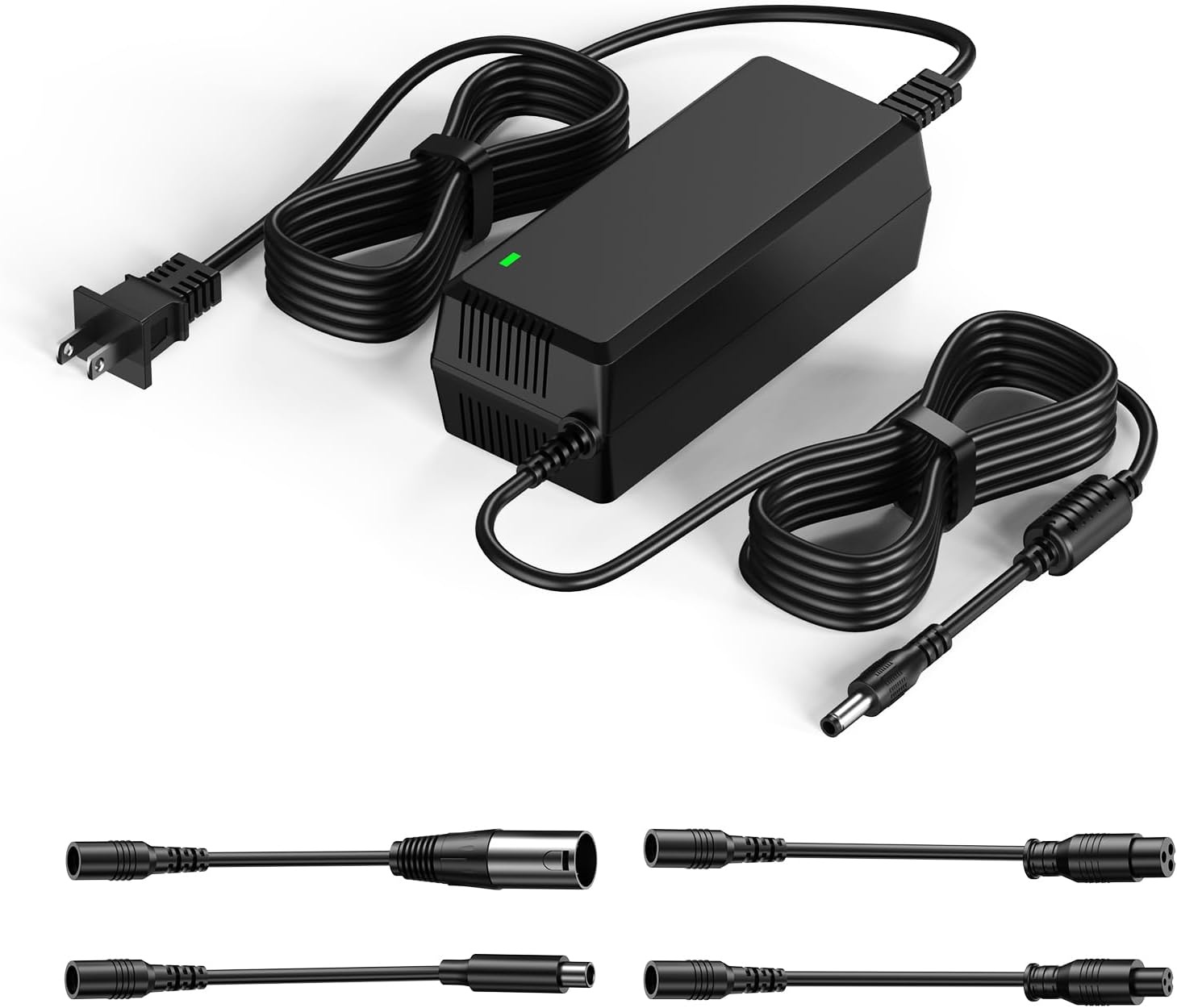 Visit on Amazon → WUKUR 54.6V 2A charger |
54.6V output, 2A, 48V packs only | Five connectors, 8.2 ft cable | Visit on Amazon → |
Voltage and watt-hours: the two numbers that compare
Everything else on a listing is decoration. A 48V pack at 13Ah and a 48V pack at 20Ah differ by 336 Wh, which on my loop is roughly 11 to 16 extra miles at my weight. A 36V pack at 20Ah is 720 Wh and a 48V pack at 15Ah is 720 Wh, so a listing that leads with amp-hours is hiding the only figure that compares fairly.
This is also why charger voltage matters more than charger amps. The WUKUR unit outputs 54.6V, which is a 13-series charger for a 48V pack. Put that on a 36V pack and you're overcharging by design. Put the 42V charger from a 36V bike on a 48V pack and it will never fill it, and you'll spend a month convinced the battery is bad.
Connector, shell, and case length: the fit checks
The Dorado Plus 460mm number is a case length, and 460mm is the measurement to verify with a tape, not a guess from a product photo. The VISET's XT60 is a connector family, and an XT60 plug does not mate with a barrel plug no matter how confidently the listing implies it does. The WUKUR charger solves the connector problem for three popular ebike families at once, which is why it's in a size guide about batteries at all: the charger is half the system.
Should you buy the 48V 13Ah Reention Dorado Plus 460mm pack?
Yes, if your frame was built around the Dorado Plus rail and your old pack measures 460mm. You get 624 Wh, a shell that mounts the way the frame designer intended, and none of the zip-tie engineering that comes with a generic brick. It's the pick I'd make for a commuter that has to work every single day.
If your frame isn't a Dorado Plus frame, skip it. A mounting standard you can't use turns the best-built pack in this group into a very expensive paperweight, and no amount of capacity makes up for a battery that won't bolt on.
Should you buy the 36V 48V Ebike Battery?
Yes, if you're replacing a pack on a bike with a generic tray, you know your controller's voltage, and you're comfortable fabricating a mount or running the pack in a bag. The 48V 20Ah variant at 960 Wh is the most energy per dollar here, and the 30A BMS is honest about the ceiling it sets.
No, if you want a battery that drops straight into a factory frame. And no if you don't know your controller voltage, because picking 36V when your bike is 48V means a pack that never reaches full charge and a charger that never turns off. Measure, then math, then buy.