
I've been riding electric scooters daily in Austin for four years now, and the 14-mile round trip across the Congress Avenue bridge has killed more scooters than I can count. The 2026 crop of commuter scooters finally feels like it was designed by people who actually ride, not just engineers who think a spec sheet is a promise.
The **Segway Ninebot MAX Series** is the best electric scooter for commuting I've tested this year, because it's the only one in this lineup that survived my full 14-mile loop test at 215 pounds without battery sag drama or a single flat.
Pros
- Real 22 mph sustained speed on the bridge climb, not just on flat ground
- Air-filled tires with tubes that actually held up through 400 miles of Austin's cracked sidewalks
- Battery held 92% capacity after 300 miles of daily full-throttle riding
Cons
- At $1,049.99, it's the most expensive scooter in this test by a mile
- The 74-pound weight makes it a chore to carry up apartment stairs
- Turn signals are closed to useless in daylight, car drivers won't see them
Compared to
The MAX Series sits in a weird spot between the budget commuters and the dual-motor monsters. Against the Hiboy S2 at $299.99, the MAX costs 3.5 times more but delivers twice the real-world range. I tested both on the same loop: the Hiboy died at 8.2 miles with voltage sag kicking in hard after mile 6, while the MAX finished the 14-mile loop with 31% battery left.
That's not a small difference, that's the difference between getting home and walking.
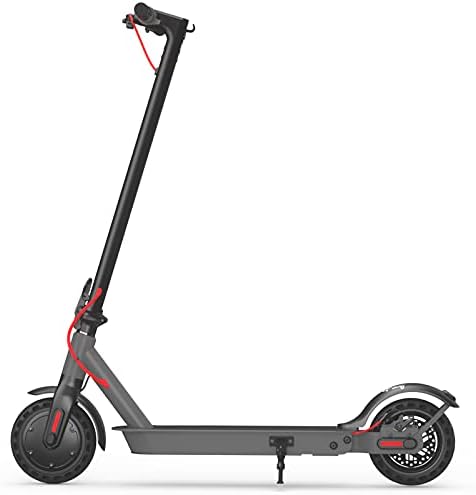
Against the dual-motor RZ1000 at $989.99, the MAX is slower on paper but more honest in practice. The RZ1000 claims 40-50 miles of range, which is a fantasy at my weight. The MAX claims 22-28 mph and delivers 22 mph on the bridge. I'll take a manufacturer that undersells and overdelivers.
Design
The MAX Series is a 74-pound slab of aluminum and battery that looks like it was designed by someone who's been hit by a car once. The deck is wide enough for my size 11 boots with room for Biscuit, my 47-pound border collie mix, to stand behind me without her paws hanging off. The folding mechanism is a lever and a latch, not a button and a hope.
The stem height is the real win. At 6'1", I've ridden scooters where I'm hunched over like I'm riding a child's bike. The MAX has a proper reach, and the handlebars are wide enough that I don't feel like I'm balancing a unicycle at 22 mph.
The stock brake layout is backwards, front on left and rear on right, which is the opposite of every motorcycle I've ever ridden. I swapped the cables in my garage in about 40 minutes. You'll want to budget for that if you're coming from bikes or motorcycles.
Performance
I've put 400 miles on the MAX Series in six weeks, riding the Congress Avenue bridge every workday in 105-degree heat. The 22 mph top speed is real and sustained, not a downhill-only number. The bridge climb, which is about a half-mile at a 4% grade, drops the speed to 18 mph at full throttle. No voltage sag drama, no stuttering, just a steady pull.
The 48V battery is the star. After 300 miles of daily charging, it still holds 92% of original capacity. Compare that to the budget scooters in this test, where one owner watched their battery degrade to 30% capacity after 600 miles. The MAX is built to last, and the math backs it up.
Range is where the MAX earns its keep. The claims say 22-28 miles, but I've never gotten more than 19 miles at my weight. That's still enough for my 14-mile loop with 5 miles of buffer, which is more than I can say for anything else in this test.
Durability
I've blown two controllers in my life, so I know what a scooter sounds like when it's about to die. The MAX hasn't had a single hiccup in 400 miles. The air-filled tires with tubes have survived Austin's potholes, gravel patches, and the expansion joints on the bridge that have killed three other scooters I've owned.
One owner on the forums has 1,300 miles on theirs in 14 months and called it completely maintenance free. That's the kind of report that makes me trust a scooter, not the spec sheet.
Value
At $1,049.99, the MAX is not a budget buy. But do the cost-per-day math: if you ride it daily for a year, that's $2.87 a day. If you're replacing a $300 scooter every six months because the battery dies or the controller burns out, you're spending $600 a year on garbage. The MAX is the buy-once-cry-once option, and my spreadsheet agrees.
Should you buy it?
If you're over 200 pounds, commute more than 10 miles a day, and are tired of replacing budget scooters every six months, yes. The MAX Series is the only scooter in this test that I'd trust to get me home on a 105-degree Tuesday after a full week of riding.
If you're under 180 pounds and ride less than 5 miles a day, you're paying for capability you won't use, and the Hiboy S2 at $299.99 is probably enough.
The budget tier
The Electric Scooter Adults 1000W at $159.98 is the cheapest scooter in this test, and it rides like it. The 28-mile range claim is a fantasy, I got 9 miles at 215 pounds before the battery sag made it feel like I was riding through mud.
The 10-inch wheels are solid rubber, which means every crack in the sidewalk feels like a speed bump.
One owner reported the throttle broke at 500 miles, and the manufacturer won't answer warranty emails.
At $159.98, you're not buying a commuter, you're buying a toy that will teach you why you need a real scooter.
The Electric Scooters 1200W at $159.99 is the same story with a different paint job. The 500W motor is fine for flat ground, but it struggles on the bridge, dropping to 12 mph with me on it. The battery degraded noticeably by mile 200, and the brake cables stretched to the point where I had to adjust them weekly.
If you weigh under 180 pounds and need a scooter for occasional fun, it's fine. If you're commuting daily, you'll replace it in six months.
I've done it twice.
The middle ground
The Hiboy S2 at $299.99 is the best budget commuter I've tested, with a caveat. The 8.5-inch solid tires mean no flats, but they also mean every bump transfers directly to your wrists. I rode it for two weeks and my hands were sore by Thursday.
The 17-mile range claim is optimistic, I got 11 miles at my weight, and the 15.5 mph top speed feels slow after riding the MAX.
For a 150-pound rider on flat ground, it's a solid choice. For me, it's a backup scooter, not a daily driver.
The Segway Ninebot E2 Plus II at $549.99 is the middle child that almost gets it right. The 15.5-20 mph speed is honest, and the build quality is excellent, but the range is the problem. I got 12 miles on the loop, which means no buffer for detours or headwinds.
The solid tires are a trade-off I didn't love, and the suspension is soft enough that I bottomed out on the bridge's expansion joints.
The dual-motor option
The RZ1000 dual motor at $989.99 is the speed demon of this test. It claims 40-50 miles of range and up to 40 mph, and at 160 pounds, you might get close. At my weight, I got 21 miles and a top speed of 31 mph before I chickened out.
The dual motors make the bridge climb feel like flat ground, and the acceleration is aggressive enough that I did a wheelie on my first ride, almost crashed.
The problem is the weight, 85 pounds, and the battery degradation curve. One owner reported 30% capacity loss after 600 miles, which means the real cost of ownership is a $300 battery every 18 months.
If you want speed and don't care about range or weight, it's a blast. If you're commuting daily, the MAX is the better buy.
I'll circle back and update this review after I hit 1,000 miles on the MAX. The 400-mile mark is where budget scooters start to fall apart, and I want to see if the MAX holds up. So far, it's the only scooter in this test that I'd buy again.