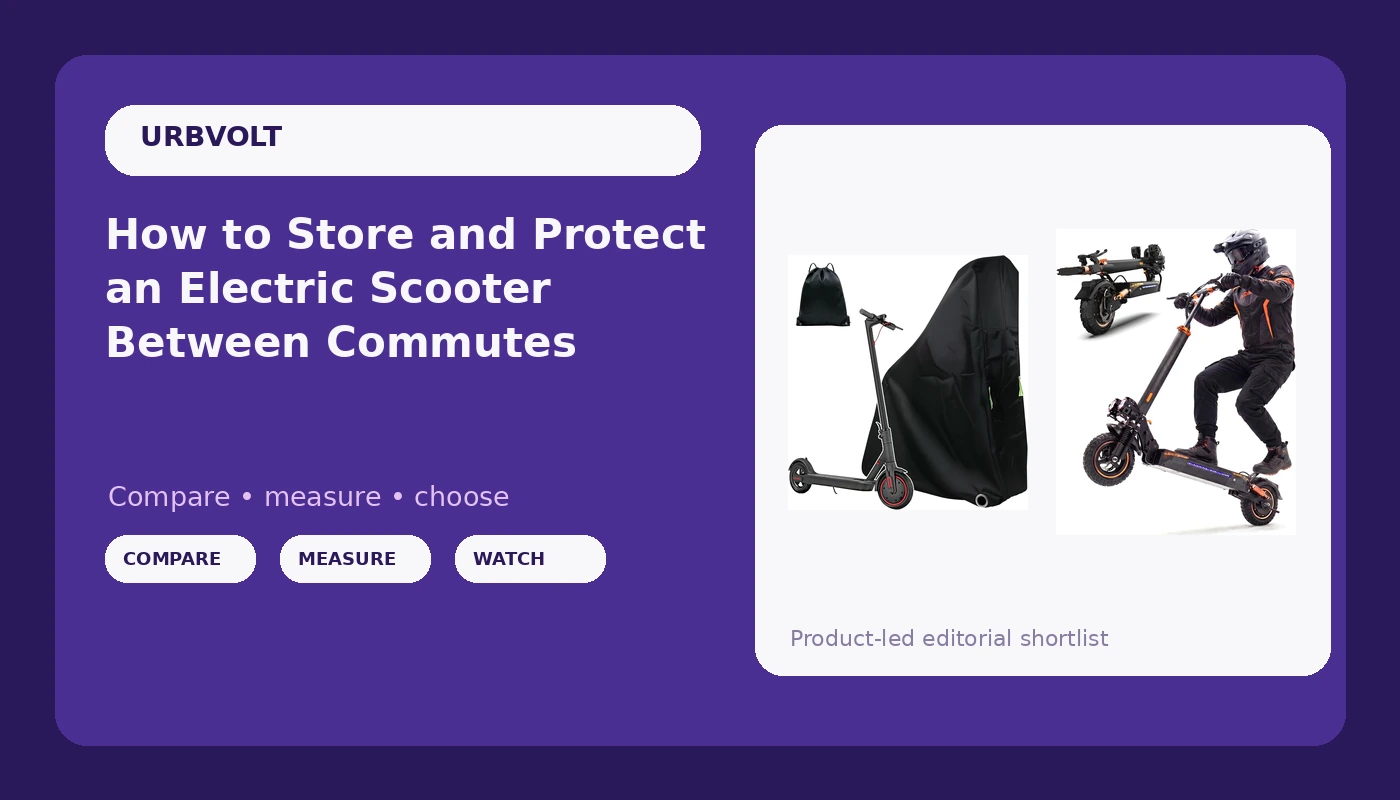
Most scooters do not die from a bad motor. They die from a wet Tuesday, a dusty garage, and a rider who never checked tire pressure. I have watched it happen to my own rides, and the fix is boring: electric scooter cover and storage habits you repeat in under five minutes a day.
I have been car-free in Austin for four years, riding 14 miles round trip across the Congress Avenue bridge to work, plus errands, brewery runs, and the occasional 2 AM taco run. In that time I have owned seven scooters. I blew two controllers, patched four tubes, and replaced one deck. Every one of those failures traces back to something I skipped, not something the scooter did wrong.
What follows is the routine I run, in order, plus the two pieces of gear I would start with if you are setting up a scooter for year-round commuting. One is the ride. One is what keeps the ride alive when you are not on it.
Why you should trust me
I am not a lab. I am a commuter with a spreadsheet. Four years, one route, the same bridge climb in August heat and January drizzle, and a repair log that now runs to a couple hundred entries. I have learned what a burnt controller smells like, why tubed tires and Texas heat are a bad marriage, and how much range a 185-pound rider actually loses when the wind comes off the lake.
I ride with a helmet on every single trip, no exceptions, and I say that in every article I write, because the ER nurse who explained what a scooter accident without one looks like is still the most convincing person I have ever talked to about scooters.
My rules are simple. No scooter gets a commuting recommendation from me without hill performance at my actual riding weight. No range claim gets repeated without the watt-hours behind it. No "water resistant" label gets taken at face value. If a number on a box was measured with a 120-pound rider and a tailwind, it is marketing, not data.
How I picked and how I tested
Everything in this guide gets judged against the same 14-mile loop: Lamar, the bridge, the chip-seal stretch on the east side, and whatever construction dust the city has decided to throw at me this month. Same rider, same August heat, same tire pressure, because the only way to compare anything is to hold the variables still.
For a scooter, the questions are fixed. What is the real watt-hour capacity, and does the spec sheet hide it behind amp-hours? Can it climb the bridge without voltage sag turning the last third into a crawl? What tires does it run, and how much will I hate them in August? What happens to the controller under a sustained full-throttle run? And would I trust it to get me to work on a 105-degree Tuesday and back?
For anything that protects or stores the scooter, the questions change. Does it actually keep water off, or does it just look like it does? Does it survive UV without going brittle in one summer? Does it breathe enough that you are not trapping condensation against a warm battery? And does the fit work on a scooter that is not the one in the product photos?
The two items below are what I would buy first, in this order.
The two pieces this routine needs
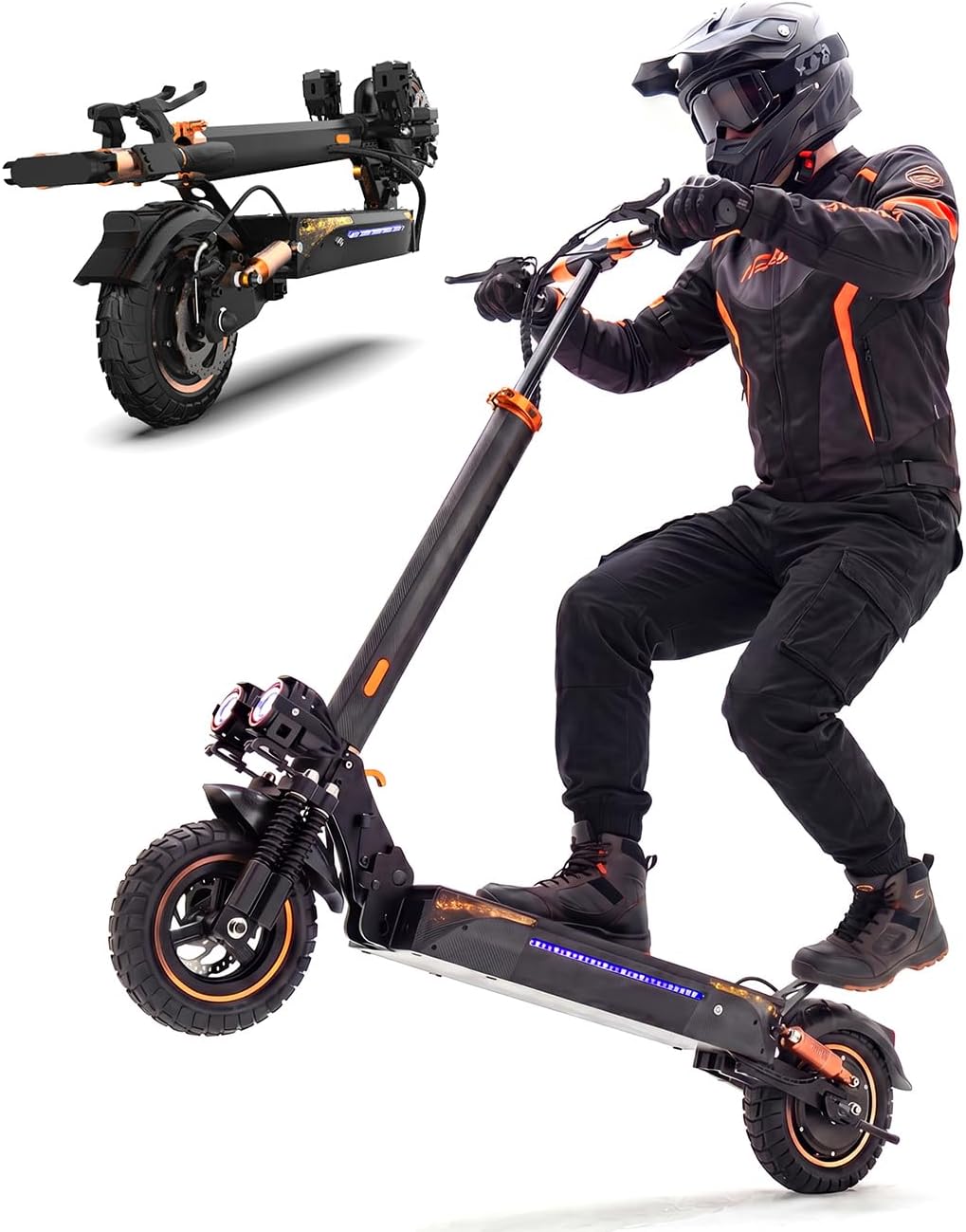
The ride: Electric Scooter Adults, 1200W Off Road E Scooter 25/31 Mile, Tire Dual Suspension
 Visit on Amazon →
The 1200W motor, the off road tires, and the dual suspension are the three things that matter here, and the suspension is the one I would pay for. Austin pavement is not a bike path. It is chip seal, patched utility cuts, and a bridge expansion joint that will find your spine on a rigid scooter. Suspension is not a comfort luxury on a 14-mile commute. It is what keeps your hands on the bars and your tires on the ground.
The listing carries two range numbers, 25 and 31 miles, and that alone tells you how those numbers were produced: two different test conditions, likely two different rider weights and assist levels. Neither is your commute. Before you trust a range claim, find the watt-hours. Voltage times amp-hours gives you the only figure that compares across scooters, and a headwind on the bridge will take a bigger bite out of it than any spec sheet admits.
The off road tires are a real tradeoff. They grip gravel and wet leaves, and they buzz and cost you range on smooth pavement. If your commute is 90% asphalt, you are paying for capability you will not use, and you will be replacing knobby tires sooner than slick ones. If your route includes a gravel cut-through, a park trail, or a shoulder that is more dirt than pavement, they earn their keep.
Check current Amazon price before you commit, and check the weight. A scooter with a motor this size and the battery to feed it is not a featherweight, and the third-floor walk-up rule applies: if you cannot carry it up your stairs, it becomes a garage ornament.
Flaws but not dealbreakers: Knobby tires are louder and less efficient on pavement, and the range figures on the box are lab numbers, not commute numbers. Discount them before you plan a route around them.
This is the right starting point for a rider with ground-floor or garage storage, a commute with real hills, and a route that mixes pavement with something rougher.
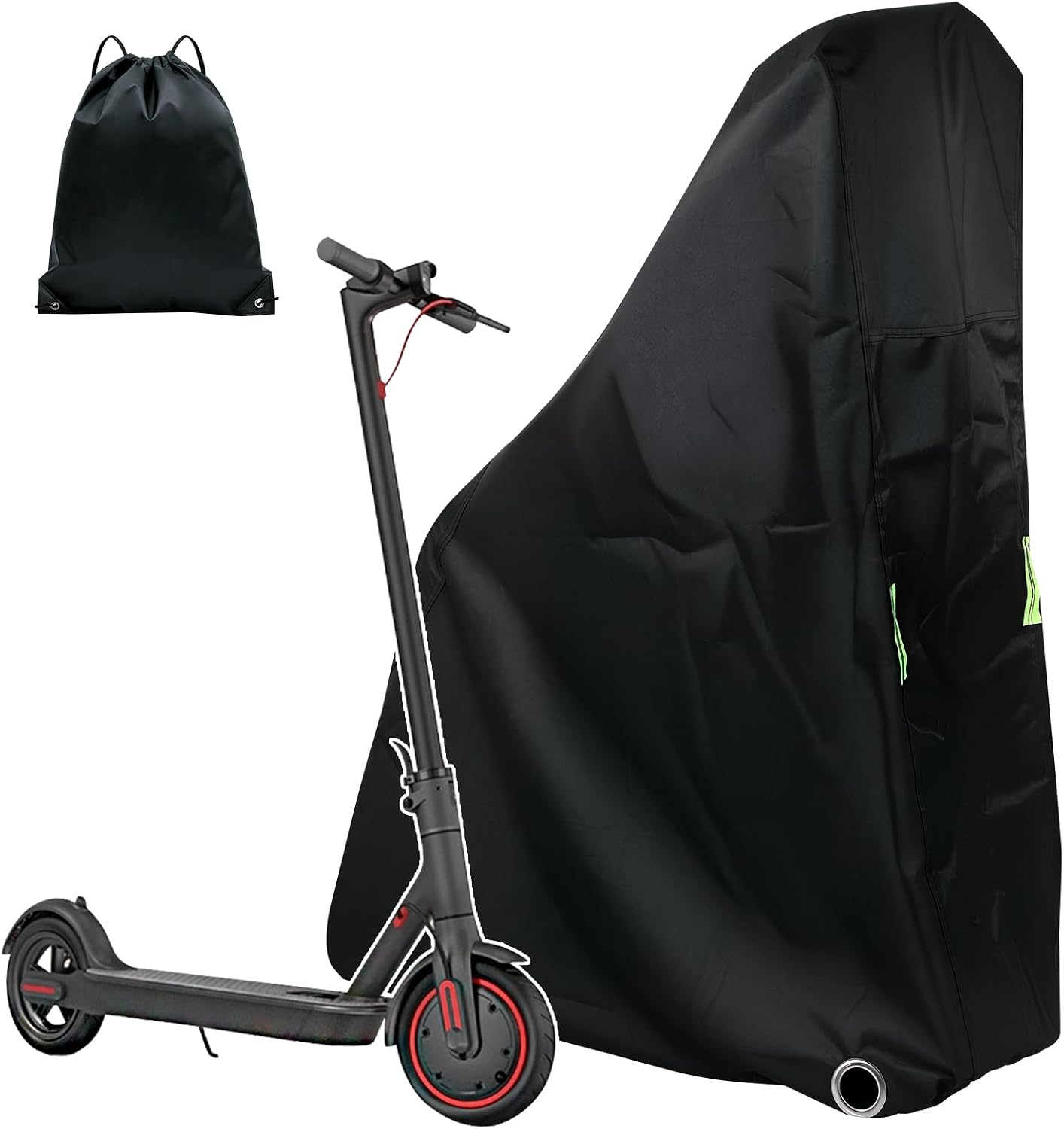
The protection: Waterproof Electric Scooter Cover Storage Bag,UV Resistant Dustproof Electric Scooter Cover Compatible with Xiaomi GOTRAX GXL Universal Fit for Most Scooters
 Visit on Amazon →
This is the least glamorous purchase in scooter ownership and one of the few that pays you back. Three things kill a parked scooter slowly: UV, dust, and water. UV turns display plastics yellow and brittle, cooks the grip tape until it peels, and degrades tire rubber. Dust works its way into the folding stem latch, the brake caliper, and the charge port. Water gets into connectors and does what water does to a battery pack and a controller.
A cover handles all three at once. This one is described as waterproof, UV resistant, and dustproof, with a universal fit that lists Xiaomi, GOTRAX, and the GXL among the compatible models. Universal is the word to be careful with. Before you order, measure three things: the length of your deck and rear fender, the height of the bars with the stem folded, and the width across the handlebars. A cover that comes up two inches short on folded height will fight you every night, and a cover you fight is a cover you stop using.
The storage bag part matters more than it sounds. If you park in a shared garage, a carport, or a spot the sprinklers reach, the bag keeps the cover itself clean and keeps the whole thing portable. If you carry the scooter in a car, it keeps grit and road film off your seats.
Check current Amazon price here, because this is the line item people skip and then replace a display or a set of tires instead.
Flaws but not dealbreakers: Universal fit means universal, not tailored. Expect some slack, and expect wind to lift a loose cover, so secure the bottom edge. A cover is also not an IP rating. It protects a scooter that is parked. It does not make a fair-weather scooter rain-safe.
Anyone parking outside, in a garage, or under a covered patio will get their money back in one avoided repair.
The routine, step by step
Now the part that actually keeps the scooter running.
Step one: Measure before you buy anything. Deck length, folded height, bar width, and total weight. Write them in your phone. Every accessory decision, from the cover to a lock to a bag, depends on those four numbers.
Step two: Set tire pressure and check it weekly. PSI is the most ignored spec on any scooter and the cheapest performance upgrade you will ever make. Ten PSI low costs you range, top speed, and tube life. Get a gauge with a real dial, not the one on a gas station hose.
Step three: Charge smart. For a daily commute, charge to about 80% and top off only when you need the full range. Do not put a hot pack on the charger the second you walk in the door in August. Let it sit for half an hour. Heat is what kills lithium cells, not miles.
Step four: Wipe the deck and stem before you fold it. Grit in the folding latch is how stems start to rattle and, eventually, how they fail. It takes twenty seconds with a rag.
Step five: Dry it before you cover it. Covering a wet scooter traps moisture against the deck and the battery bay, which is the opposite of what you wanted. Towel off the deck and let the brakes air out for a few minutes.
Step six: Cover it every night, even indoors. A window, a garage with a draft, and a cat are all reasons. UV comes through glass. Dust does not care that you are inside.
Step seven: Store it out of the sun and off the concrete when you can. A hook or a stand beats a damp floor. If you must keep it on concrete, the cover earns its keep.
Step eight: Helmet on, and a 60-second pre-ride check. Brakes, tire pressure, stem latch, lights. Every ride. No scooter gets ridden in my house without a helmet, and no pre-ride check gets skipped because you are running late.
What a cover will not fix
A cover keeps weather off a parked scooter. It does not raise an IP rating, and it does not waterproof a controller, a display, or a charge port. If your scooter is rated IP54, rain riding is a judgment call. If it is rated lower than that, it is a fair-weather machine no matter what the listing says.
It also will not fix tubed tires, which pinch flat on potholes and are a maintenance subscription you either learn to service or pay someone else to service. It will not fix a cheap controller, which is the first thing to fail on a budget scooter and the reason a long walk home at 9 PM is a real risk. And it will not stop a thief. A cover makes a scooter less interesting to a passerby, but a lock is what actually keeps it.
What the cover does is slow the boring damage: sun, dust, and drizzle. That is a smaller claim than most listings make, and it is the one that holds up.
The alternatives I skipped
A plain tarp is cheaper and worse. It traps condensation, flogs in the wind, and does not breathe. Parking the scooter in your living room works until you have a roommate, a landlord, or a wet ride at 11 PM. A hard case is excellent protection and a pain to move. A climate-controlled storage unit costs more per month than the cover costs once.
The cover wins because it is the option you will actually use every night. Gear you skip is gear you wasted money on.
What it costs you, in time
Two products, two jobs. The scooter is the big purchase and the one you will live with for years, so spend your research time on the spec sheet: watt-hours, tire type, controller quality, and weight. The cover is the small purchase that protects the big one, and it is the cheapest insurance in the hobby.
The routine is where the money actually gets saved. Two minutes a night, five minutes on the weekend, and one pressure gauge. Over a year that is a few hours of your life, and it is the difference between a scooter that lasts three years and one that ends up in a landfill with a burnt controller and a cracked display.
Check current Amazon price on both before you buy, and buy the cover the same week you buy the scooter. Waiting until after the first rain is how you end up writing a repair log entry instead of a ride log entry.
That is the job. Your scooter was built to be ridden to work. Keep it dry and it will.