Range is the first number anyone reads on a scooter listing and the number that survives real life least often. A spec sheet can promise 22 miles, and the same scooter can deliver something closer to half that on a windy morning with a bridge in the way, and both numbers can be technically honest. Range is not a fixed property of a scooter. It is the result of rider weight, hills, wind, temperature, tire pressure, speed, and how hard the controller is being asked to work at any given moment.
So if you want to extend electric scooter range, the useful question is not which listing prints the biggest number. It is where the energy actually goes, and which of the fixes available to a normal rider are worth paying for. Some of them are free. Some of them are hardware. And one of them, buying a bigger scooter than you need, is the most expensive way to solve a problem that tire pressure and throttle discipline often solve first.
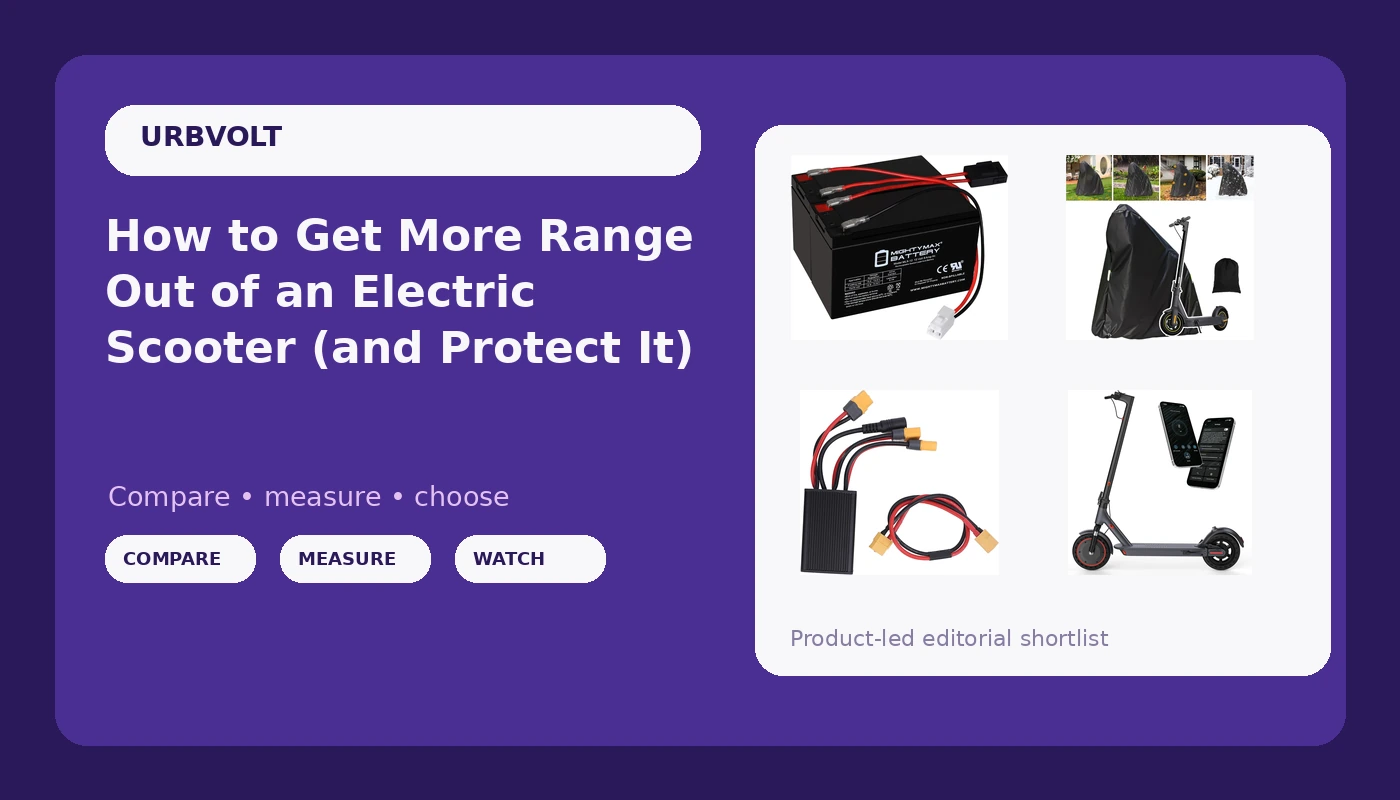
This guide covers the realistic options: a complete commuter scooter, a replacement battery for a ride-on toy that has lost capacity, a cover that protects the pack from weather, and a dual battery module for riders who want to add capacity to a scooter they already own.
Related: How Tire Pressure Changes Electric Scooter Range →
Quick answer
The cheapest way to extend electric scooter range is to fix the variables you already control: pump the tires to the pressure printed on the sidewall, ride at a steady cruising speed instead of full throttle, and charge in a cool place rather than a hot garage. Hardware comes second. A parallel battery module adds capacity to a scooter you already own, a replacement pack restores capacity a worn battery has lost, and a cover protects the pack and electronics when the scooter lives outside. None of those upgrades will rescue a scooter whose battery is simply too small for the length of your ride.
Four useful options
| Model | Best fit | What stands out |
|---|---|---|
| Maxshot Electric Scooter for Adults | Riders who want one complete, ready-to-ride commuter scooter | 500W motor, 10 inch solid tires, dual braking, dual suspension, foldable frame with an app |
| Mighty Max Battery 9ah kit and harness | Owners replacing a worn battery in a 12V Razor ride-on toy | 12V 9Ah drop-in replacement supplied as a kit with a harness |
| Electric Scooter Cover | Anyone parking a scooter outside or in an unheated garage | Universal fit with waterproof and sun protection |
| Double Battery Parallel Module | Riders adding a second pack to an existing scooter or e-bike | Dual battery support with a discharge switch rated 20-72V at 40A |
The complete scooter: Maxshot Electric Scooter for Adults
The trade-off to understand here is the tire choice. Solid tires are the reason a scooter like this can be marketed to commuters who do not want to patch tubes in August heat, and that is a genuine benefit: no pinch flats, no slow leaks, no spare tube in your bag. The cost is ride quality and rolling resistance. Solid rubber does not deform around road texture the way air does, so more of the road comes through the deck, and a firmer tire generally takes slightly more energy to roll. Dual suspension is the manufacturer's answer to that, and it is a reasonable one, but it does not make a solid tire feel like a pneumatic one.
The range claim deserves the same skepticism you would apply to any listing. A 22 mile figure is typically produced with a lighter rider, warm battery, flat route, and moderate speed. Heavier riders, hills, cold mornings, and full throttle all pull that number down. Treat the claim as an upper bound for ideal conditions rather than a promise, and measure your own commute over a couple of weeks before deciding whether the capacity is enough.
The replacement pack: Mighty Max Battery Extended Range Drop in Replacement for 12v Razor Scooter Ride on Toy 9ah Battery kit and Harness
This is a different kind of range fix, and it is worth being precise about what it is for. A ride-on toy that used to run for an hour and now runs for twenty minutes has not lost motor power. It has lost usable battery capacity, which is the normal fate of a lead-acid pack that has been charged and discharged a few hundred times, especially if it sat at full charge through a hot summer.
Replacing the pack restores the runtime the toy originally had. It does not add range beyond the original specification, and the capacity number is small in adult terms: 12V multiplied by 9Ah gives roughly 108 watt-hours, which is a fraction of what a commuter scooter carries. That is appropriate for a ride-on toy and not appropriate for an adult scooter, so this is not a shortcut to a longer commute. It is a repair part for a specific class of vehicle.
If you are replacing a pack like this, check the voltage and chemistry of the original before ordering, and treat the old pack as hazardous waste rather than household trash.
The storage protection: Electric Scooter Cover, Universal Scooter Cover, Waterproof Sun
A cover looks like an accessory, but it is really a range and reliability product. Heat is the enemy of lithium packs, and a scooter parked in direct Texas sun all afternoon sits in a greenhouse of its own making. UV breaks down rubber, plastic, and the seals that keep water out of a deck. Rain finds every gasket that was only rated for a drizzle.
Two honest limits. First, a cover is not a security device; it hides a scooter from weather, not from a thief with bolt cutters, and anything valuable should still be locked to something immovable. Second, a cover works best when the scooter is dry going in. Trapping moisture under waterproof fabric for weeks is worse than letting the scooter breathe in a shaded spot. Cover it dry, and let it air out after a wet ride.
The dual battery hardware: Double Battery Parallel Module
This is the piece that actually adds capacity rather than restoring it. In a parallel setup, two packs of the same voltage share the load, so amp-hours add while voltage stays the same. A 48V scooter with two matched 48V packs effectively doubles its watt-hours, and doubling watt-hours is the only honest way to double range.
The catch is that parallel battery wiring is not a place for improvisation. The packs need to match in voltage, chemistry, and ideally age and state of charge, because current will flow between them the moment they are connected. A mismatched pair can push current where it should not go, and the failure mode for a lithium pack is a fire, not a blown fuse. If you are not confident reading a wiring diagram and confirming your controller's voltage and current limits, this is a job for someone who is. Buy matched packs, charge them to the same level before the first connection, and respect the 40A discharge rating rather than assuming it is a suggestion.
Prices and availability may change. Product images, names, and retailer links are matched to verified listings. No current price, rating, stock status, or measured result is stated here without current evidence.
What actually determines electric scooter range
Watt-hours is the only battery number that lets you compare two scooters honestly. Multiply voltage by amp-hours and you get watt-hours, which is the actual size of the tank. A 36V 10Ah pack holds 360 watt-hours. A 48V 15Ah pack holds 720, roughly twice the energy, and no amount of marketing language about "extended range" changes that arithmetic. Amp-hours alone are marketing math, because 10Ah at 36V and 10Ah at 48V are very different amounts of energy.
From there, range is a budget. Rider weight is the biggest single variable, and it is why a 120 pound test rider and a 200 pound commuter get different results from the same scooter. Hills cost disproportionately more than flat distance, because climbing is work against gravity rather than just rolling resistance. Speed costs more than most riders expect, since aerodynamic drag rises with the square of velocity; going from 12 mph to 19 mph can cut range substantially even though the trip takes less time. Cold weather temporarily reduces usable capacity and increases internal resistance, which is why a pack that feels fine in April feels weak in January. Tire pressure matters more than people believe: a tire 10 PSI low has a bigger contact patch and more rolling resistance, and you pay for it in miles.
Voltage sag is the experience riders describe as "50 percent battery that rides like 20 percent." Under load, a pack's voltage drops, and a tired or cold pack drops further. The controller reads that lower voltage and reduces power, which is why the last third of a charge always feels slower than the first. A worn pack sags more, which is the real reason a two-year-old battery feels weaker even when it still charges to full.
How to plan a range upgrade without wasting money
- Measure your actual route first. Track distance, elevation change, and your real riding weight, then note where the battery percentage drops fastest. That tells you whether you have a capacity problem or a discipline problem.
- Calculate your watt-hours. Multiply the pack voltage by its amp-hour rating. If the manufacturer only lists amp-hours, find the voltage and do the multiplication yourself before comparing anything.
- Fix the free variables before buying hardware. Tire pressure at the sidewall spec, a steady cruising speed, a cool charging spot, and a properly inflated rider weight of gear all cost nothing and can recover a meaningful slice of range.
- Decide between restoring and adding. A replacement pack brings a degraded battery back to its original capacity. A parallel module adds a second pack on top of the first. Those solve different problems, and only one of them increases the ceiling.
- Match hardware to your system. Confirm your scooter's voltage and controller current limit before buying a parallel module, and confirm the original battery's voltage and chemistry before buying a replacement. A part that does not match is not a range upgrade, it is a paperweight.
Practical guidance for longer rides
- Check tire pressure weekly, not monthly. It is the single cheapest range fix available, and it also protects the tubes and the rims.
- Charge in a cool, dry place and avoid leaving a pack at 100 percent in a hot garage for weeks at a time.
- Cover a scooter that lives outside, but only after it has dried, and never treat a cover as a lock.
- When adding a second pack, use matched batteries at the same state of charge, and respect the discharge rating of the module and the controller.
- Wear a helmet on every ride. Range and speed discussions are meaningless if you are not around to enjoy the extra miles.
Which option should you choose?
Choose the Maxshot Electric Scooter for Adults when you do not own a scooter yet and want one complete, foldable commuter platform with the motor, tires, brakes, and suspension already specified, and you understand that its range claim is an ideal-condition figure. Choose the Mighty Max Battery Extended Range Drop in Replacement for 12v Razor Scooter Ride on Toy 9ah Battery kit and Harness when you are repairing a Razor ride-on toy whose original pack no longer holds a charge, and you have confirmed the original voltage and chemistry. Choose the Electric Scooter Cover, Universal Scooter Cover, Waterproof Sun when your scooter parks outside or in a garage that bakes in summer, and you want to slow down UV and water damage to the pack, seals, and rubber. Choose the Double Battery Parallel Module when you already own a scooter or e-bike you like and want to add capacity with a second matched pack, and you are prepared to verify voltage, current limits, and wiring before connecting anything.
The caveat that applies to all four: none of these products can be evaluated for your ride without knowing your route, your weight, and your climate. A 22 mile claim and a 14 mile commute are not the same conversation, and the only range number that matters is the one you measure yourself, on your route, in your weather, at your weight.
The bottom line
Extending electric scooter range is mostly an exercise in honesty about where the energy goes. Watt-hours set the ceiling, rider weight and hills and speed and temperature decide how much of that ceiling you actually reach, and tire pressure quietly taxes you every mile you ride underinflated. Hardware helps at the margins and sometimes a lot more than the margins: a parallel module genuinely adds capacity, a replacement pack genuinely restores it, and a cover genuinely slows the wear that degrades it. But the order matters. Fix the free variables first, measure your real route second, and buy hardware third, once you know exactly which problem you are solving.