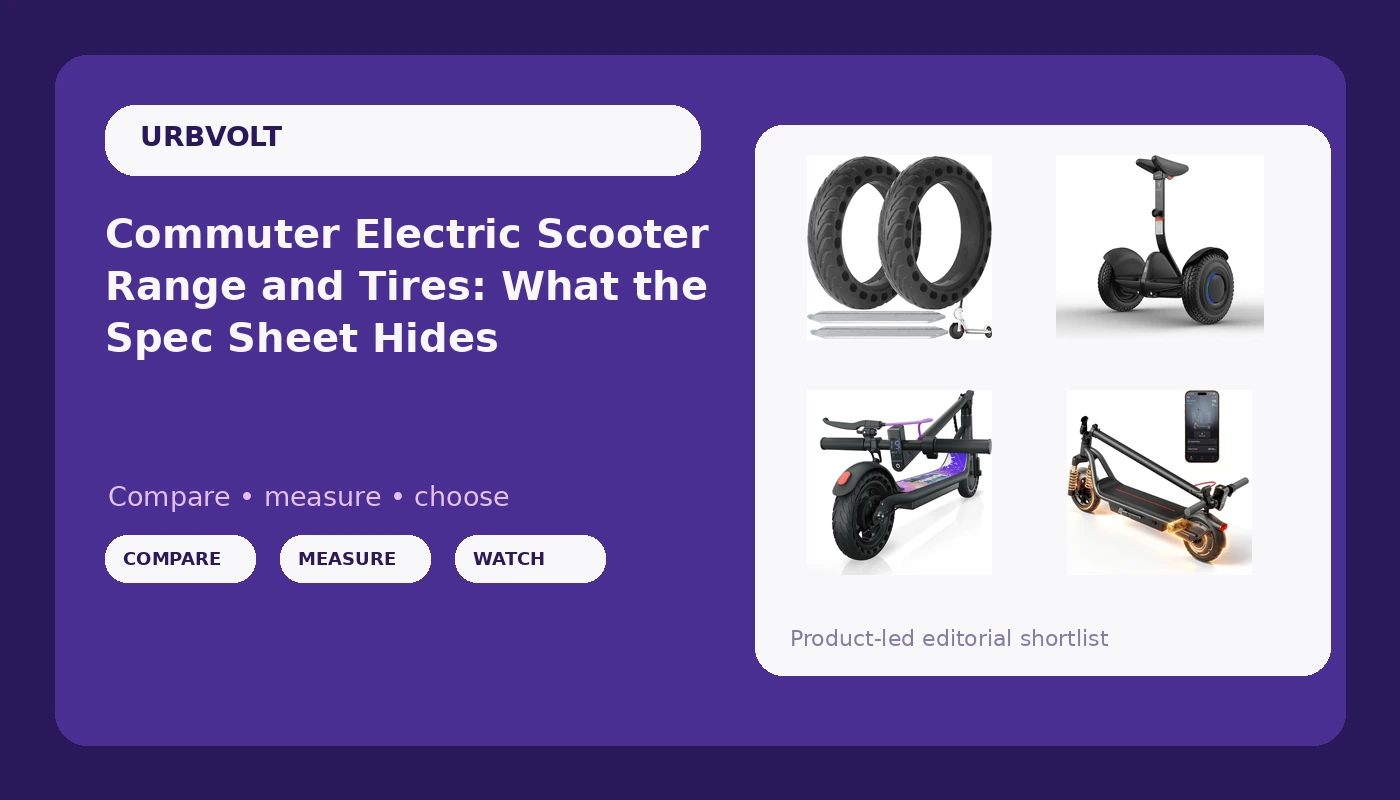
Most electric scooter commuter range claims are written for a 120 pound rider on flat ground with a fresh battery and no wind. Add a backpack, a bridge, August heat in Austin, and a rider who weighs more than the test dummy, and the number printed on the box stops meaning anything. If you are shopping for a scooter to genuinely replace car trips, the specs that matter are the boring ones: battery capacity in watt-hours, the tires you will live with, the brakes, and how much the thing weighs when you carry it up three flights of stairs. This guide walks through what four current listings actually tell you, what they leave out, and how to compare them without a showroom test ride.
Related: How to Check Scooter Tire Pressure and Avoid Pinch Flats →
Quick answer
There is no single best commuter scooter, and anyone who says otherwise is selling something. Match the machine to the ride. If your commute is long, hilly, or you weigh more than the lab-test rider, battery capacity in watt-hours and tire construction matter far more than a top speed claim. If your commute is short and multimodal, a folding frame matters more than range. The AR-PRO solid tires solve one specific problem, repeated flats on compatible 8.5 inch scooters, and create another, a firmer ride with less grip in the wet. The Segway Ninebot S2 is a self-balancing platform with 10 inch tubeless tires, which is a different category from a folding commuter with a handlebar. Check watt-hours, tire type, brake type, and carry weight before you check anything else.
4 useful options
| Model | Best fit | What stands out |
|---|---|---|
| Electric Scooter | 28/19Miles Range | Up to 20MPH | 550W/500W Motor | Riders who want published range, speed, and motor figures to compare | Listing states a 28/19 mile range, up to 20 MPH, and a 550W/500W motor |
| AR-PRO (2-Pack) 8.5" Electric Scooter Solid Tires, 8 1/2 x 2 Scooter Replacement Tires, Compatible for Gotrax Gxl V2/Gotrax XR/Xiaomi M365/Pro Electric Scooter Tire | Owners of compatible scooters who are tired of patching tubes | Two solid rubber tires, 8 1/2 x 2, listing names Gotrax GXL V2, Gotrax XR, Xiaomi M365 and M365 Pro |
| Segway Ninebot S2 Electric Self-Balancing Scooter, 10-Inch Tubeless Tires | Riders who want a hands-free, self-balancing platform | Self-balancing design with 10 inch tubeless tires |
| Aovowheel Electric Scooter for Adults, Folding E Scooter Commuting Scooters | Short, mixed-mode trips where folding matters | Folding frame built for adult commuting |
The advertised-range commuter: Electric Scooter | 28/19Miles Range | Up to 20MPH | 550W/500W Motor
Dual range figures like 28/19 almost always mean two riding modes, usually a slow eco mode and a faster one, tested separately. That is not dishonest, it is just incomplete. Ask for the watt-hour figure, which is volts multiplied by amp-hours. A 36V pack with 10Ah is 360 Wh. A 48V pack with 15Ah is 720 Wh. Two scooters can advertise similar miles with batteries that differ by a factor of two, and the smaller pack is the one that sags on the bridge climb in the second half of your ride.
The flat-proof fix: AR-PRO (2-Pack) 8.5" Electric Scooter Solid Tires, 8 1/2 x 2 Scooter Replacement Tires, Compatible for Gotrax Gxl V2/Gotrax XR/Xiaomi M365/Pro Electric Scooter Tire
The trade-off is real and worth stating plainly. Solid rubber has less give than air, so expansion joints, chip seal, and brick streets come straight through the deck to your knees. Grip in the rain is generally lower than a pneumatic tire, and fitting solid tires is a job, especially on a motor wheel where you have a cable to route and a split rim to wrestle. Confirm the stated compatibility against your exact model and wheel position before ordering, because an 8 1/2 x 2 tire on the wrong hub is a very annoying paperweight.
The self-balancing option: Segway Ninebot S2 Electric Self-Balancing Scooter, 10-Inch Tubeless Tires
If you are replacing a car commute, be honest about what a self-balancing platform is for. It is excellent for short, smooth, last-mile hops and genuinely fun, but it is not a 14 mile bridge commute with a laptop on your back, and local rules about where self-balancing devices may ride vary by city. The tubeless 10 inch tires are the practical advantage here, since larger air volume and pluggable punctures reduce the maintenance tax that small tubed tires impose. Helmet, always, and not the decorative kind.
The folding commuter: Aovowheel Electric Scooter for Adults, Folding E Scooter Commuting Scooters
Every hinge is a wear point. Check the latch for play when the scooter is folded and unfolded, keep grit out of the mechanism, and accept that a folding stem is one more thing to inspect monthly. Before buying, pull the full spec sheet and confirm the watt-hour figure, the tire size and type, the brake type, the payload rating, and the folded dimensions, because the listing name alone will not tell you whether it fits your trunk or your stairwell.
Prices and availability may change. Product images, names, and retailer links are matched to verified listings. No current price, rating, stock status, or measured result is stated here without current evidence.
Watt-hours, not miles, is the number to compare
Ampere-hours on their own are marketing math, because Ah without voltage tells you nothing about stored energy. Watt-hours do: multiply volts by amp-hours. A 36V, 7.8Ah pack is about 281 Wh. A 48V, 13Ah pack is about 624 Wh. That difference is roughly the difference between a scooter that limps home on the last mile and one that still has margin when you hit the bridge.
Real range then gets adjusted by everything the lab ignored. Rider weight is the biggest variable, since every extra pound costs energy on every climb. Temperature matters, because cold cells sag and a hot pack in August will throttle itself to protect the cells. Tire pressure matters more than most riders believe: 10 PSI low on a small tire costs you range, speed, and tube life at the same time. Hills matter, and so does how you ride, because a rider who uses throttle only is pulling far more current than one who pedals off the line and cruises.
The battery management system is the other hidden spec. It balances the cells and keeps them from becoming a fire story, and it is exactly where cheap scooters cut corners. An IP rating tells you how much rain the electronics will tolerate. IP54 is rain-safe-ish. Anything unrated is a fair-weather toy, no matter what the photos suggest.
Tires and the maintenance subscription
Scooter tires come in three flavors and each one costs you something different. Tubed pneumatic tires ride well and grip well, but they pinch flat on potholes and they lose air slowly enough that you will not notice until the ride feels wrong. Tubeless pneumatic tires ride well, grip well, and can usually be plugged at the roadside instead of requiring the wheel to come apart. Solid rubber tires cannot go flat at all, at the cost of a firmer ride, generally lower wet grip, and a genuinely unpleasant installation.
Size matters too. An 8.5 inch tire has less air volume and less rollover ability than a 10 inch tire, so it transmits more of the road and is more likely to pinch. Whatever you ride, check pressure weekly, because that single habit prevents more flats than any upgrade.
- Measure your actual one-way commute and note the biggest hill and whether you can charge at work.
- Find the watt-hour figure by multiplying listed volts by listed amp-hours, and compare it against a pack you already trust.
- Identify tire size and type, then decide honestly whether you will maintain tubes or want solid rubber.
- Add your body weight to your bag and laptop, and check that against the listed payload and carry weight.
- Confirm brakes, IP rating, and the return window, then test the hill before you commit to the purchase.
Practical guidance before you buy
- Wear a helmet on every ride, including the two minute test loop in the parking lot.
- Check tire pressure weekly, and keep a pump with a gauge where you park the scooter.
- Charge indoors at room temperature and avoid charging a hot pack straight off a summer ride.
- Ride your actual commute route before buying if you can borrow a scooter, because a hill tells you more than a spec sheet.
- Treat a hot deck, a burnt smell, or a controller that cuts out under load as a stop-riding signal, not a quirk.
Which option should you choose?
Choose the Electric Scooter | 28/19Miles Range | Up to 20MPH | 550W/500W Motor when you want a listing that publishes range, speed, and motor figures you can compare, and you are prepared to verify the watt-hours behind the range claim. Choose the AR-PRO (2-Pack) 8.5" Electric Scooter Solid Tires, 8 1/2 x 2 Scooter Replacement Tires, Compatible for Gotrax Gxl V2/Gotrax XR/Xiaomi M365/Pro Electric Scooter Tire when you already own a compatible Gotrax or Xiaomi scooter and recurring flats are what is ruining your commute. Choose the Segway Ninebot S2 Electric Self-Balancing Scooter, 10-Inch Tubeless Tires when you want a hands-free platform for short, smooth trips and you accept that it is not a folding handlebar commuter. Choose the Aovowheel Electric Scooter for Adults, Folding E Scooter Commuting Scooters when folding and a low entry point matter more to you than published range figures.
None of these listings states a watt-hour figure, a weight, a brake type, or an IP rating in its name, and those are the details that decide whether a scooter survives a real commute. Confirm them on the product page before you buy.
The bottom line
Range claims are the least useful number on a scooter box and the easiest one to market. Watt-hours, tire construction, brake type, and carry weight are the four specs that determine whether the machine gets you to work on a 105 degree Tuesday and back. Buy for the commute you actually ride, not the one in the advertisement, and budget for the maintenance that comes with small tires. If your current scooter is eating tubes, the solid tire two-pack is the cheapest fix on this list. If you are buying new, decide first whether you need a folding frame, a hands-free platform, or a straightforward commuter, then check the watt-hours behind whatever range number caught your eye.