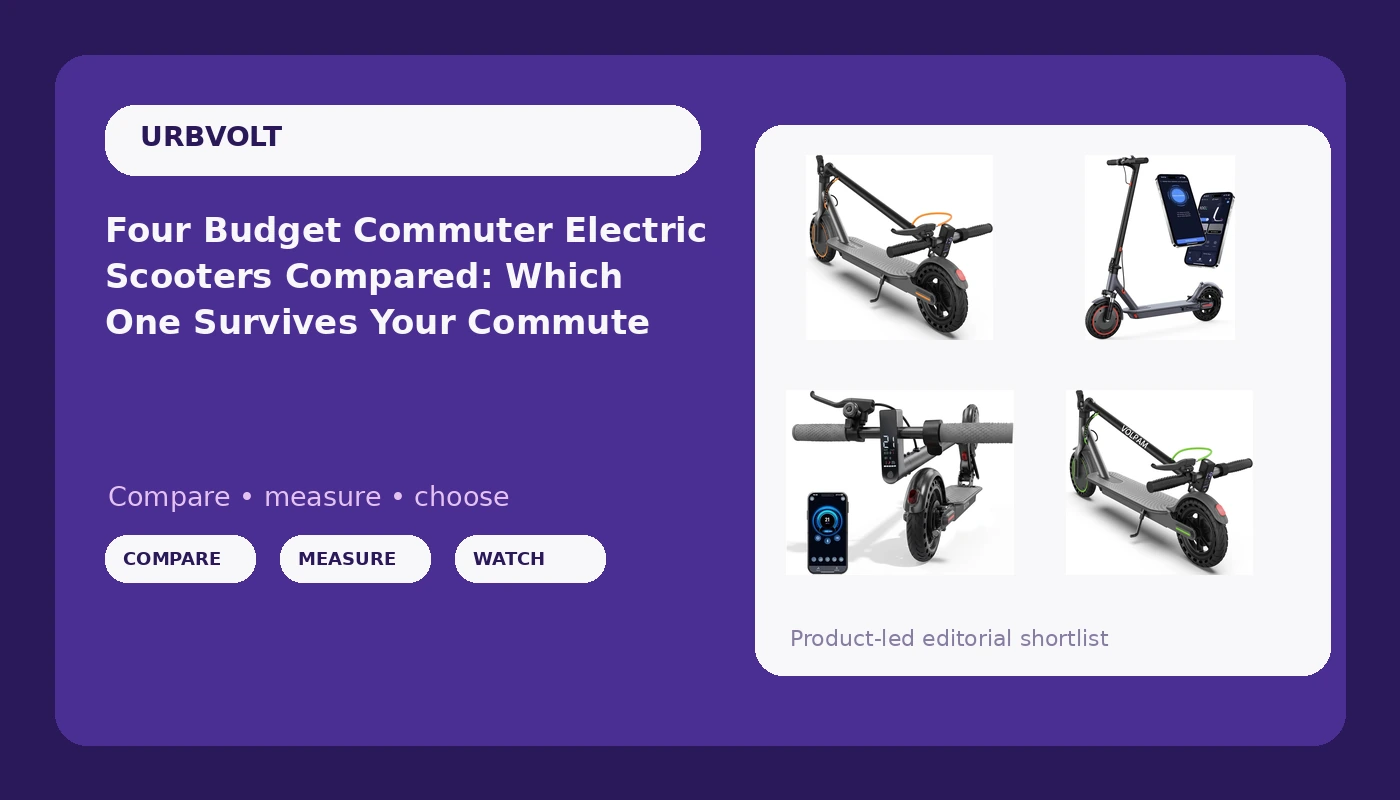
I ride 14 miles round trip to work, across the Congress Avenue bridge, in Austin heat that makes asphalt soft by 9 a.m. I have owned seven scooters in four years, blown two controllers, patched four tubes, and kept a spreadsheet of every range claim a manufacturer told me that turned out to be fiction. So when four sub-$200 electric scooters show up in the same search results with 350W/500W motors and three different range numbers, I do not read the marketing copy. I read the spec sheet, and then I ask what happens on the bridge at 185 lb.
This commuter electric scooter comparison covers the four listings below: three VOLPAM models that share a motor rating and a naming scheme, plus one 1000W outlier with app control and a larger front tire. I have not put a watt meter on these four, and I am not going to pretend I have. What I can do is tell you what the numbers in these listings mean, which ones are marketing math, and which of the four I would actually want under me at 7 a.m. on a Tuesday in October.
The short answer: the 1000W listing with the 10-inch front tire and dual brakes is the one that reads like a different machine, and the two identically named VOLPAM listings are the ones you need to slow down and read twice, because they may be the same scooter wearing two different product pages.
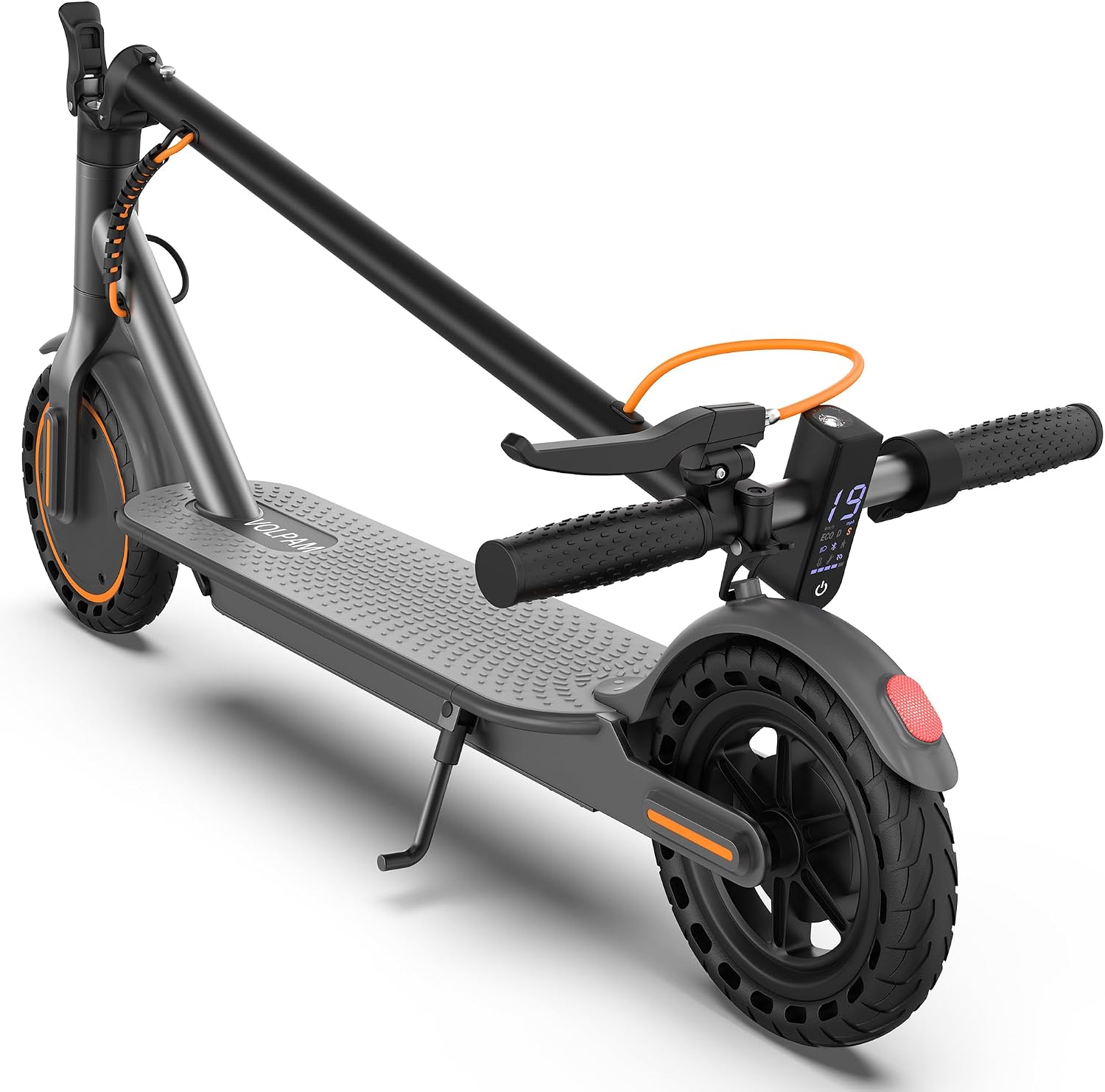
VOLPAM Electric Scooter, 350W/500W Motor, 21/28/40 Miles Long Range
Longest claimed range of the group, with three range tiers to choose from
That 40 mile figure is a lab number, and the listing bundles several very different batteries
VOLPAM Electric Scooter, 350W/500W Motor, Long Range 15/17/21/28Miles, 19 Mph Top Speed
States its 19 mph top speed plainly and offers four range tiers
Smallest range claims in the group, and the cheapest tier will feel slow on a long commute
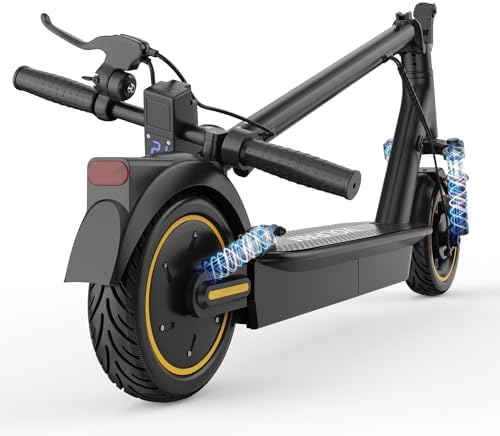
Electric Scooter, 1000W/500W Motor, 10''/8.5'' Tires, 28/23/21 Miles, APP Control, Dual Brake
1000W peak power, a 10-inch front tire, dual brakes, and app control
The heaviest and most complicated option here, and complication is not free
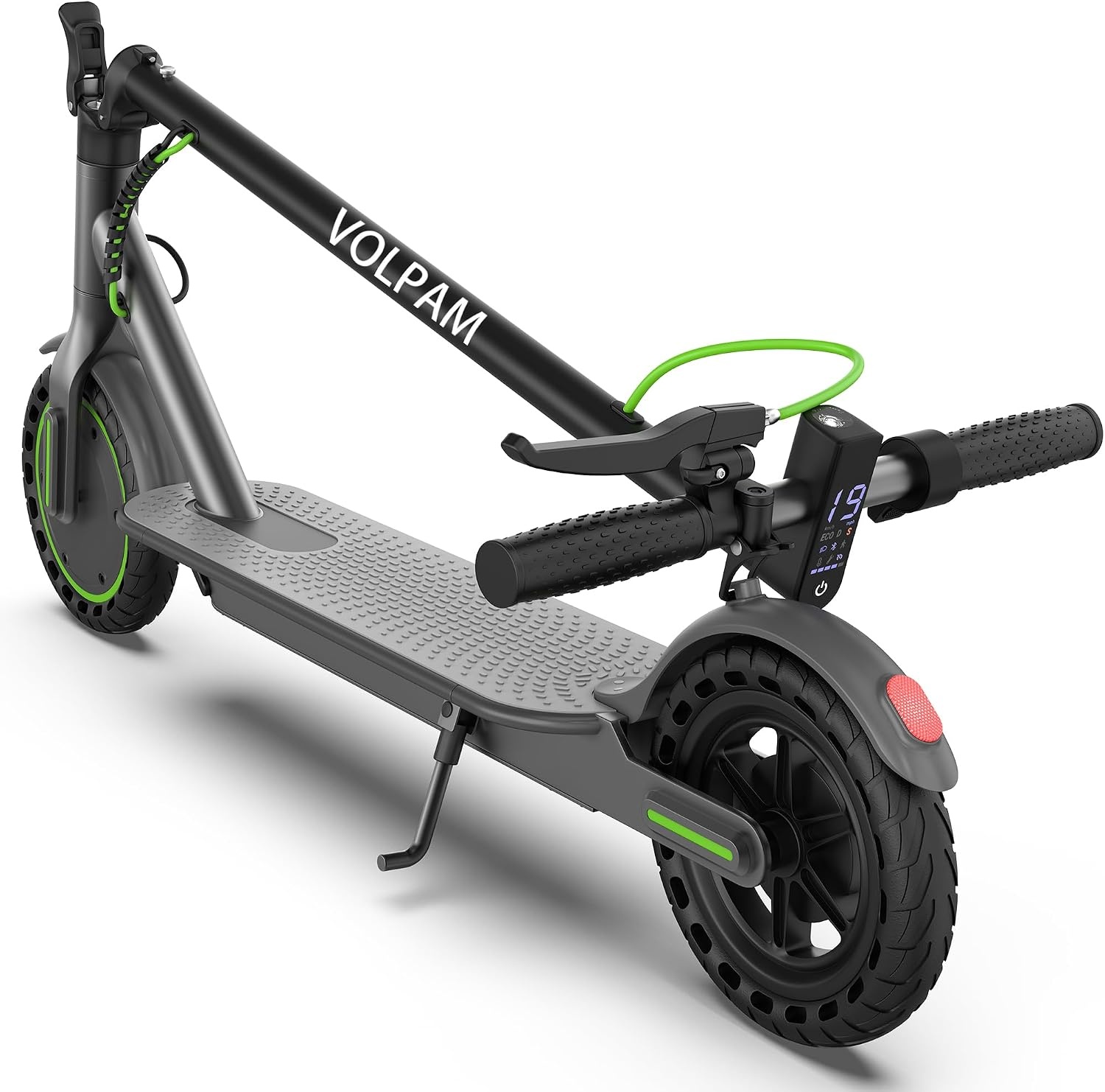
VOLPAM Electric Scooter, 350W/500W Motor, Long Range 15/17/21/28Miles, 19 Mph Top Speed
Identical spec sheet to the other 19 mph VOLPAM, so the two are directly comparable
A near-duplicate listing, which makes the comparison harder than it should be
Prices and availability were captured from Amazon Creators API and may change.
How I read a scooter listing
There are four questions I ask of any scooter before I care how fast it goes. What is the real battery capacity in watt-hours? What tires does it ride on, and are they tubed? What is the controller rated for, and does the listing say anything about it at all? And what does the thing weigh, because a scooter I cannot carry up three flights of stairs is a garage ornament, not a commuter.
None of these four listings answer all four questions. That is normal at this price, and it is also the reason most people end up disappointed. A listing that gives you a top speed and a range but never mentions watt-hours is telling you the two numbers that sell scooters and hiding the one number that determines whether you make it home.
What 350W/500W actually means
Three of these four listings lead with 350W/500W, and the fourth leads with 1000W/500W. That slash is doing a lot of work. One number is the continuous rating, the power the motor can hold for the whole ride. The other is peak, the number it can hit for a couple of seconds on a fresh battery, usually while climbing or launching from a stop.
Peak watts are a party trick. They sell scooters to people who have never watched a battery gauge drop while a hill gets longer. What matters is the continuous number, because that is what you get for the 20 minutes of full throttle that a bridge climb actually requires. A 350W continuous motor will get a lighter rider up most urban grades. It will not get a 185 lb rider up a long grade at 19 mph, and no amount of peak wattage printed on the box changes that.
The second thing the slash hides is voltage sag. As a battery drains, its voltage drops, and the motor makes less power at the same throttle position. That is why a scooter at 50% battery feels like a scooter at 20%. It is also why the range number on the box and the range you experience diverge so badly in the last third of a ride. If the listing will not tell you the watt-hours, assume the worst and plan a shorter route.
The two identically named VOLPAM listings
Two of these four listings carry the same name: 350W/500W motor, long range 15/17/21/28 miles, 19 mph top speed. One is the VOLPAM 19 mph model, and the other is the VOLPAM 19 mph model with the same range tiers. Visit on Amazon for each and you are looking at what appears to be one scooter sold under two product pages, most likely as different variants or colors.
That is not automatically bad. It is annoying, and it matters for one practical reason: when two listings describe the same machine, the deciding factor is whichever one is actually in stock in the configuration you want, and which tier you select at checkout. The 15, 17, 21, and 28 mile figures are almost certainly four different battery options inside one listing, not four ranges you get from one scooter. The 15 mile tier and the 28 mile tier are not the same purchase, and the price difference between them is the real story.
The 19 mph top speed is worth taking at face value, because it is a modest claim and modest claims tend to be honest. Nineteen mph is a reasonable commuter speed. It is fast enough to hold a lane on a quiet street and slow enough that a pothole does not end your month.
The 21/28/40 mile VOLPAM
The VOLPAM with the 21/28/40 mile tiers is the range play of this group. Same motor rating as the other two VOLPAM listings, which tells you the extra miles come from battery, not from power.
Here is the honest read on that 40 mile figure. Range tests are run at roughly 120 lb, on flat ground, in mild weather, at a speed that flatters the battery, with tires at full pressure and a freshly charged pack. Change any one of those variables and the number falls. Change all of them, which is what a real commute does, and the number falls a lot. My working rule for any budget scooter is to halve the top range claim and treat that as a good day, then subtract more if you have hills, cold mornings, or a rider over 170 lb.
What makes this listing genuinely interesting is not the 40. It is that a 28 mile tier exists in the same product page as a 21 mile tier. If you are choosing between this scooter and the 19 mph model, the question is whether the extra battery is worth the extra weight and money for your specific round trip. For a 4 mile each way commute, it is not. For my 7 mile each way ride, with a bridge in the middle, it might be.
The 1000W model with the 10-inch front tire
The 1000W scooter with the 10 inch front tire and app control is the one that does not belong in the same conversation as the other three. A 1000W peak rating with a 500W continuous figure is the most power here. A 10 inch front tire paired with an 8.5 inch rear is a real design choice, not a spec sheet accident. Dual brakes mean two independent ways to stop. App control means you get to tune settings from your phone, and it also means one more thing that can fail or lose support.
The tire sizes are the part I would pay attention to. Bigger front tires roll over cracks, bridge expansion joints, and Austin's endless construction plates with noticeably less drama. If your route includes any of that, the 10 inch front is worth more than a couple of extra claimed miles. The range tiers here are 28/23/21, which suggests three battery options again, with the 28 mile version at the top.
The trade-off is weight and complexity. More motor, more battery, and a bigger tire all add mass. This is the scooter in this group most likely to be a pain on stairs, and the one with the most electronics to go wrong. Dual brakes and app control are genuinely useful features. They are also two more systems that a cheap scooter can cheap out on.
Tires, tubes, and August
None of these listings advertise tubeless tires, and at this price point you should assume tubed until proven otherwise. Tubed tires are a maintenance subscription. They pinch flat on potholes, they hate heat, and they will teach you to patch a tube or teach you to pay someone who can. The 10 inch front tire on the 1000W model reduces the risk of pinch flats simply because there is more air volume between the rim and the road, which is the single best argument for that scooter on a bad street.
Check your tire pressure weekly. I say this as someone who averages about once a month and has the scar to prove it. Ten PSI low costs you range, top speed, and tube life all at once. It is the cheapest performance upgrade on any scooter.
The bridge test
Every scooter I ride gets judged on the climb first. Not the top speed, not the spec sheet, not the color. The climb, because that is where a cheap controller and an optimistic wattage rating get exposed. A 350W continuous motor at my weight on a sustained grade means slower speeds and more voltage sag, and if the controller is not up to holding that load for 20 minutes, you find out at 9 p.m. with a burnt toast smell and a long walk home.
The 1000W model has the most headroom here by a wide margin. Between the two 19 mph VOLPAM listings, there is nothing to separate them, because the spec sheets are the same. Between those and the 21/28/40 mile version, the difference is battery, not climbing ability, so the climb performance should be similar across all three.
Who each one is for
If your commute is short, flat, and you want to spend as little as possible to find out whether scooter commuting is for you, the 19 mph VOLPAM in its lowest range tier is the sensible entry. It states a realistic top speed and it does not pretend to be something it is not.
If you have a longer round trip or a hill in the middle, the 21/28/40 mile VOLPAM with the middle or top battery tier is the better buy, because range is the thing you will run out of first, and running out of range is worse than running out of speed.
If your route is rough, your streets are bad, or you want dual brakes and app tuning, the 1000W model with the 10 inch front tire is the one I would choose. It is the heaviest and the most complex, and it is also the only one of the four that reads like it was designed for a real road.
What to check before you buy
Confirm which battery tier you are actually selecting, because the range in the title is a menu, not a promise. Look for a watt-hour figure, and if the listing only gives you amp-hours, multiply by voltage yourself. Check the tire type and buy a patch kit and a pump before the first flat, not after. Check the weight against your stairs. Check the water resistance rating, because anything below IP54 is a fair weather toy and Austin does not do fair weather in April.
And wear a helmet. Every ride, no exceptions. I have never tested a scooter without one, and I have never once regretted the two seconds it takes to buckle it.
None of these four is a $1,500 commuter, and none of them is pretending to be. They are first scooters, backup scooters, and short trip machines. Read the tiers carefully, buy the battery you actually need, and check your tire pressure more often than I do.