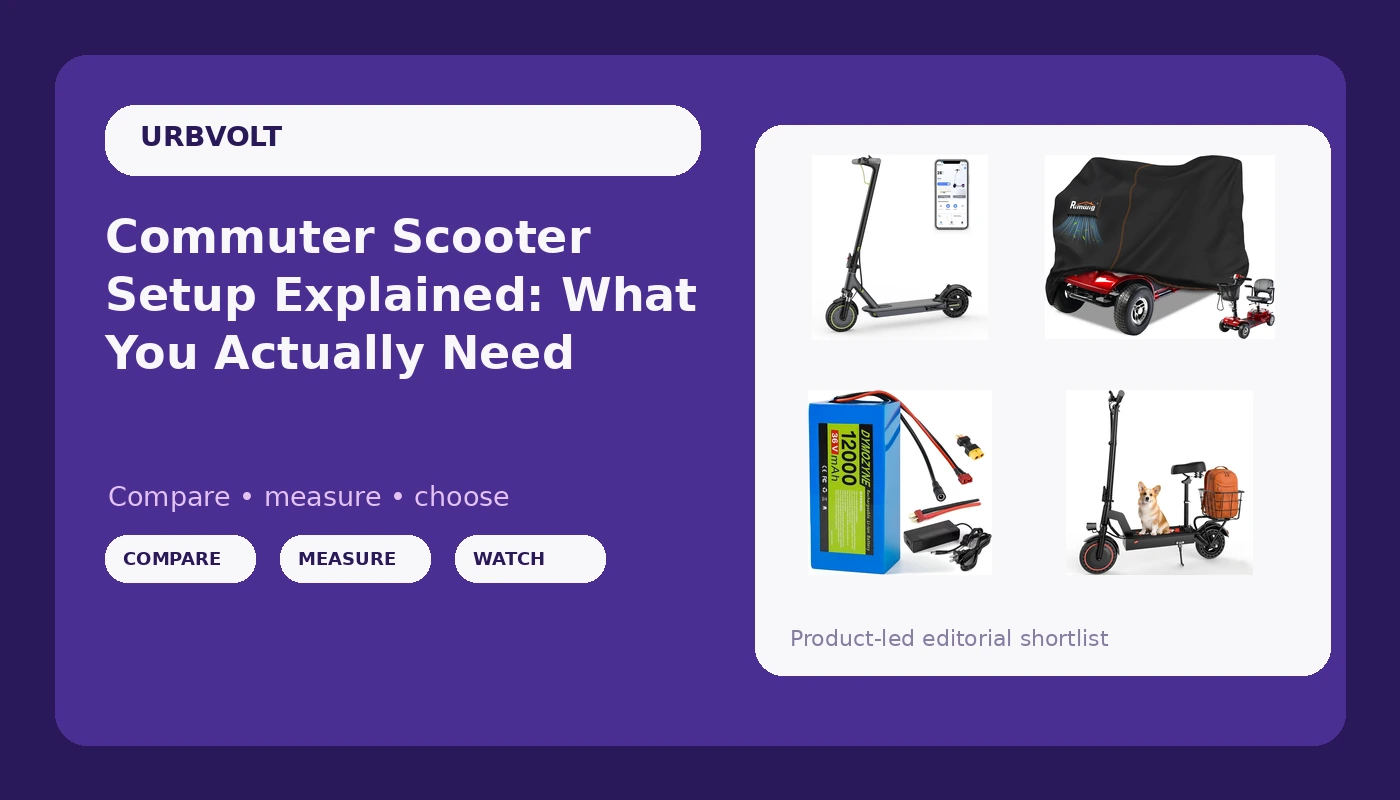
A commuter scooter setup is not one purchase. It is a platform, a power source, a way to keep the thing dry, and a decision about whether you want to stand or sit for the whole ride. I have commuted 14 miles round trip across the Congress Avenue bridge for four years without a car, and the pattern I see in almost every first-time buyer is identical: they shop for a scooter, then discover three weeks later that they also needed a battery plan, a cover, and a completely different set of expectations about range. The four products below cover the pieces that show up most often in a real commuting setup, what each one is actually for, and how to decide which of them belongs in yours.
Related: How to Read an Electric Scooter Spec Sheet Without Getting Fooled →
Quick answer
A commuter scooter setup works best when you match the platform to your route first, then add power and protection around it. The folding scooter with a 350W/500W motor, solid tires, and a double braking system is the standing commuter platform. The seated scooter with a basket is the option for riders who want to sit upright and carry groceries without a backpack. The 36V/48V lithium-ion pack is a replacement or upgrade power source for a scooter, e-bike, or DIY build that accepts that voltage. The 420D cover is weather protection for a three or four wheel scooter parked outside. None of these is universally better than the others; each one solves a different problem.
Four useful options
| Model | Best fit | What stands out |
|---|---|---|
| Electric Scooter with 350W/500W Motor and Solid Tires | Standing commutes and short errands | 8.5 or 10 inch solid tires, listed 19/22 MPH top speed, double braking system |
| WERHY Electric Scooter with Seat and Basket | Riders who want to sit and carry cargo | Seat and front basket included, listed 21 mile range |
| 36V/48V Lithium-ion Battery Pack with 30A BMS | Replacement or upgrade power | 12Ah and 20Ah versions, 30A BMS, listed for 100W to 2000W motors |
| 420D Mobility Scooter Cover | Outdoor parking and storage | Waterproof 420D fabric, sized 49x22x39 inches for 3 to 4 wheel scooters |
The standing commuter platform: Electric Scooter with 350W/500W Motor and Solid Tires
Solid tires are the single biggest reason this style of scooter ends up in a commuter's hands. Tubed tires on a scooter ridden daily in Texas heat are a maintenance subscription: you will patch them or you will pay someone who can. Solid rubber removes that entire category of failure, and it also removes some ride comfort, because there is no air to absorb a rough chip-seal road. The range spread from 16 to 23 miles is not a typo, it reflects different battery and motor configurations in the same listing, so read the specific variant you are buying rather than the headline number. At 185 lb with a bridge climb in the middle of the route, expect the real number to land at the low end of whatever that variant claims.
The seated option: WERHY Electric Scooter with Seat and Basket for Adults 21 Miles Range
A seat changes the math on a commute more than people expect. Standing for 20 minutes is fine; standing for 45 minutes with a backpack on is a different physical experience, and riders with knee, hip, or lower back issues often find the seated position is the difference between commuting by scooter and not commuting by scooter at all. The basket matters too, because carrying a bag on your back raises your center of gravity and makes the whole ride hotter. The trade-off is honest: a seated scooter is heavier and bulkier than a folding standing model, it is harder to carry up stairs, and a seated rider cannot shift weight the same way over a pothole. If your route ends in an elevator, this is a strong fit. If it ends in three flights of stairs, weigh that carefully.
The power source: 36V 48V Ebike Battery, 12Ah 20Ah Lithium-ion Battery Pack with 30A BMS
This is the one item on the list that is not a scooter, and it is also the one that requires the most care before you buy. A battery pack is not universal. Voltage has to match your controller's rating, the discharge connector has to match your wiring, the physical dimensions have to fit your frame or deck compartment, and the mounting hardware has to line up. If any of those four things is wrong, you own a very heavy brick. What makes this listing worth a look for the right buyer is the amp-hour and BMS transparency: 12Ah and 20Ah are stated plainly, and a 30A BMS is specified rather than hidden. Multiply voltage by amp-hours and you get watt-hours, the only battery number that means anything. A 48V 20Ah pack is roughly 960 watt-hours on paper, which is a genuinely large amount of energy for a scooter or e-bike build, though usable capacity is always lower than the label.
The weather layer: 420D Mobility Scooter Cover Waterproof for 3-4 Wheel Scooters 49x22x39in
Rain is not the thing that kills a scooter; it is the thing that starts the clock on everything else. Water gets into a throttle, a display, or a controller connector, and three weeks later you are diagnosing an intermittent fault that only shows up on wet mornings. A cover is the least expensive line of defense in the entire setup, and it is also the most overlooked. The important caveat here is sizing and shape. This cover is built around the footprint of a three or four wheel mobility scooter at 49 by 22 by 39 inches, so measure your own machine before ordering. A folding commuter scooter is a different silhouette and may not fit this cut well. If you park a seated or four wheel scooter on a porch or under a carport, this is a sensible add-on.
Prices and availability may change. Product images, names, and retailer links are matched to verified listings. No current price, rating, stock status, or measured result is stated here without current evidence.
What watt-hours and amp-hours actually tell you
Battery specs are written to be hard to compare, and the reason is that amp-hours alone are meaningless without voltage. A 36V 12Ah pack and a 48V 12Ah pack have the same amp-hour number and a 33 percent difference in actual energy. Multiply volts by amp-hours and you get watt-hours, which is the number that determines how far you can go under a given load. A 48V 20Ah pack is about 960 Wh, a 36V 12Ah pack is about 432 Wh, and those two batteries will not behave remotely alike on the same hill.
The second number that matters is the BMS rating, and it is the one manufacturers bury. The battery management system is the circuit that keeps individual cells balanced, prevents over-discharge, and cuts power before something goes wrong. A 30A BMS tells you roughly how much sustained current the pack is willing to deliver, which in turn tells you what motor it can realistically feed. A pack rated for 100W to 2000W motors spans a huge range, so the honest reading is that the pack can support modest builds comfortably and only the upper end of that window with careful matching to your controller.
Peak watts, by contrast, are a party trick. A motor that claims a big peak number for two seconds is telling you about a marketing department, not about your commute. Continuous rating, voltage, and watt-hours are the three specs that predict what a ride will actually feel like at mile eight with a headwind.
Solid tires versus air tires on a daily commute
Tire choice is the decision that determines how much of your Saturday you spend with a tire lever. Tubed pneumatic tires ride softer and grip better on wet pavement, and they also pinch flat on potholes, lose pressure in cold weather, and require you to either learn to patch a tube or pay someone who already has. Solid tires remove that maintenance category entirely, at the cost of a firmer ride and slightly less traction in the rain.
For a commuter who rides the same route every day and does not want to think about PSI, solid rubber is the pragmatic pick. For a rider who wants maximum comfort on rough roads and is willing to check pressure weekly, air tires still win on feel. There is no universal answer, but there is a rule: if you are not going to check tire pressure regularly, buy solid, because a low tire costs you range, speed, and tube life all at once.
- Measure your actual round-trip distance and add 30 percent for detours, headwinds, and cold mornings.
- Ride the hardest hill on your route before you commit to a motor wattage, because hill climbing exposes voltage sag faster than any flat test.
- Decide whether you are standing or sitting for the full ride, since that choice eliminates half the market immediately.
- Confirm your storage situation: stairs, elevator, garage, or porch. That answer determines weight limits and whether you need a cover.
- If you are replacing a battery, write down your controller voltage, your connector type, and your compartment dimensions before you shop.
Practical guidance for a real commute
- Check tire pressure or tire condition before every ride, not every month. It is the cheapest range you will ever buy back.
- Wear a helmet on every single ride, without exception, including the two minute trip to the store.
- Store the battery indoors when you can. Heat is what ages a lithium pack, and a Texas summer is a slow bake.
- Charge to full before a long ride and avoid leaving a pack at zero percent for weeks at a time.
- Keep the charger matched to the pack. A mismatched charger is a fire risk, not a convenience upgrade.
- Cover the scooter if it sleeps outside, and check that connectors and displays are dry before you power on.
- Log your real range and the weather it happened in. After a month you will know your scooter better than any spec sheet does.
Which option should you choose?
Choose the Electric Scooter with 350W/500W Motor, 8.5"/10'' Solid Tires when you want a folding standing commuter you can carry indoors, and you would rather never patch a tube again. Choose the WERHY Electric Scooter with Seat and Basket for Adults when your ride is long enough that sitting matters, or when you need to arrive with groceries and no backpack. Choose the 36V 48V Ebike Battery, 12Ah 20Ah Lithium-ion Battery Pack with 30A BMS when you are rebuilding or upgrading a scooter, e-bike, or DIY project and you have already confirmed voltage, connector, and dimensions. Choose the 420D Mobility Scooter Cover when a three or four wheel scooter lives outside and you want rain and dust off the seat and electronics.
There is a real limitation to state plainly: these four items do not come from a single matched system, and a battery in particular only works if the electrical and physical fit is correct. Treat the battery as a project part, not an accessory.
The bottom line
The best commuter scooter setup is the one you will actually maintain. Start with the platform that fits your route and your storage, add power only when you know your voltage and connector, and spend the small money on a cover so the expensive parts last. Buy the scooter for the hill you climb every day, not for the top speed printed on the box.