Most commuter electric scooter advice is written by people who have never ridden one to work. It quotes the box, repeats the range claim, and skips the two questions that decide whether you get to the office: can this thing climb the hill on my route, and will it survive a Tuesday in August.
I have been car-free in Austin for four years. My commute is 14 miles round trip across the Congress Avenue bridge, and I have owned seven scooters in that time. I have blown two controllers, patched four tubes, replaced one deck, and learned to read a spec sheet the way a mechanic reads a wiring diagram. The scooter that stranded me at 9 PM smelled like burnt toast. That smell is a lesson you only need once.
This is the short version of everything I know about picking a commuter electric scooter: the numbers that matter, the ones that are marketing, and two models that fit the job at two different budgets.
Why you should trust me
Four years, no car, roughly 900 commutes on the same route. I keep a repair log in a battered notebook and a spreadsheet of every mile, every tire pressure, and every range claim a manufacturer has told me that turned out to be optimistic.
I have owned the cheap end and the expensive end. A GOTRAX taught me what a dying controller smells like. A Hiboy taught me that tubed tires hate Texas heat. A Ninebot Max survived a full year of abuse and made me respect good engineering. A used Kaabo taught me why you do not buy a 60 mph scooter to ride at 18.
One thing I will not do: tell you I ran a scooter through my loop when I have not. What I can do is tell you exactly which spec lines decide the outcome, and what I would verify before handing over money.
How I judge a commuter scooter
Five things, in this order.
Watt-hours, not amp-hours. Watt-hours are the real measure of battery capacity. Multiply voltage by amp-hours if the listing hides it. Amp-hours alone is marketing math because it says nothing without the voltage. Two scooters can both claim "10Ah" and differ by 40 percent in actual energy.
Hill performance at your weight. If it cannot climb the bridge, it does not matter how fast it goes downhill. A single 350W motor at 185 pounds on a grade is a different scooter than the same motor at 140 pounds on flat ground.
Tire type. Tubed tires on a daily commuter are a maintenance subscription. You will learn to patch a tube or you will pay someone who can. Solid tires never flat, which is a real commuting advantage, but they ride firmer and transfer more road texture into your knees.
Folded weight and deck height. A scooter you cannot carry up three flights of stairs is a garage ornament. Weigh it against your actual stairs, your actual bus rack, your actual office closet.
Brakes and IP rating. A double braking system on a commuter is not a luxury. Neither is water resistance. IP54 means rain-safe-ish. Anything less means it is a fair-weather toy, and Austin does not do fair weather in April.
Two scooters that fit this ride
These two cover the entry and step-up ends of the commuter market. Read both product notes, then run the checklist below against whatever you are actually considering.
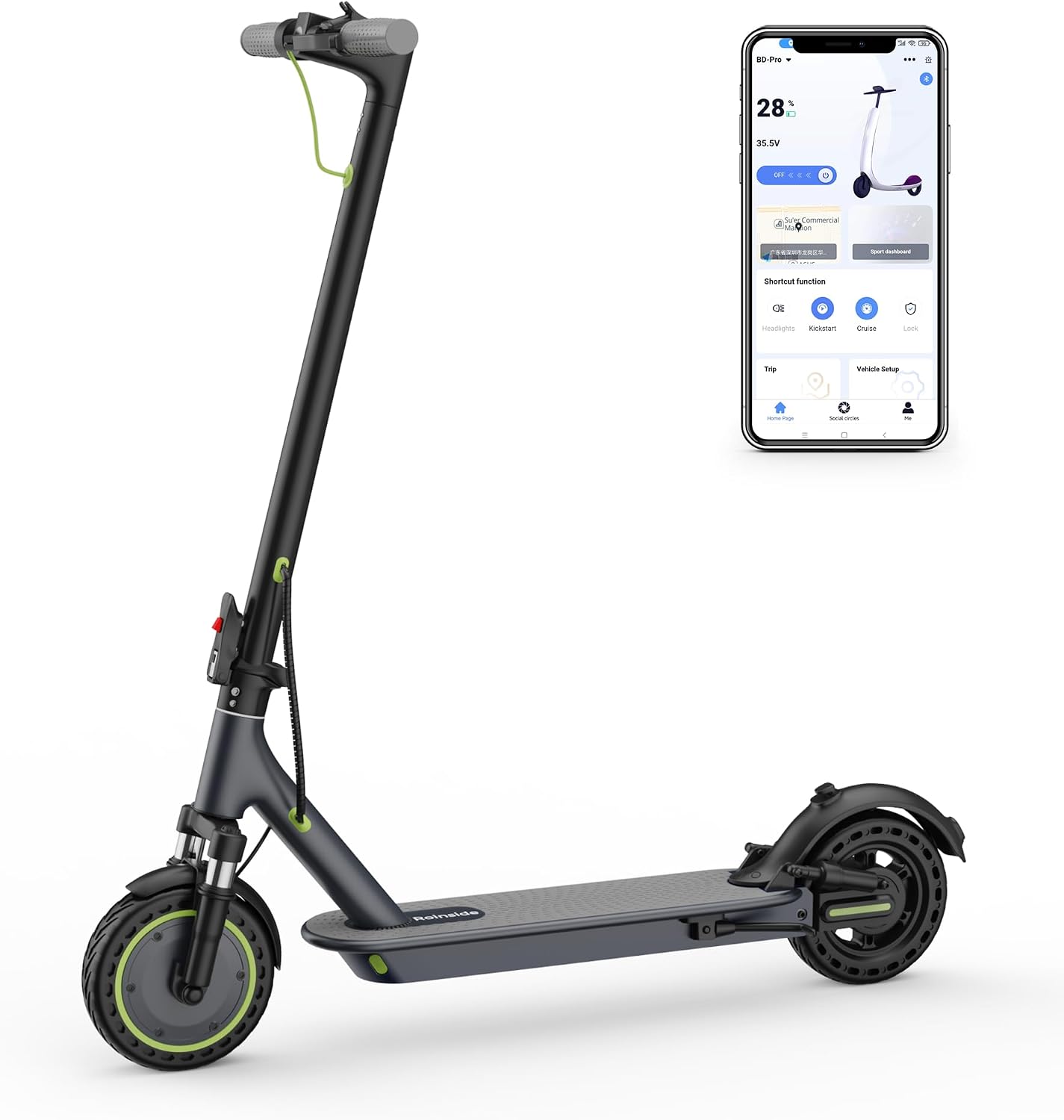
Budget pick: Electric Scooter - 350W/500W Motor, 8.5"/10''Solid Tires, Up to 19/22MPH& 16/21/23Miles Long-Range Portable Commuting Scooter for Adults with Double Braking System
 Visit on Amazon →
This is the one I would point a first-time commuter toward, and the reason is the tires. Solid tires mean no tube patches, no pinch flats on potholes, and no 20-minute roadside repair in the heat. If you have never owned a scooter, that single line removes the most common reason people give up on commuting on one.
The spec sheet lists two motors, two tire sizes, two top speeds, and three range figures. That is the listing telling you it is sold in multiple configurations. Before you order, confirm which battery you are getting, because the range number moves with it. A 16 mile figure and a 23 mile figure can be the same scooter with different packs, and the one you receive is the one you live with.
The 500W number is peak power, and peak watts are a party trick. It is the figure the motor can hit for a couple of seconds on a fresh charge, not what it holds on a long climb. Judge the scooter on the continuous motor rating and the watt-hours, not the bigger number on the box.
Flaws but not dealbreakers: Solid tires ride harsh. On chip seal and broken asphalt you will feel every seam, and you cannot tune that with tire pressure the way you can on pneumatic tires. For a 3 to 6 mile commute on decent pavement, that trade is worth it. For 12 miles of rough road, think harder.
A double braking system on a scooter at this price is the right call, and it is the feature I would refuse to compromise on. Check current Amazon price before you commit, and check the folded weight against your stairs while you are there.
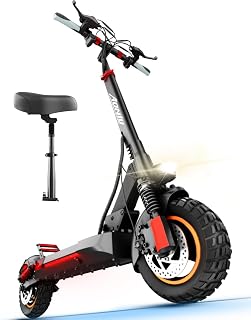
Step-up pick: M4 Electric Scooter for Adults Off Road Escooter for Commuting
 Visit on Amazon →
The M4 is positioned as an off road escooter that doubles as a commuter, and that positioning tells you what to verify first. Off road usually means more torque, more suspension, and more weight, and only two of those three help you get to work.
More torque is genuinely useful on a bridge climb and on the ramp out of a parking garage. Suspension is useful if your route has expansion joints and patched asphalt, which every Austin street does. Weight is the cost, and it is the one that decides whether the scooter fits your life. Before you buy, get the folded weight in pounds and compare it to what you can lift onto a bus rack or carry up a flight of stairs without swearing.
The other thing to check on a listing like this is the battery in watt-hours. Off road scooters often carry a larger pack than pavement-only models, and a larger pack is the only honest way to buy more range. If the listing only gives amp-hours, ask for the voltage and do the multiplication yourself.
Flaws but not dealbreakers: Off road styling sometimes means knobby or larger tires, which add grip off pavement and rolling resistance on it. If 95 percent of your riding is a paved commute, that is a small tax you pay for the days you cut through a park or a gravel lot.
This is the scooter I would look at if your commute is longer than 6 miles, if your route has a real climb, or if you want one machine for the commute and the weekend. Check current Amazon price, then run the checklist below before you decide.
The eight-step checklist before you buy
Step one: Find the watt-hours. Voltage times amp-hours. Write it down. If the listing will not give you both numbers, that is your answer about the seller.
Step two: Measure your actual commute. Not the round number you tell people. Ride the route on a bike or in a car once and note the distance and the total climb. A 5 mile commute with one 150 foot climb is harder on a scooter than a flat 8 mile one.
Step three: Test the hill in your head. Take your real weight, add a backpack, and ask whether a single motor in the 350W to 500W range will hold speed on your worst grade. If the answer is maybe, you want the step-up model or a dual motor.
Step four: Decide your tire policy. Solid tires for short paved commutes and zero maintenance patience. Tubeless for longer rides where comfort matters. Tubed only if you are ready to patch, and you should still carry a patch kit and a pump.
Step five: Weigh the folded scooter against your stairs. This is where most people get it wrong. A heavier scooter rides better and carries worse, and you carry it every single day.
Step six: Check the IP rating. IP54 or better for a commuter. Below that, you are gambling on the weather, and the loser of that bet is the controller.
Step seven: Confirm the brakes. A double braking system means you have a backup when one system fades on a long descent. Single brake scooters are fine at 12 mph and terrifying at 22.
Step eight: Ask about parts. Controllers, brake pads, chargers, and tires should be replaceable and available. A scooter with no parts channel is disposable, no matter what it cost.
What to skip
Skip anything advertised by peak watts alone. Skip scooters with no IP rating, because "water resistant" with no number attached means it will not survive a drizzle. Skip 60 mph machines if your route is 4 miles of city street, since you are paying for speed you cannot legally use and carrying the weight every day.
Skip any listing that gives battery size only in amp-hours, and skip any scooter whose folded weight you cannot find. Both of those omissions are the seller telling you something.
And skip riding without a helmet. I have worn one on every ride since an ER nurse explained what a scooter crash without one looks like. That is not a spec line, it is the only one that matters.
What this all costs
The budget scooter is the lower-cost entry point, and the step-up model is where you land if your route is longer or hillier. Budget beyond the scooter itself for a helmet, a lock, a floor pump with a gauge, and a small tool kit. Those four things cost less than one controller replacement, and the controller replacement is what you are avoiding.
The math that actually matters is not the purchase price. It is whether the scooter still works in month fourteen. A cheap scooter that climbs your hill and has parts available beats an expensive one that strands you, every time.
Check current Amazon price on both, run the eight steps, and buy the one that matches your route rather than the one with the biggest number on the box. Then pump your tires. I say that weekly and I mean it, even if my own gauge and I disagree about the schedule.