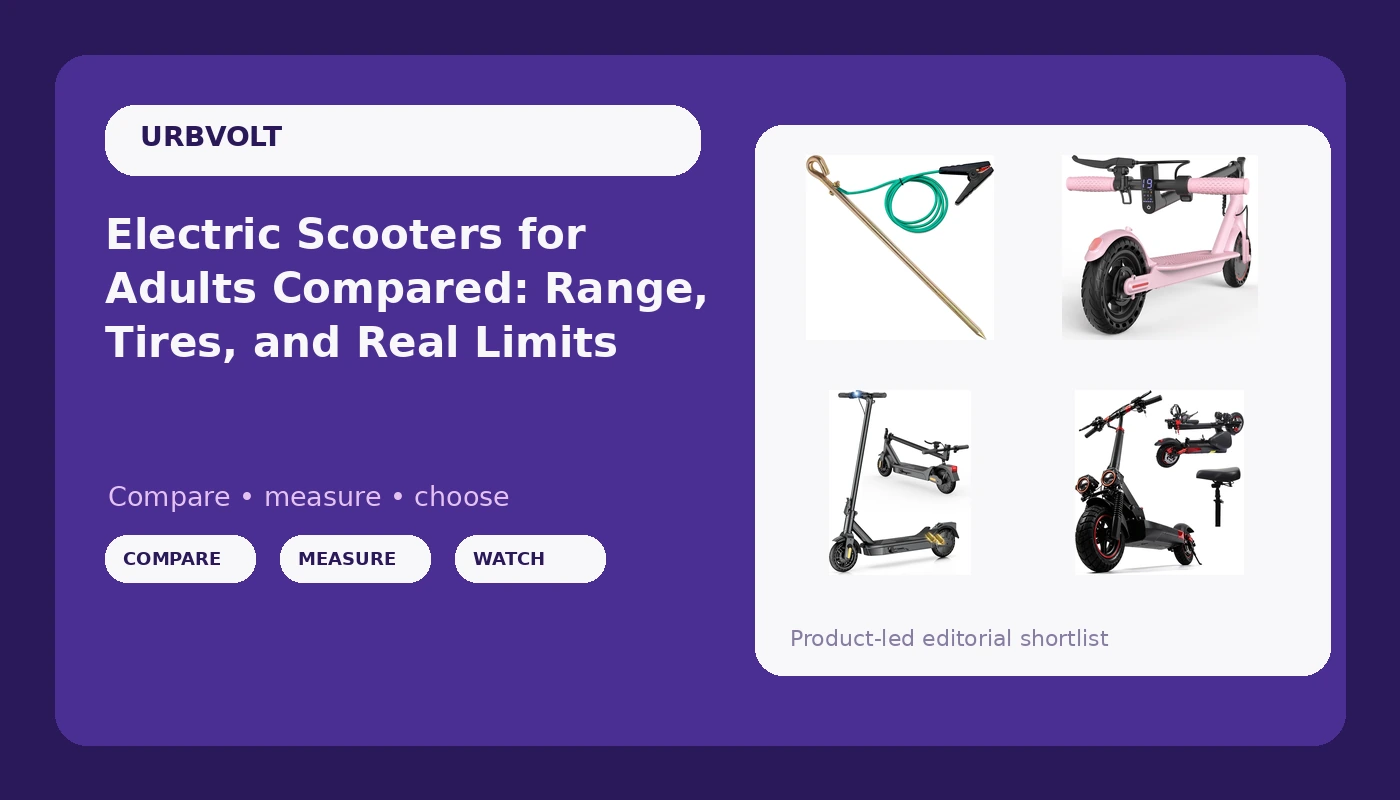
Electric scooters for adults are sold on two numbers that rarely survive a real commute: top speed and claimed range. The part of the spec sheet that decides whether you still like the thing in month three sits further down, in tire size, battery format, brake type, and how much weight you have to haul up a flight of stairs. This explainer covers four listings that do different jobs rather than sit at different points on one ladder: two folding standing commuters, one seated model built around a larger motor and fat tires, and one small grounding accessory that belongs on a charging bench. Here is what each one is actually for, and where the marketing language needs translating.
Related: Scooter Tire Pressure and Tube Reality: A Commuter's Guide →
Quick answer
For a folding standing scooter with the widest spread of listed tire options, the Aovowheel model is the compact pick. For app features, dual suspension, and a higher peak motor rating, the 600W-1000W commuter scooter sits in the middle. For seated riding, a 48V 15Ah battery, and 10-inch off-road tires, the 1200W model is the long-distance option. The portable ground rod is not a scooter at all; it is a grounding accessory for a charging bench, a generator, or an antenna mast.
Four useful options
| Model | Best fit | What stands out |
|---|---|---|
| Aovowheel Electric Scooter for Adults | Short city commutes, folding storage | 250W-500W motor, listed 16-24 mph top speed, tire sizes from 6.5 to 14 inches, dual brakes |
| Electric Scooter for Adults Peak 600W-1000W | Riders who want suspension and app features | Peak 600W-1000W motor, 20 mph, dual suspension, dual braking system, 8.5 to 10 inch tires |
| Electric Scooter for Adults with Seat, 1200W | Longer rides and seated comfort | 1200W motor, 48V 15Ah battery, listed up to 28 mph, 10 inch off-road fat tires, dual disc brakes with EABS |
| Portable Ground Rod with 5.1ft 12AWG Wire | Charging bench and equipment grounding | 5.1 ft 12AWG UL listed grounding wire, crocodile clip, ground post pin |
The compact folding option: Aovowheel Electric Scooter for Adults
That 15-60 mile spread is the single most important thing on this page, and it is not a typo. A small-wheel, small-battery configuration and a large-wheel, large-battery configuration cannot produce the same distance, so the range figure is really a menu. Before ordering, confirm which tire size and which battery the specific variant you are buying carries, because the price and the ride quality follow that choice. Small wheels accelerate quickly and feel twitchy over broken pavement; larger wheels roll over cracks and potholes with far less drama.
The suspension and app option: Electric Scooter for Adults Peak 600W-1000W
Read "peak 600W-1000W" as a marketing range rather than a continuous rating. Peak watts describe a short burst, usually on a climb or from a standstill, and they are not what the controller can sustain for twenty minutes of full throttle. The number that actually predicts your commute is watt-hours, and this listing, like most, does not lead with it. The 20 and 40 mile figures almost certainly track two different battery sizes, so the configuration question applies here too.
The seated long-range option: Electric Scooter for Adults with Seat, 1200W
A seat changes the category more than any single spec. It moves weight off your feet and wrists, which matters on longer rides, and it also makes the scooter harder to fold, heavier to carry, and less useful on a crowded train. Fat tires add stability and absorb rough surfaces, at the cost of rolling resistance and a bit of range. If your route includes unpaved paths or badly maintained asphalt, that trade usually goes in your favor.
The odd one out: Portable Ground Rod with 5.1ft 12AWG Wire
Why include it? Because the scooter work that actually strands people happens at a bench, not on the road. If you are opening a deck, swapping a controller, or handling bare battery packs, a proper earth ground for the equipment you are working near is a safety item, not a gadget. This rod is intended for electric fences, antennas, and generators per its listing. Follow the manufacturer's instructions and your local electrical code, and never treat a grounding accessory as a substitute for a licensed electrician.
Prices and availability may change. Product images, names, and retailer links are matched to verified listings. No current price, rating, stock status, or measured result is stated here without current evidence.
Watt-hours are the battery number that matters
Amp-hours alone tell you almost nothing, because amp-hours without voltage is half an equation. Multiply the two and you get watt-hours, which is the actual size of the tank. The seated scooter here lists 48 volts and 15 amp-hours, so 720 watt-hours. A competing listing that says only "10Ah" might be 36 volts, which is 360 watt-hours, or it might be 52 volts, which is 520. Same number on the box, wildly different distance.
Two more pieces of vocabulary worth knowing. Voltage sag is the power drop you feel as a battery empties or gets cold, which is why a scooter at half charge can suddenly feel sluggish on a hill. And a battery management system, or BMS, is the circuit that keeps cells balanced and prevents the pack from cooking itself. It is invisible, it is where budget scooters cut corners, and it is the difference between a battery that lasts three seasons and one that does not.
Tires, brakes, and deck decide month three
Tires are the maintenance subscription you cannot cancel. Tubed tires pinch flat on potholes and require patching or replacing a tube; tubeless tires self-seal small punctures and are the upgrade most commuters should want. Tire diameter matters just as much. A 6.5 inch wheel is nimble and harsh; a 10 inch wheel is stable and forgiving; the 14 inch option in the Aovowheel listing behaves more like a small bicycle than a scooter.
Brakes come in tiers too. A basic drum or single mechanical disc works, but dual braking systems and disc brakes with EABS spread the stopping force across two wheels and recover a little energy while slowing. Neither replaces good tires or a rider who leaves following distance.
- Add up the watt-hours before you compare anything else, using voltage times amp-hours.
- Confirm the exact configuration, tire size, and battery for the variant you are buying, not the headline spec.
- Measure your actual round trip and add a margin for cold, wind, hills, and a heavier rider than the test dummy.
- Check the tire type first, then the brake setup, then the suspension, in that order.
- Weigh the scooter against the stairs, the elevator, or the bus rack it has to live with every day.
Practical notes before you order
- Wear a helmet on every ride. It is the single cheapest piece of safety equipment you will ever buy.
- Check tire pressure weekly. Low pressure costs range, speed, and tube life, and it is the most ignored spec on any scooter.
- Look at the IP rating before you ride in rain. A rating that barely handles drizzle is not a rain rating.
- Store and charge the battery indoors, away from anything flammable, and never charge a pack that has been physically damaged.
- Assume claimed range is optimistic. Plan your route around roughly two thirds of the advertised figure and you will rarely be stranded.
Which option should you choose?
Choose the Aovowheel Electric Scooter for Adults when you want a folding standing scooter for short city trips and you are willing to confirm which tire and battery configuration you are actually buying. Choose the Electric Scooter for Adults Peak 600W-1000W when you want dual suspension, app connectivity, and a bit more motor headroom on a foldable frame. Choose the Electric Scooter for Adults with Seat, 1200W when comfort, a stated 48V 15Ah battery, and 10 inch off-road tires matter more to you than portability. Choose the Portable Ground Rod when the job is grounding equipment on a bench, a fence line, or a generator, not getting you across town.
A caveat worth stating plainly: this article compares what the listings disclose. It does not include instrumented range tests, hill climbs, or controller durability runs, and those are exactly the numbers that decide whether a scooter survives a real commute. Treat the specs here as a shortlist, then verify the details that matter to your route.
The bottom line
The three scooters here are separated less by price than by job. A folding standing commuter covers short trips and mixed transit. A suspended commuter with app controls covers the same ground with more comfort and more motor headroom. A seated model with a 48V 15Ah battery and fat tires covers longer distances in more comfort, and gives up portability to do it. The grounding rod is a bench accessory for people who work on the hardware rather than just ride it. Pick the job first, then confirm the watt-hours, the tire type, and the exact configuration before you order.