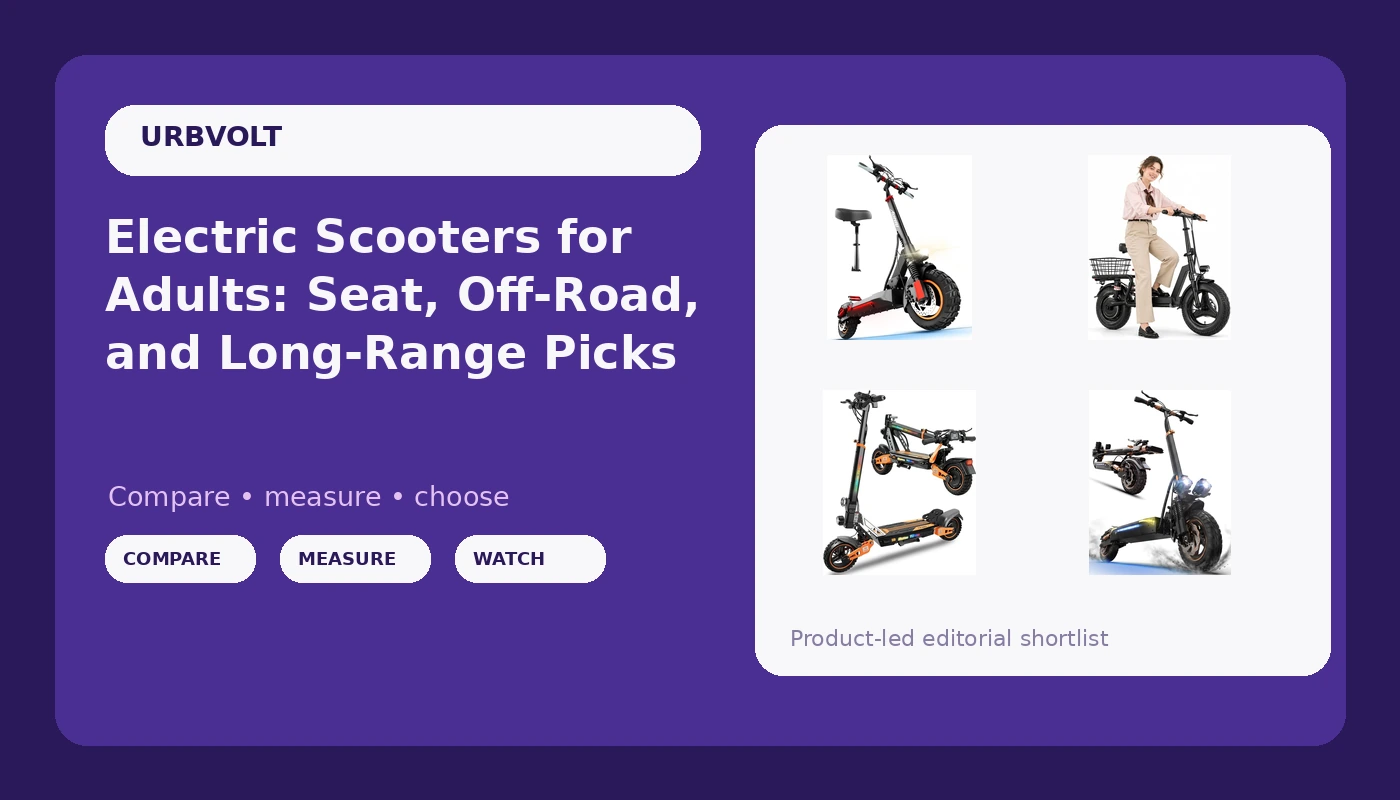
Electric scooters for adults are sold on two kinds of numbers: the ones that matter and the ones that fit on a box. A listing will shout about peak watts and top speed while quietly leaving out battery watt-hours, tire type, or whether the thing has suspension at all. That makes comparison shopping harder than it should be, especially when four scooters that look similar in photos are built for four different kinds of riders.
This guide walks through four current options, what each one is built for, and which specs you should use to narrow the field before you spend anything. No prices are printed here because they move, and no range figure below is a measured result. Everything comes from the manufacturer listings, which is exactly why the specifications matter more than the marketing copy wrapped around them.
Related: How to Read an Electric Scooter Spec Sheet Before You Buy →
Quick answer
Buy for the ride you actually do, not the ride in the photos. If you want to sit rather than stand, the seated model is the only one of the four built that way. If your commute is long and you are a heavier rider, prioritize the scooter that states a 48V 18.2Ah battery and a 300+ lb capacity claim. If your route is rough pavement and patched asphalt, dual suspension is the feature worth paying for. And if you split your riding between streets and unpaved paths, an off-road commuter makes sense. Check current Amazon price on each before you commit, because listings and stock move constantly.
Four useful options
| Model | Best fit | What stands out |
|---|---|---|
| Electric Scooter for Adults, 1200W Peak Motor Fast E Scooter | Long commutes and heavier riders | 48V 18.2Ah battery, 10 inch off-road tires, 300+ lb capacity claim, folding frame |
| M4 Electric Scooter for Adults Off Road Escooter for Commuting | Mixed street and unpaved riding | Off-road build aimed at commuting, lighter positioning |
| Electric Scooter Adults, 25/31 Mile, Off Road Tire Dual Suspension | Rough pavement and comfort | Dual suspension plus off-road tires, 25/31 mile range claims |
| Electric Scooter with Seat for Adults, 1000W Peak Motor E-Scooter | Riders who want to sit | Seated frame, 1000W peak motor |
The long-range commuter: Electric Scooter for Adults, 1200W Peak Motor Fast E Scooter, 10" Off-Road Tires, Up to 30 MPH & 35 Miles Long Range, 48V 18.2AH Battery, Heavy Duty 300+ lb Capacity, Foldable Commuter E-Scooter
The reason this one leads the group is not the peak watt number. It is the battery. When a listing states 48 volts and 18.2 amp-hours, you can multiply those two figures and get roughly 874 watt-hours, which is the number that actually predicts how far the scooter goes and how much it sags on a climb. Peak watts are a two-second party trick; watt-hours are what get you home.
The trade-offs are real. Off-road tires are heavier and noisier than street tires, and they cost a little range on smooth asphalt. A 300+ lb capacity claim usually means a stiffer, heavier frame. If you have to carry the scooter up stairs, weigh that decision carefully, because a big battery and a heavy frame are the same purchase. The claimed 35 miles is a lab-style figure at best; assume a real commute at real rider weight lands well under it.
The off-road commuter: M4 Electric Scooter for Adults Off Road Escooter for Commuting
The honest problem with this one is the missing battery spec. A listing that does not publish voltage and amp-hours is asking you to trust a range claim you cannot check. That does not make it a bad scooter, but it does mean you should read the full product page and the answered questions before treating it as equivalent to the 48V scooter above.
Where it makes sense is for riders who want an off-road-capable commuter and are willing to do that extra verification. If your route includes gravel paths, torn-up shoulders, or a park cut-through, off-road tires are genuinely useful. If you ride a clean bike lane the whole way, you are paying a weight penalty for capability you will not use.
The dual-suspension pick: Electric Scooter Adults, 25/31 Mile, Off Road Tire Dual Suspension
Suspension is one of the few features that changes how a scooter feels on every single ride. A rigid frame transmits every expansion joint and pothole straight into your wrists and knees; dual suspension absorbs most of that. If your commute runs on older asphalt, brick, or a bridge deck with seams, this is the category to look at first.
Two range numbers in one listing almost always means one battery and two speed settings, so treat 31 miles as the eco figure and 25 as the faster one. Neither is a measurement at your weight, on your hills, in your weather. Note also that suspension adds moving parts, and those parts eventually need attention, so plan on checking pivot bolts and shock mounts as part of routine maintenance.
The seated option: Electric Scooter with Seat for Adults, 1000W Peak Motor E-Scooter
Seated scooters are their own category, and the trade-offs run both directions. Sitting is far less tiring over distance and easier on your back, and it lowers your center of gravity in a way many riders find steadier at speed. On the other side, a seat adds weight and bulk, makes the scooter harder to fold small, and changes how you handle curbs and tight turns. If you have ever finished a 10 mile standing ride with numb feet, you understand the appeal.
Prices and availability may change. Product images, names, and retailer links must be matched by verified ASIN. Do not state a current price, rating, stock status, or measured result without current evidence.
Watt-hours, amp-hours, and peak watts
The single most useful thing you can learn before buying any electric scooter is the difference between the three numbers manufacturers love to mix up.
Amp-hours (Ah) measure how much charge a battery holds, but only in combination with voltage. 18.2Ah at 48V is a very different battery from 18.2Ah at 36V. A listing that gives amp-hours alone is telling you half the story.
Watt-hours (Wh) are voltage multiplied by amp-hours, and they are the real measure of capacity. The 48V 18.2Ah battery in this lineup works out to roughly 874 Wh. If you know your route pulls about 25 Wh per mile at your weight and speed, that number tells you something real. Amp-hours alone tell you nothing you can compare.
Peak watts describe the maximum the controller will allow for a brief moment, often just a few seconds. Continuous or rated watts matter far more for climbing, and many listings do not publish them. A 1200W peak motor might run at half that continuously, which is why peak watt numbers should never be your primary comparison.
Two more terms worth knowing. Voltage sag is the power drop you feel as a battery drains or gets cold, and it is why a scooter at 50 percent charge can feel noticeably weaker than one at full. IP rating describes water resistance; anything below IPX4 should be treated as a fair-weather machine no matter what the marketing implies.
How to match a scooter to your actual commute
- Measure your real round trip, then add 40 percent for wind, cold, hills, and battery age. A 14 mile round trip needs a scooter you believe can do 20.
- Weigh yourself with a backpack, helmet, and anything you carry. Compare that number against the stated capacity claim, and leave headroom, because motors work harder and batteries drain faster near their limit.
- Look at your surface. Smooth bike lane favors street tires and lighter weight; patched asphalt, gravel, and brick favor off-road tires and suspension.
- Decide sit or stand. Standing is quicker to mount and easier to store; sitting is easier on long rides and on your feet.
- Check the carry. If stairs are part of your day, the folded weight and dimensions matter more than top speed ever will.
Practical guidance before you buy
- Budget for a helmet before you budget for accessories. Every ride, no exceptions, and this is not a scooter-specific rule.
- Check tire pressure weekly. Low pressure costs range, speed, and tire life, and it is the most commonly ignored maintenance item on any scooter.
- Confirm the tire type and how you would fix a flat. Tubed tires are a maintenance subscription; ask what the replacement process looks like.
- Read the water resistance rating literally. Rain riding on a scooter with a low IP rating is how controllers die.
- Verify the return window and warranty terms before purchase, since shipping a scooter back is expensive and slow.
- Look for the battery management system mentioned in the listing. It is the circuit that keeps cells balanced and is one of the first places cheap builds cut corners.
Which option should you choose?
Choose the Electric Scooter for Adults, 1200W Peak Motor Fast E Scooter when your commute is long, you are a heavier rider, and you want the only listing here that publishes a comparable battery capacity. Choose the M4 Electric Scooter for Adults Off Road Escooter for Commuting when you want off-road capability for mixed surfaces and you are willing to verify the battery details yourself. Choose the Electric Scooter Adults, 25/31 Mile, Off Road Tire Dual Suspension when comfort over rough pavement is the priority. Choose the Electric Scooter with Seat for Adults, 1000W Peak Motor E-Scooter when standing for a full commute is the part you dislike most.
One caveat applies to all four. The numbers above come from manufacturer listings, not from independent measurement, and claimed range is almost always recorded under ideal conditions with a light rider, warm weather, and flat ground. Treat every published figure as a ceiling rather than an expectation, and read the full product page and buyer questions before you decide.
The bottom line
The right electric scooter for adults is the one that matches your route, your weight, and your riding position, and those three things matter more than any peak watt figure on a box. If you want the most verifiable specification set, start with the 48V 18.2Ah commuter. If comfort is your problem, dual suspension solves it. If standing is your problem, the seated model solves that. If you ride mixed surfaces, the off-road commuter fits. Check current Amazon price on each, confirm the battery and tire details on the listing itself, and buy the scooter that fits the commute you already have.