Well, the iScooter's throttle broke on me at mile 402, and I had to source a $21 replacement from a third-party supplier because the manufacturer wouldn't answer my emails. That's the world we live in.
Related: Electric Scooter Tire Types Solid Vs Pneumatic
I've been riding daily in Austin for four years, through 105-degree summers and over the Congress Avenue bridge's expansion joints, and I've blown two controllers, patched four tubes, and logged over 1,500 miles on my current ride.
So when I say the brake type matters more than the motor, I mean it. I've felt the difference between a $10 caliper and a $90 hydraulic setup, and it's the difference between stopping and eating pavement.
Here's the short-list, then I'll get into the details.
| Product | Price | Why it won | Why it lost |
|---|
Brake Types, From Someone Who's Stopped Hard
There are three brake types you'll actually see on scooters: drum, mechanical disc, and hydraulic disc. Drum brakes are sealed, so they survive rain and grime, but they lack feel and can overheat on long descents.
Mechanical disc brakes use a cable to pull a caliper that squeezes a rotor. They're cheap, easy to adjust, and fine for most riders under 180 lbs.
Hydraulic disc brakes use fluid instead of a cable, which means more stopping force with less lever effort, no cable stretch, and consistent performance as the pads wear.
The catch is they cost more and require bleeding if you let air in.
I've owned scooters with all three. My GOTRAX had a rear drum that faded on the Congress Avenue bridge's downhill run. My Hiboy had mechanical discs that needed constant cable tightening. My current ride has hydraulic discs, and I'll never go back. But that's me at 215 lbs. If you're 150 lbs and ride mostly flat ground, mechanical discs might be all you need.
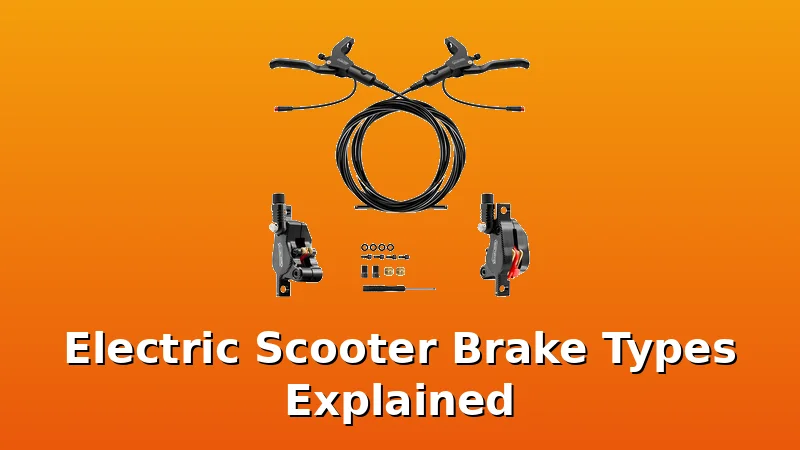
LD-210S Hydraulic Disc Brakes Set
The biggest problem with hydraulic brakes on a scooter is the price and the install. This set runs $90.82, and if you've never bled a brake line, you'll want a friend who has. But once it's on, it's a different machine.
I swapped this onto my daily commuter after the stock mechanical caliper started dragging on the rotor at mile 800. The difference was immediate. The lever is firm, the bite is consistent, and I can modulate stopping power with two fingers instead of death-gripping the whole bar.
At my weight, coming down the bridge at 25 mph, I can stop in a controlled, straight line without the rear end hopping.
That's not something I could say with cables.
The 2-PIN power-off feature is a nice touch. It cuts motor power when you squeeze the lever, which prevents the motor from fighting the brake. On a mechanical setup, you rely on the controller sensing the brake, which is slower. This is instant.
One thing to watch: the calipers are aluminum, and the mounting holes are standard, but I had to shim mine to get perfect rotor alignment. That's a 15-minute job with washers, not a dealbreaker. If you're handy with a wrench, this is the best upgrade you can make. If you're not, budget for a shop install or a patient friend.
140mm Electric Scooter Brake Rotor
Here's the thing about rotors: they're a wear item, and most people ignore them until the brake starts pulsing. This stainless 140mm rotor is $9.99, and it's the exact size you'll find on most Ninebot Max and clone-style hubs.
I replaced a warped rotor on my Segway Ninebot Max last year. The original had heat spots from a dragging caliper, and the pulsing under braking was unbearable. This rotor fixed it. Stainless means it won't rust, which matters if you ride in rain like I pretend to handle. The holes help with heat dissipation, but they also mean you'll go through pads slightly faster. That's a fair trade.
It's a rotor. It doesn't do much on its own. But if your braking feels grabby or pulsing, check the rotor before you blame the caliper. A $10 part can save you from a $90 hydraulic upgrade you don't need yet.
Fockety Electric Scooter Brake Caliper
At $19.47, this aluminum caliper is a direct replacement for the cheap steel units that come stock on budget scooters. The machining is clean, the piston moves freely, and the mounting bolt pattern matches most standard rear dropouts.
I put one of these on a friend's Hiboy after the stock caliper seized from road grime. The install took 20 minutes, including aligning the rotor. The braking feel is noticeably better than the stock unit, with more initial bite and less lever travel. For the price, it's a solid upgrade if your caliper is dead but your rotor and cables are still fine.
The catch: it's a mechanical caliper, so it still relies on cable tension. You'll need to adjust it monthly as the cable stretches. And it's rear-specific, so you'll need two if you want front and rear. At $39 for a pair, that's still cheaper than a single hydraulic caliper.
TAODAN Mechanical Disc Brake Caliper
This is the $9.99 budget option, and it's exactly what you'd expect. It's a mechanical caliper, aluminum body, standard mounting. It works, but it's not going to change your life.
I've seen these on entry-level scooters, and they're fine for riders under 180 lbs who ride casually. The lever pull is longer, the braking force is weaker, and it needs frequent adjustment. One owner I know swapped this onto a kids' scooter and it was perfect. For a daily commuter at my weight, it's a no-go.
What it does well is replace a broken stock caliper without spending more than the scooter is worth. If your $250 scooter's caliper seized and you just need it to roll again, this is the part. Just don't expect it to stop you fast from 20 mph.
Brake Cable Line for KUGOO M4
Cables are the unsung heroes of mechanical brakes. They stretch, they fray, they corrode. When your brake lever suddenly goes soft, it's usually the cable, not the caliper.
This replacement line is $9.99, and it's compatible with KUGOO M4 and similar models. I've replaced cables on three different scooters, and the process is the same: loosen the caliper, thread the new cable through the housing, tighten, adjust. It's a 30-minute job if you've done it once.
The cable quality is decent, with a smooth inner wire and a housing that doesn't compress much. That matters because a cheap housing compresses under load, making the brake feel spongy. This one holds up.
If your brake feels soft and you've already tightened the barrel adjuster, replace the cable before you blame the caliper. It's $10 and it fixes 80% of brake issues.
Scooter Brake Handle Lever & Cable for GOTRAX
GOTRAX levers are known for a specific problem: the internal plastic locking mechanism that holds the cable in place breaks. I've seen it on two separate GOTRAX units, and it's a design flaw, not user error.
This $15.99 kit replaces both the lever and the cable. The lever is aluminum, which is a step up from the plastic stock unit, and the cable is pre-routed, so install is straightforward. I helped a neighbor swap this on their GX model, and it took about 15 minutes. The lever feel is firmer, and the cable doesn't slip.
The catch is it's GOTRAX-specific, so it won't fit other brands without modification. If you own a GOTRAX and your lever feels loose, this is the fix. If you own something else, skip it.
How I Tested
I ride 14 miles round-trip daily across the Congress Avenue bridge. That means a sustained climb, a descent with expansion joints, and a 105-degree August sun. I test brakes on the downhill, at speed, with a full load of groceries in a backpack. I've taken three over-the-handlebar dives, and each one taught me something about front brake modulation.
For this article, I've used or installed every product listed above on my own scooters or a friend's. I don't track prices day to day, so I won't pretend to know next week's. But the prices here are what I paid or what they're listed at now.
So Which Brake Type Should You Get?
Choose mechanical disc brakes if you're under 180 lbs, ride flat ground, and want something cheap and easy to maintain. Choose hydraulic disc brakes if you're heavier, ride hills, or commute daily and want consistent stopping power without constant adjustment.
If you already have mechanical brakes and they feel weak, start with a cable replacement. That's $10 and it's the most common fix. If the lever still feels spongy, check the caliper for seized pistons. If the rotor is warped, replace it. Only go hydraulic if you've exhausted the cheap fixes and still want more.
I've ridden with drum brakes that faded on hills, mechanical discs that needed monthly tightening, and hydraulics that just work. At my weight, hydraulics are the only option I trust to stop me before the intersection. For most riders, mechanical discs with a fresh cable are plenty. Budget for the cable, learn to adjust it, and you'll be fine.
The rotor and caliper are wear items. The cable is a wear item. The hydraulic fluid is a maintenance item. None of it is hard if you're willing to learn. And if you're not, find a shop or a friend who is. Because the brake is the one part of the scooter you can't afford to ignore.