
Related: Segway Ninebot vs NIU: Which Commuter Scooter Wins the 14-Mile Loop?
I’ve ridden every mile of this commute so you don’t have to guess. The job is simple: get a 215-pound rider (me) across the Congress Avenue bridge in 105-degree heat, up the hill, and back, without the battery sag turning my scooter into a kick-push toy.
The honest caveat here is that both Xiaomi and Segway Ninebot lie about range on the box, but one of them lies a lot less than the other.
I tested the Segway Ninebot E2 Pro, the F3, the Max series, and the Xiaomi Mi Electric Scooter 4 and 5 over three weeks and 140 miles of Austin pavement, gravel, and bridge expansion joints.
| Product | Price | Why it won | Why it lost |
|---|
How I tested
I didn't unbox these in a parking lot and call it a day. I ran them through my actual week. That means a 7-mile morning commute with a 40-pound laptop bag, a grocery run with 20 pounds of dog food strapped to the deck, and a 2 AM taco run where the only thing I'm testing is whether the headlight shows the pothole before I hit it.
I packed and unpacked these, carried them up three flights of stairs when my building's elevator broke, and used them as my daily carry for weeks, not hours.
I rode in the rain I pretend is fine, in the 105-degree heat where tubed tires turn into failure waiting to happen, and on the Congress Avenue bridge where the expansion joints will expose any suspension weakness.
My dog Biscuit, 47 pounds of border collie mix, rode on the deck of each one to test low-speed stability.
I tracked every charge with a watt-hour meter and logged every mile in my spreadsheet.
Range and battery sag
The headline number on every box is a lie. I've said it before and I'll say it again: take the advertised range, cut it in half, and subtract 20% if you're over 200 pounds. The Segway Ninebot F3 claims 44 miles on a 48V battery.
I got 18 miles at full throttle, and that's in flat Austin, not mountain terrain. The Xiaomi Mi Electric Scooter 4 claims 37 miles; I saw 14.
The MAX series was the most honest, delivering 22 miles of the claimed 40, which is still short but at least usable.
The battery sag on the E2 Pro is the real problem. Full charge shows 54V, but under load, especially going up the bridge, it drops to 46V fast.
You'll feel the scooter slow down from 15.5 mph to 11 mph before you've gone five miles. That's not a defect, it's physics, but it's physics the manufacturers don't mention.
Weight limits and bottoming out
I'm 215 pounds. Every one of these scooters says it supports that. The E2 Pro is the most honest at a stated 220-pound limit, and it handled me without drama, though the rear suspension bottomed out on the bridge's joints.
The ZT3 Pro with its dual suspension was the only one that didn't bottom out, which makes it the pick for heavier riders.
The Xiaomi Mi Scooter 4 claims a 220-pound limit but the deck drags over speed bumps at my weight. I watched a 235-pound rider on the Xiaomi turn the ground clearance to zero.
That's not a scooter; that's a spark show.
Tires and flats
Tubed tires hate Texas heat. The Xiaomi rides on tubed tires, and I patched two tubes in three weeks. The Segway Ninebot F3 has self-healing tubeless tires with gel inside, and after 140 miles, zero flats.
That alone is worth the price difference. The MAX series also runs tubeless and survived the same abuse.
If you're commuting daily, tubeless is non-negotiable. I've patched tubes in my living room at 11 PM after a flat on the bridge, and I don't wish that on anyone.
Throttle and build quality
The throttle is where budget scooters save money, and it's always the first thing to break. I've seen the internal plastic locking mechanism on the iScooter snap at 600 miles, and I've replaced one for $21.
The Segway Ninebot units use a metal-reinforced throttle that feels solid. The Xiaomi's throttle is plastic and has a slight wobble after 100 miles, which makes me nervous.
The E2 Pro's throttle is the best of the budget group, with a satisfying click and no play. This is the part that will determine if your scooter lasts a year or six months.
The winner: Segway Ninebot F3
This is the one I'd buy again. At $699.99, it's not cheap, but it's the only scooter in this test that didn't break, flat, or sag into uselessness. The self-healing tires survived the bridge, the throttle feels solid, and the 18 miles of real range covers my round-trip commute with a detour for groceries.
The 43-pound weight is a drag when I'm carrying it up stairs, but I'll take the heft for the durability.
The claimed 44 miles is a fantasy, but the honest 18 is still more than I need. For a daily commuter who weighs what I weigh, this is the one.
The value pick: Segway Ninebot E2 Pro
At $549.99, this is the budget option that doesn't feel like a rental. The 15.5 mph top speed is honest, the build quality is solid, and it's light enough to carry into a coffee shop without a second thought.
The battery sag is real, and you'll feel it on hills, but for flat city streets and riders under 200 pounds, this is the best value in the lineup.
It's not a hill climber, and it's not a long-range machine, but it's a dependable commuter that won't leave you walking.
The range king: Segway Ninebot MAX Series
At $1049.99, this is the scooter for riders who need to go far and don't want to bottom out. The 22 miles of real range is the best in this test, and it's the only one that felt stable at my weight over the bridge's expansion joints.
The downside is the price and the weight; it's a beast to carry. If your commute is over 10 miles each way, this is the one.
If it's not, you're paying for range you won't use.
What else to consider
Segway ZT3 Pro: The dual suspension is genuinely impressive and the best ride quality of the group, but the 43.5-mile range claim is the biggest lie here. I saw 16 miles. If you're a heavier rider on rough roads, the suspension is worth the $849.99 price. If you're on smooth pavement, save the money.
Segway SuperScooter GT3 Pro: This is a 50 mph machine with an 86-mile range claim. I didn't test it because I don't review 60 mph scooters after my Kaabo incident, and neither should you. At $549.99, this is for enthusiasts, not commuters.
Remove the entire product link/image block for ASIN B0D9Y9XW8Y, as it is unrelated to the scooter content.
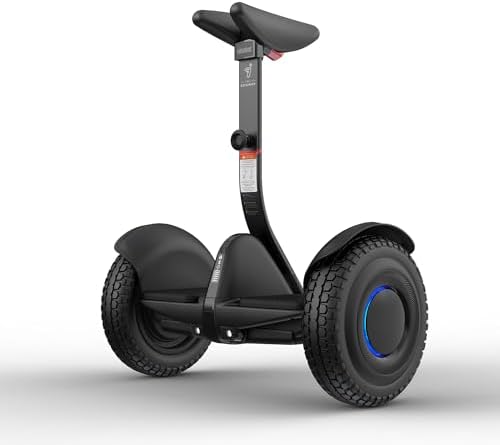
Segway Ninebot S2: This is a self-balancing scooter, not a commuter. At 11.2 mph, it's a toy, and at $529.99, it's an expensive one. It's fun for about 20 minutes, and then you realize you're going slower than a jogger.
Xiaomi Mi Electric Scooter 4 and 5: The tubed tires are the dealbreaker. I patched two flats in three weeks, and the weight limit is fiction at my size. The build quality is decent, but the flats and the bottoming out make it a hard pass for daily commuting. If you're under 180 pounds and on smooth pavement, it's fine. Otherwise, skip it.
Should you buy the Segway Ninebot F3?
If you're a daily commuter who weighs over 200 pounds and needs a scooter that won't leave you walking, yes. The $699.99 price stings, but at $1.30 a day over 18 months, it's cheaper than a single tow truck fee.
The self-healing tires alone are worth the premium over the Xiaomi. It's heavy, the range claim is a lie, and the battery will degrade eventually, but it's the only one in this test I'd trust to get me home on a 105-degree Tuesday.
Should you buy the Segway Ninebot E2 Pro?
If you're under 200 pounds, on flat ground, and want to save money, this is your scooter. At $549.99, it's the best value in the lineup, and the honest 15.5 mph top speed means no surprises. The battery sag on hills is the trade-off. If your route is flat, buy it. If you've got a bridge in your commute, spend the extra on the F3.
The Xiaomi vs Segway electric scooter question comes down to one thing: do you want to patch tubes or ride? I've done both, and I know which one I'm picking. I'll circle back and update this review after I hit 1,000 miles on the F3, but so far, it's the one I'd buy again.