Related: How to Read a Scooter Battery Spec and Hill Climb Test: What Watts Actually Mean
There is no single best commuter electric scooter. Anyone who says otherwise has never ridden one to a real job in real weather. There is only the scooter that fits your hill, your weight, your stairs, and your willingness to patch a tube on a sidewalk in August.
I have been car-free in Austin for four years. My commute is 14 miles round trip across the Congress Avenue bridge, in 105 degree heat, and in that time I have blown two controllers, patched four tubes, replaced a deck, and learned to read a spec sheet the way a mechanic reads a wiring diagram. The controller that died on me smelled like burnt toast and turned a 25 minute ride home into a 90 minute walk. No listing mentions that.
This guide covers three scooters built for three different jobs, plus one repair part that belongs in the toolkit of anyone who owns the models it fits. I have sorted them by what the listing actually tells you, which is not the same thing as what the marketing wants you to believe.
Watt-hours, hills, and tires: what actually decides a commute
Multiply volts by amp-hours. That gives you watt-hours, and it is the only battery number that lets you compare two scooters honestly. Amp-hours alone are marketing math, because 10Ah at 36V is a very different pack than 10Ah at 48V. When a listing hides the watt-hours, do the multiplication yourself before you read another word.
Peak watts are a party trick. A motor rated at a big peak number may hold that figure for two seconds. Continuous watts are what climb a hill for a mile, and continuous watts are the number that rarely appears on the box.
Then there is the hill. If a scooter cannot climb the bridge at your weight without the power sagging away under you, nothing else about it matters. Speed downhill is free. Getting up is the test.
Tires decide how much of your life you spend with a pump and a patch kit. Tubed tires on a commuter scooter are a maintenance subscription, and Texas heat makes them worse. Solid tires never flat, but they transmit every crack in the road straight into your wrists. Pneumatic tires ride best and demand that you check PSI weekly, which almost nobody does, including me. PSI is the most ignored spec on any scooter and the cheapest range you will ever buy back.
Two more things. A scooter you cannot carry up three flights of stairs is a garage ornament, not a commuter. And the controller and the battery management system are the parts that strand people, so they deserve more of your attention than the top speed figure does.
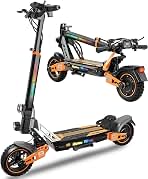
The long range pick: 1200W peak, 48V, 10 inch tires
This listing gives you the numbers I actually want. The 48V, 18.2Ah pack multiplies out to roughly 874 Wh, which is a genuinely large battery for a folding commuter, and it is the reason a 20 mile round trip is even in the conversation. The claimed 35 miles will not survive a 185 lb rider in August with a headwind, but the pack size is what makes the claim plausible rather than decorative.
The 10 inch off-road tires matter more than the 30 mph top speed. Bigger wheels roll over expansion joints, bridge seams, and chip seal, and 10 inch is roughly the size where a pothole stops being a coin flip. Ask whether they are tubed, because tubed tires in this climate are a subscription you pay in patches.
The 300+ lb capacity tells you the frame and motor are built for a bigger rider, which is exactly what heavy commuters have trouble finding. It also tells you the scooter is not light, and that is the trade: more range and more stability, more effort on the stairs. The 1200W figure is a peak rating, so treat it as a ceiling rather than a cruise.
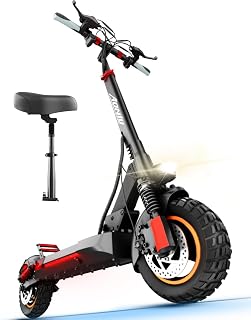
The off road commuter: M4 Electric Scooter
The M4 leans on two words in its name, off road and commuting, and those words describe intent, not capability. The listing does not hand you watt-hours, continuous motor watts, tire size, tire type, IP rating, or total weight. Those are the six numbers that decide whether a scooter works as a commuter, and without them you are buying a silhouette.
So ask. What is the battery in watt-hours? What is the continuous motor rating? What size are the tires, and are they tubed or tubeless? What is the IP rating, and is it honest enough for a drizzle? How much does the whole thing weigh, because you are the crane? And does the controller have any published thermal protection?
If a seller cannot answer those questions, that silence is your answer. Off road styling usually means a wider deck and tires with more tread, which helps on gravel, broken asphalt, and the loose shoulder where the bike lane gives up. It also tends to cost you a little range and a little more noise on smooth pavement. Compare this one against the other two by watt-hours, not by how aggressive the fenders look.
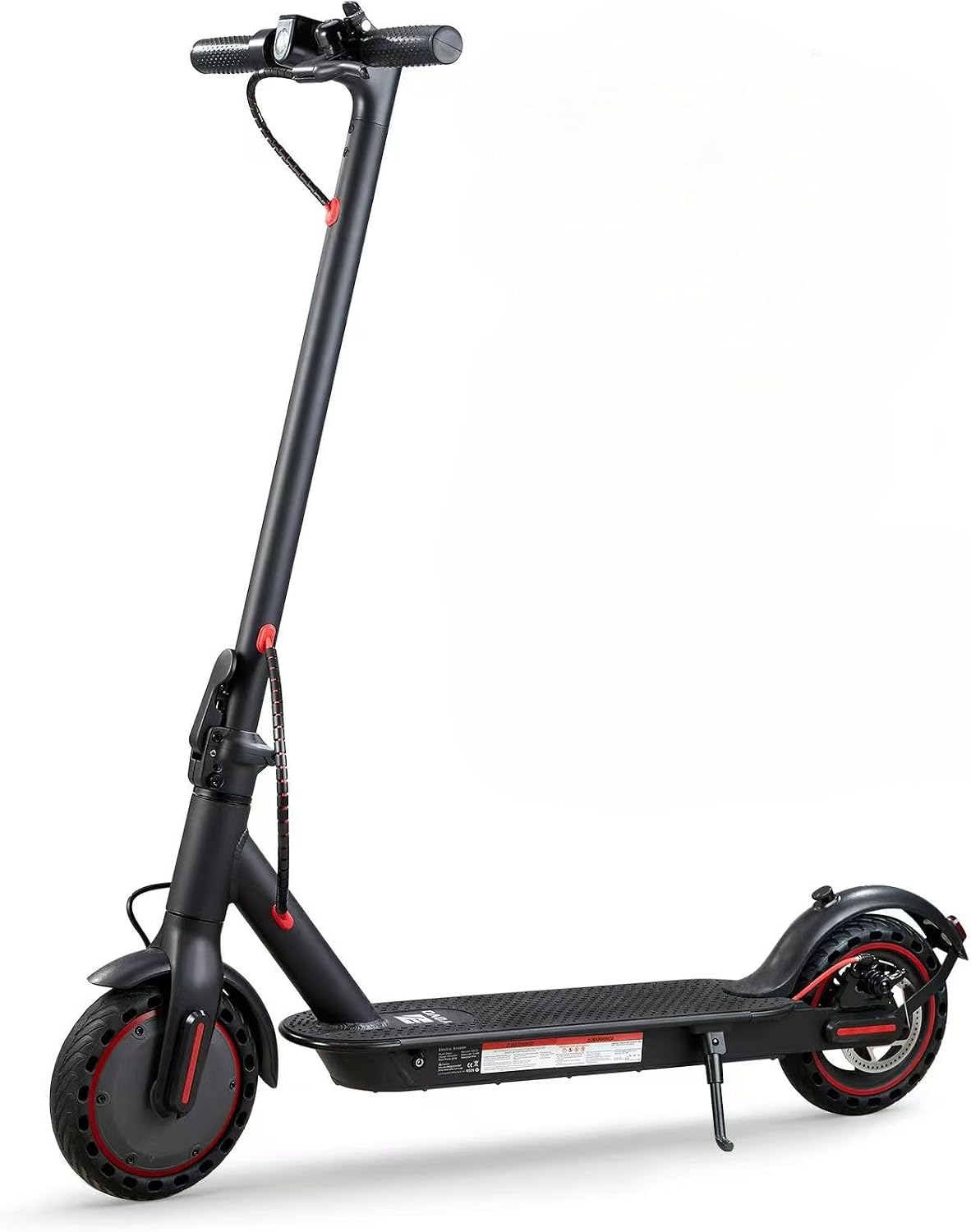
The no flat option: Nexiscoot with 8.5 inch solid tires
Solid tires are the whole story here, and for a lot of riders that is a feature rather than a compromise. You will not patch a tube, you will not carry a pump, and you will not be the person sitting on the curb at 8 AM with a flat. For a teen, a renter without tools, or anyone whose commute is short and mostly flat, that trade is worth taking.
The cost shows up in your hands and knees. An 8.5 inch solid tire is the least forgiving combination on a scooter, because the tire has no air to absorb anything, and the wheel is small enough that every crack, seam, and driveway lip arrives at your wrists with a receipt. On smooth pavement it is fine. On rough pavement you will feel like you are riding a shopping cart with a battery.
The power numbers are modest and honest: 350W nominal with a 500W peak, 19 mph, and two claimed range figures of 19 and 21 miles. Two range numbers on a listing almost always mean two power modes, and either one is a best case. Nineteen mph is real commuter speed, not a number you need to be afraid of in a bike lane. The braking system and app control are the practical extras worth having. Just know that a 350W nominal motor will work hard on a steep bridge with a heavier rider, and the solid tires will tell you about every degree of that grade.
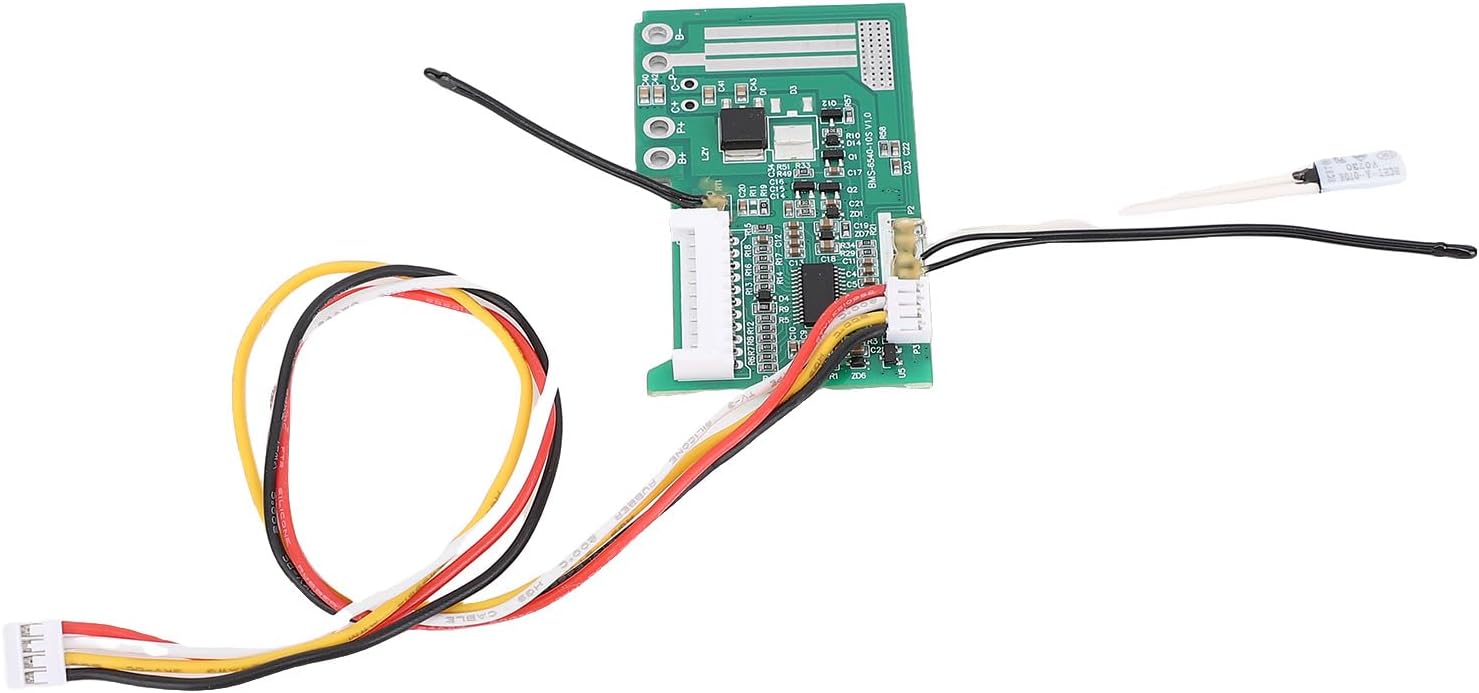
The part that keeps the battery alive: Yoidesu Battery Protection Board
The battery management system is the circuit that keeps the individual cells balanced, cuts power when a cell drops too low, and stops the pack from cooking itself. It is the part cheap scooters cheap out on, and it is the part that decides whether a battery lasts three years or becomes a fire risk in year two.
This board is listed for the F30 and F40 models named in the listing, so it is a repair part rather than a universal upgrade. If your battery has stopped charging, has started cutting out under load, or has begun draining unevenly, a failed board is one of the usual suspects. Before you swap it, find out what killed the original. Water ingress, a dead cell, or a shorted controller will kill the replacement the same way, and a new board is not a fix for a pack that has already gone out of balance. If you can read a wiring diagram and you own one of those models, this is the cheap, sensible thing to keep on the shelf. If you cannot, pay someone who can.
The four options side by side
| Scooter | Motor | Tires | Battery and claimed range | Price |
|---|---|---|---|---|
 Visit on Amazon → Visit on Amazon →Long range commuter |
1200W peak | 10 inch off-road | 48V 18.2Ah, up to 35 miles | $385.00 |
 Visit on Amazon → Visit on Amazon →Off road commuter |
Not listed | Off-road, size not listed | Not listed | $399.98 |
 Visit on Amazon → Visit on Amazon →Nexiscoot |
350W nominal, 500W peak | 8.5 inch solid | Up to 19/21 miles | $189.00 |
 Visit on Amazon → Visit on Amazon →Yoidesu protection board |
Repair part | Not applicable | Battery management for F30 and F40 | $27.59 |
What the spec sheets still do not tell you
Range figures are written by a lab with a light rider, no wind, a fresh charge, and a flat road. Real range is what you get at your weight, in August, with a bridge to climb. The only way to know that number is to ride the route you actually ride, which is why I log watt-hours pulled rather than miles claimed.
Weight is the spec nobody prints prominently and everybody should care about. The long range scooter here carries a big pack and a frame rated for 300+ lb, so it will be the heaviest of the three. The Nexiscoot with its solid tires and smaller motor will be the easiest to fold and haul. The M4 is an unknown until someone tells you the number. If you live on a third floor walk-up, that unknown is the whole decision.
Water resistance is where budget listings get creative. An IP rating below IPX4 means fair weather only, no matter what the photo of the scooter in the rain suggests. I ride in rain I pretend is fine, and I have replaced the electronics to prove it.
And no scooter gets a commuting recommendation from me without one line attached: wear a helmet. Every ride, no exceptions. The nurse who told me what a scooter crash looks like without one has kept me in a helmet for four years.
Should you buy the 1200W long range commuter?
Yes, if your commute is long, your route has real hills, or you are a heavier rider who has struggled to find a frame that admits you exist. Roughly 874 Wh, 10 inch tires, and a 300+ lb capacity is a serious combination for the money. Just plan for the weight, ask whether the tires are tubed, and respect that 30 mph is faster than the bike lane wants you to go.
Should you buy the M4 off road commuter?
Not until you have the six numbers: watt-hours, continuous watts, tire size and type, IP rating, and weight. The off-road styling is a genuine advantage on broken pavement, but styling does not climb a bridge. If the seller answers, compare it against the long range scooter by watt-hours. If the seller does not, walk.
Should you buy the Nexiscoot?
Yes for a short, flat commute, a teen, or anyone who has patched their last tube. Solid tires and a modest 350W nominal motor make it simple and low maintenance, and 19 mph is honest commuter speed. Accept the ride quality trade, because 8.5 inch solid rubber tells you about every crack in the road.
Should you buy the Yoidesu battery protection board?
Only if you own one of the F30 or F40 models named in the listing and the board has actually failed. It is a repair part, not an upgrade, and it will not fix a pack that has already gone out of balance. Diagnose the cause first, then replace.